

Quantum quackery
-
- from Shaastra :: vol 04 issue 11 :: Dec 2025
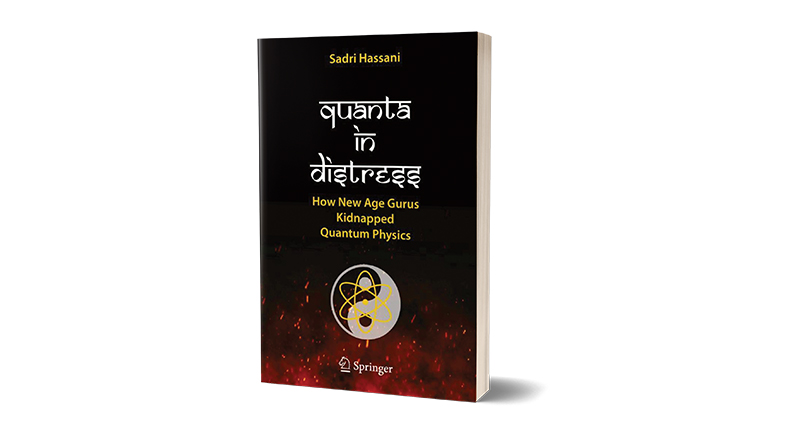
A physics educator agonises over the slide from quantum physics to mysticism and mumbo-jumbo.
Modern superstition, physics educator Sadri Hassani argues, has acquired a new armour: it claims to have support from the science of quantum physics. In a cultural landscape where a TV producer-writer invokes quantum effects to claim that just thinking about it enough can make a person lose weight, gain wealth, or find love, where a physician claims the body is governed by a network of intelligence rooted in quantum reality and capable of defeating cancer, heart disease, and even ageing, and where a yoga evangelist says quantum discoveries echo ancient insights of yoga, Hassani, an Adjunct Professor at the University of Illinois Urbana-Champaign, decided to confront what he describes as "quantum quackery".
His unsparing book is an effort to wrest quantum physics back from those who have sought to bind it to mysticism, miracle cures, and mind-over-matter fantasies. Quantum physics undeniably contains elements of strangeness: notably the idea of entanglement, or "spooky-action-at-a-distance", where measurements on one member of a pair of particles will influence its distant partner. Some have seized entanglement as evidence of a universal consciousness. But as Hassani points out, physicist John Bell had shown that the mathematics of quantum theory accounts for this behaviour without the need to invoke hidden spiritual agents.
Hassani delivers his critique in language that is accessible, at times conversational, and driven by a frustration at seeing quantum physics invoked for weight loss, spiritual healing, and metaphysical objectives. His tone is not merely corrective but openly impatient. His argument rests on a simple principle: quantum mechanics is a complete theory, and if you engage with it through mathematics – the language of nature, as Galileo put it – quantum physics makes perfect sense. If it behaves strangely, it is only because of prejudices that humans have accumulated over time.
The author sees classrooms as the last protected spaces where science can be disentangled from New Age narratives.
In his attempt to address the question of how quantum physics "became a companion of Eastern mysticism", Hassani grapples with what he describes as "an unfortunate coincidence": several founders of quantum physics had an affinity with Eastern theosophy and wove aspects of their worldview into their reflections on quantum physics. He shows how pioneers such as Bohr, Heisenberg, and Schrödinger, while building the foundations of quantum physics, also offered metaphysical reflections that blurred personal belief with scientific conviction. Their speculative language, he argues, helped nurture impressions several decades later that quantum mechanics endorsed some mystical ideas. Untangling "the message from the messenger", he writes, is now the responsibility of scientists and educators, a task made harder by the physics community's reluctance to confront how the founders' mysticism laid the groundwork for later abuses. That reluctance, he suggests, allowed a self-help industry to thrive by attaching metaphysical ambitions to scientific concepts.
The author's own "tug of war" – balancing admiration for the founders with the duty to expose how their metaphysical musings enabled misappropriation – appears to shape the book's wide-ranging intellectual exposition. He moves from ancient Greek philosophy to group theory's prediction of specific subatomic particles, and from debates on the anthropic principle to the resolution of entanglement, tracing how ideas evolved and were later distorted by New Age interpretations.
Hassani concedes that best-sellers such as The Tao of Physics and The Dancing Wu Li Masters convinced audiences that some Eastern faiths align naturally with quantum physics. These books, he notes, created the philosophical scaffolding that made later claims seem plausible, creating the ground for metaphysical speculation to claim camaraderie with pure science.
In a chapter on physician Deepak Chopra's book Quantum Healing, Hassani alleges that Chopra first "steals the scientific discovery" that brain cells synthesise and release neuropeptides, then reduces the mind to the activity of the brain, and further "he turns the science on its head by reversing the relational order of the two and declares that thought creates neuropeptides". Amplified through celebrity platforms, such fusion of quantum language with Ayurveda and meditation, Hassani cautions, has distorted the public understanding of science.
A broader worry animates Hassani's argument: a "mystical halo" around quantum physics continues to strengthen in a media ecosystem that rewards pseudoscience. With misinformation pushed by profit-seeking publishers and influencers, he sees classrooms as the last protected spaces where science can be disentangled from New Age narratives. The book is an appeal to science educators to help sustain scientific literacy and keep quantum physics anchored to science rather than fantasies built around it.
See also:










Space-age Entrepreneurs
A cluster of start-ups led by young engineers is making a mark in India's newly unlocked aerospace market.

The life digital
As the world gears up to embrace a sustainable future, scientists are mimicking biological systems to find solutions to disparate problems.



Have a
story idea?
Tell us.
Do you have a recent research paper or an idea for a science/technology-themed article that you'd like to tell us about?
GET IN TOUCH