

Single set-up, diverse uses
-
- from Shaastra :: vol 05 issue 01 :: Jan 2026
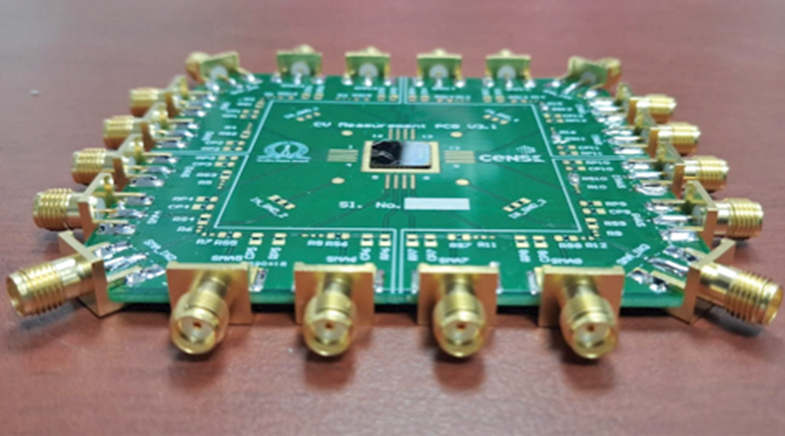
A team creates molecular devices for more efficient computing.
For artificial intelligence (AI) to be energy-efficient and secure, computing devices need to be autonomous and quick. A recent breakthrough by Sreetosh Goswami's laboratory, which works on neuromorphic or brain-inspired computing, marks a significant achievement towards this goal.
Goswami's team at the Centre for Nano Science and Engineering (CeNSE) at the Indian Institute of Science (IISc), Bengaluru, has designed tiny molecular devices that can be controlled to perform diverse functions in a single set-up — such as a memory unit, a logic gate, or an analogue processor. The IISc researchers describe them as molecularly engineered memristors.
Conventional microelectronic circuits built with complementary metal-oxide-semiconductor technology are static, with fixed functionality, in which nanoelements can behave as analogue devices, diodes, or memory cells. Molecular computing, in which molecules such as DNA and proteins replace metal oxides, offers the flexibility to switch between functions. The process, however, had a problem: there was no way of controlling the function the memristor would change to. "We developed an analytical model, in which, if you tweak the molecule, you can change its functionality in the same set-up," Goswami explains.
The scientists showed that the same molecule could be 'chemically' tweaked to switch its function, depending on how it was stimulated.
The team synthesised 17 different molecules with ruthenium as the core and studied how their functionality changed with minute tweaks to the geometry of the molecule and in the ions surrounding them. They showed that the same molecule could be 'chemically' tweaked to switch its function, as its conductance (the flow of electrons) could vary over a wide range (up to 1 million times). As a result, the same device could behave as a memory unit, a logic gate, a selector, an analogue processor or an electronic synapse, depending on how it was stimulated. "This work reimagines the traditional rubric of computing, creating materials that not only store and compute, but also adapt and reconfigure," the researchers state in a recent paper (bit.ly/memristor-programmable).
According to Samit Kumar Ray, Professor in the Physics Department of the Indian Institute of Technology Kharagpur, the CeNSE work will impact future low-power computing and AI applications. Meanwhile, Goswami and his team plan to incorporate these memristors into silicon chips."We take inspiration from the brain in bits and pieces, for creating adaptability of computing architecture," Goswami says.









From ground to space
Start-ups to offer inflatable space habitats, medical devices for small labs, and safe air corridors for drones.

This vaccine can take the heat
The Mynvax vaccine is particularly suited for Indian conditions: it is stable at high temperatures, which eliminates the need for a cold chain during…

One for two
An insulin jab may also help treat Parkinson's disease.



Have a
story idea?
Tell us.
Do you have a recent research paper or an idea for a science/technology-themed article that you'd like to tell us about?
GET IN TOUCH