

The name is bond, weak bond
-
- from Shaastra :: vol 04 issue 11 :: Dec 2025
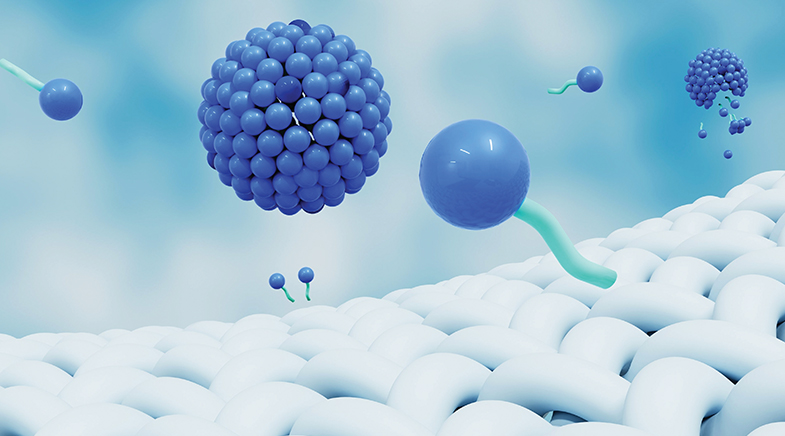
From delivering drugs to specific sites to tackling plastic waste, supramolecular chemistry helps researchers address a spate of challenges.
In July 2025, a team led by Grace Han, Professor of Chemistry at the University of California, Santa Barbara, announced a striking breakthrough. By tweaking a chemical commonly found in coal tar, they enabled it to store sunlight in its molecular bonds — and release that energy as heat on demand. The discovery could one day offer a viable alternative to the fossil-fuel-based heating systems used across much of the mid-latitudes.
The research, published in the journal Chem (bit.ly/Sunlight-Storage), shows that the new form of anthracene — a liquid — is capable of packing around 0.65 megajoules of energy per kg, as much as the power in a lithium-ion battery of the same size. When exposed to light, the anthracene molecules shift from a stable form to a high-energy form, trapping solar energy in their strained chemical structures.
At its root is the chemistry of weak bonds, in which chemical compounds are held together by weak forces such as hydrogen bonds, van der Waals forces, or electrostatic interactions. These are different from bonds that hold atoms together. Such weak interactions enable the self-assembly of smaller building blocks, forming larger, more complex structures.
PAST ISSUES - Free to Read








Taming tumours
Researchers are beating cancer by developing an understanding of the microenvironment around tumour cells.

'Hydrogen plays an exciting role in decarbonisation'
Dr Nigel P. Brandon on harnessing hydrogen's potential as a clean-energy source.



Have a
story idea?
Tell us.
Do you have a recent research paper or an idea for a science/technology-themed article that you'd like to tell us about?
GET IN TOUCH