

Out of this world
-
- from Shaastra :: vol 05 issue 03 :: Mar 2026
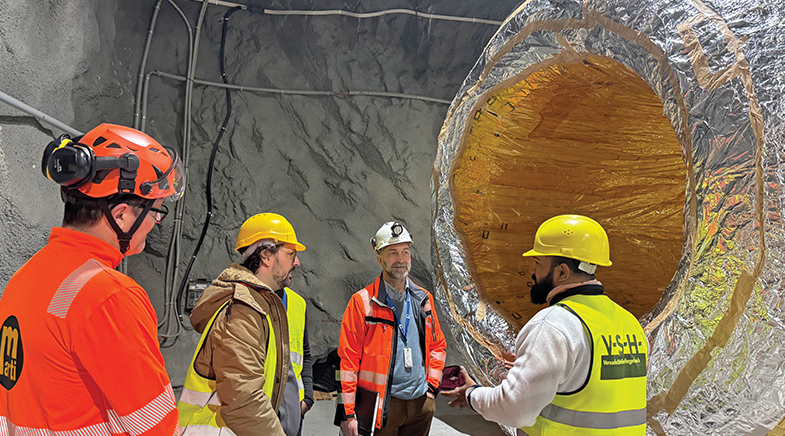
India's first inflatable space habitat is all set to take flight, taking space tech prowess to new heights.
An inflatable habitat approximately the size of a one-bedroom flat in India is being prepared for deployment in space. AntarikshHAB, the country's first such habitat, will house a data centre, and a pharmaceutical research unit. Bengaluru-based start-up AkashaLabdhi will deploy the space station with these components in July 2026, and then bring the units back to Earth, while testing its heat shield during re-entry.
AntarikshHAB will have six payloads. Founder Siddharth Jena says the success of the 70-cubic-metre space station — which can be scaled up to 500 cubic metres — depends on its ability to accommodate manufacturing and research units. "But how do we get bigger and bigger structures with lower weight? Because that's ultimately going to decide what profits we make," says Jena, "Inflatables are the best way to do that."
In existing structures, such as the International Space Station (ISS), or other commercial stations that are coming up, a 70-cubic-metre centre would require material weighing over 50,000 kilograms. With inflatables, the weight is 250-300 kg, including all systems, electronics, and an integrated ECLSS (Environmental Control and Life Support System).
FROM THEORY TO PRACTICE
The notion of inflatable space habitats was first explored in the 1950s when German-American engineer Wernher von Braun popularised an early concept of a space station that humans could inhabit. It took the shape of a 250-foot-diameter wheel spinning on its axis. The wheel had inflatable sections to be connected in orbit and went on to inspire the space station in Stanley Kubrick's 1968 film 2001: A Space Odyssey. It was decades later — in 1997 — that the National Aeronautics and Space Administration's Johnson Space Center came up with its Transit Habitat (TransHab), a three-level inflatable habitat for NASA's mission to Mars.
The TransHab never saw space. But Bigelow Aerospace, a private company which specialised in inflatable habitats, launched the first such structure, Genesis, in 2006 and the Bigelow Expandable Activity Module (BEAM) in 2016. Mired in financial troubles, the company shut down during the COVID-19 pandemic — but not before proving that inflatable habitats could work. Its BEAM structure, initially sent for a two-year test, was stable enough for NASA to repurpose it as a 16-cubic-metre storage space that will remain attached to the ISS until 2028.
While earlier habitats proved the concept, companies were not very keen to take it forward. But now there is growing interest in inflatable habitats, with space and lunar or Martian surfaces being seen as commercial hubs. So, companies are focusing on inflatable units that can accommodate large numbers of people for extended periods. Space is where applications ranging from research and development to industrial-scale manufacturing and warehousing are being tested out.
Take data storage. As artificial intelligence computing systems scale up, companies are looking to space to provide a consistent, solar-powered supply and reduce the load on Earth's grid. However, cooling in space is a challenge. In the absence of a convection medium, massive radiators would be required to dissipate heat into space, increasing the station's weight. "With inflatables, you already get a large surface area, which acts as a radiator itself. That is one reason the company sending data centres with us is interested in doing it inside an inflatable structure," Jena says.
Such applications have given rise to a slew of start-ups. Founded over the past few years, they are experimenting with inflatable space structures. In 2023, Canadian aerospace engineer Maxim de Jong, who worked on the material used to build Genesis and BEAM through his company, Thin Red Line Aerospace, went on to co-found another company, Max Space. This U.S.-based start-up is developing inflatable stations to expand 'space real estate'. Its Thunderbird station will provide a volume of 350 cubic metres and support a crew of four astronauts.
A few older aerospace companies are also entering this vertical; U.S.-based Sierra Space and Lockheed Martin have both completed pressure tests for their inflatable habitats. Sierra Space is building a three-storey inflatable habitat called LIFE (Large Integrated Flexible Environment). In New Zealand, Astrix Astronautics focuses on deploying solar arrays. The start-up replaces mechanical hinges in solar arrays with inflatable tubes that, once deployed, rigidise in space to provide a greater surface area. At AkashaLabdhi, inflatable solar arrays and an inflatable Martian rover are in the works as well.
MATERIAL MATTERS
While in the lower Earth orbit, structures are still weighed down by gravity and are in a constant state of free fall, conventional structures are heavy and need boosters to maintain that altitude. "Rigid modules are also often constrained by the size and shape of the rocket fairing (the nose of the rocket) that carries them," says a Max Space spokesperson.
And then there is the question of assembling the structure in space. Jena cites the case of the ISS. "It took around 15 years and $160 billion to assemble it, and around 500 hours of spacewalk involving around 50 astronauts," he says. Inflatables, on the other hand, are single-launch deployable structures that do not require spacewalks to assemble.
The fabric used in an inflatable space habitat is folded multiple times and packed tightly inside the top of the launch vehicle. Once in space, it is inflated via a pressure-based system. A restraint or tendon architecture, made up of cables and strings, controls the expansion shape.
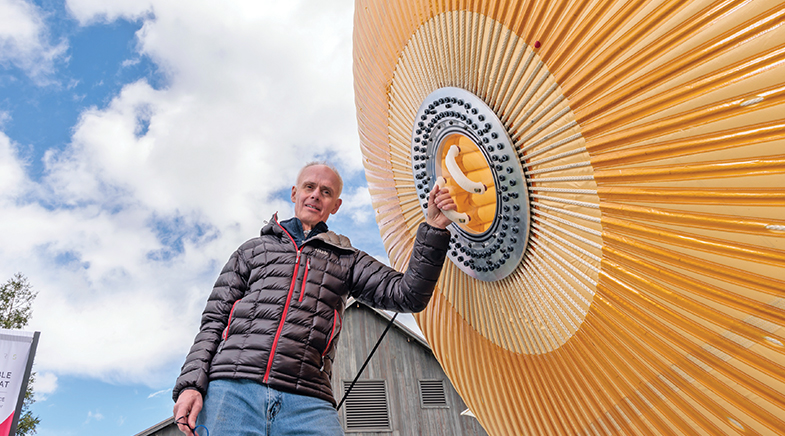
Each layer of the shell performs a specific function. The overall structural stack ensures that the habitat remains rigid and durable once deployed.
The shell is made of multiple layers, with each layer performing a specific function. The overall structural stack ensures that the habitat remains rigid and durable once deployed. The innermost layer faces the crew and is flame- and puncture-resistant. In between are layers that act as gas barriers to maintain the internal atmosphere and carry the structural load. The structure faces intense vibrational loads during ascent, and once in space, the outer layers endure temperature variations from 160° Celsius to -75° Celsius, three or four times a day. They also need to resist damage from asteroids and space debris.
"Building an inflatable which can sustain all these harsh conditions is a big challenge. That is why when we started AkashaLabdhi, we realised that the solution lies less in the structural part and more in materials science," says Jena.
Most space inflatables use Vectran, a fabric five times stronger than steel. AkashaLabdhi and Max Space, however, have been developing their own high-strength composite textiles. "We designed our own thermal layer, our own space debris shield — the Whipple shield, as it is called — and our own radiation shields," Jena says. The structure undergoes burst tests to determine its pressure capacity; hypervelocity gas-gun tests against space debris; and creep tests for structural integrity under vacuum conditions in both cold and hot environments.
AkashaLabdhi performs its material testing at the Indian Institute of Technology (IIT) Delhi. For academic support, it works with the Indian Institute of Science (IISc) in Bengaluru and IIT Roorkee. At IISc, Aloke Kumar, Associate Professor of Mechanical Engineering, has been working on building a lunar habitat called BHEEM (Bhartiya Extraterrestrial Expandable Modular Habitat), using titanium alloy panels. Jena suggests that the precursor structure for BHEEM could be inflatable. "Then you have a ready-made infrastructure on which the astronauts would only need to lay the plates," he says.
Lunar space habitats could also be connected through inflatable tunnels, says a paper (bit.ly/NASAHabitat) reviewing habitable inflatables. The tunnels could be used between habitat elements, or between a habitat and a rover or other spacecraft, or as a connection between two spacecraft or rovers. As space tourism advances, the goal for space companies is not just to send people to the edge of space and bring them back. "With inflatable habitats, people can even stay in space," Jena says.








No longer cast in cement
Researchers in India and elsewhere are buiding a better world by harnessing new forms of eco-friendly cement.


User discretion is advised
For better learning, treat AI as a sparring partner and not a substitute for thought, experts suggest.

What lies beneath
The roots of plants are subterranean architects: how they form and extract nutrients and water from the ground is a fascinating story of evolution.



Have a
story idea?
Tell us.
Do you have a recent research paper or an idea for a science/technology-themed article that you'd like to tell us about?
GET IN TOUCH