

The robot revolution
-
- from Shaastra :: vol 04 issue 11 :: Dec 2025
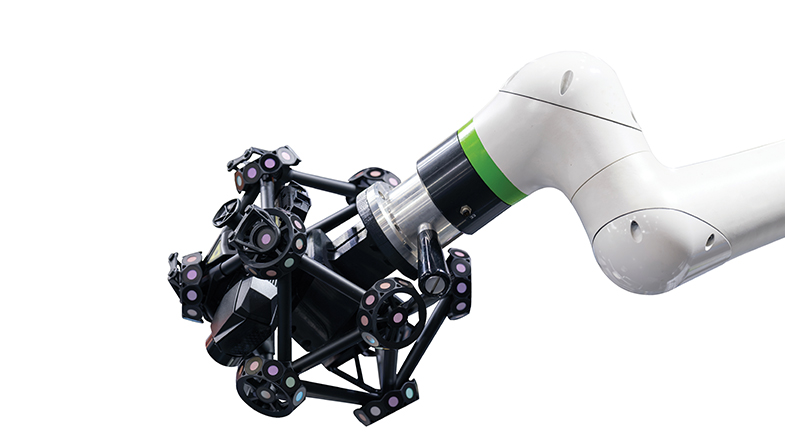
Robots will reshape the economy; the challenge is to ensure that humans remain at the centre of the transformation.
howindialives.com
howindialives.com is a database and search engine for public data
For years, automation meant machines doing what humans told them to. Now, robots are beginning to act with a measure of judgment: navigating warehouses, assisting in surgeries, and learning from their surroundings. The shift from programmed efficiency to adaptive intelligence marks a turning point in how economies deploy labour and technology.
It's not a sudden transformation. Industrial robots continue to expand, led by China and other manufacturing powerhouses, while early experiments in humanoid and general-purpose robots point to what's next.
The economic promise is clear. Robots promise greater speed, safety and quality. But they also raise social questions.
THE FACTORY FOUNDATION
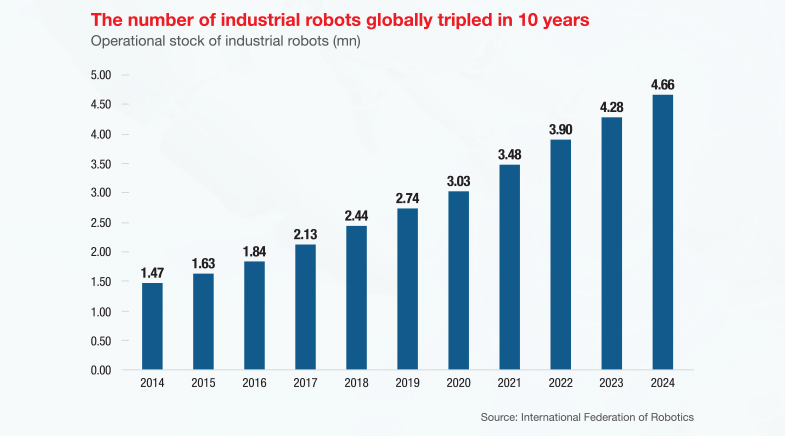
Industrial robots have become an important element of global manufacturing, with installations more than doubling over the past decade. Annual installations rose from about 221,000 units in 2014 to over 540,000 in 2024, while the total operational stock is projected to reach nearly 4.7 million units this year.
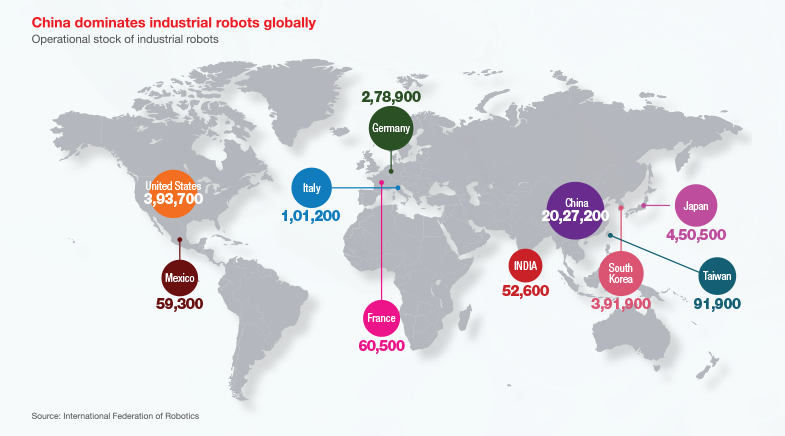
China continues to dominate this landscape, accounting for more than 2 million robots, or over 43% of the world's total. Japan, the United States, South Korea, and Germany round out the top five, together comprising roughly another third of the global fleet.
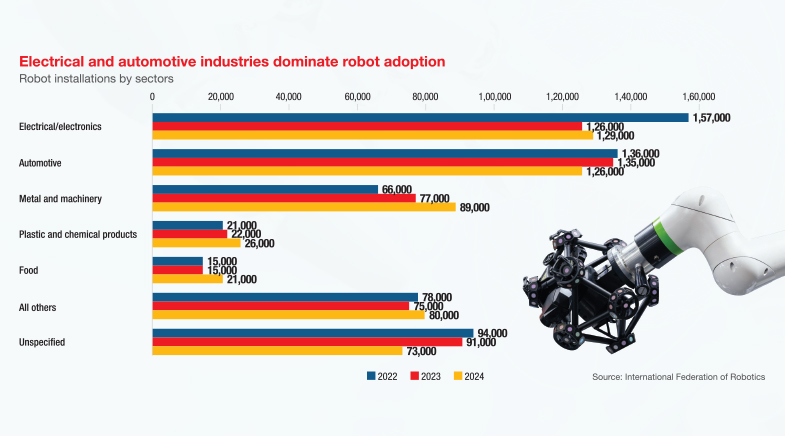
Its adoption has been uneven, but that's changing. Installations in the automotive and electronics sectors, traditionally the largest customers, have plateaued or declined. In contrast, demand from metals and machinery, plastics, and food industries is accelerating.
THE NEXT WAVE
A second wave of robotics is emerging — one defined not by precision machinery but by artificial intelligence (AI), machine learning, and other technologies. Patent data show a sharp rise in filings related to 'humanoid' or general-purpose intelligent robots. This is led overwhelmingly by Chinese inventors (5,688 filings), followed by the U.S. (1,483) and Japan (1,195).
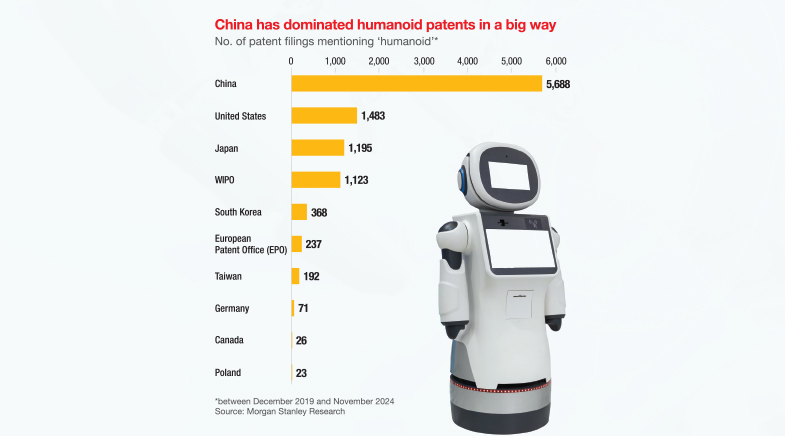
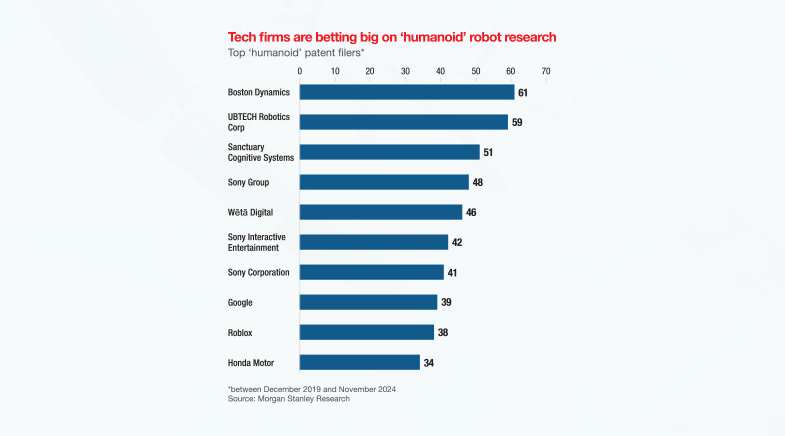
In the U.S., the most active companies include Boston Dynamics, Google, Sony, and Toyota, reflecting a convergence between robotics, entertainment and AI research. These machines, equipped with computer vision, multimodal AI and adaptive control systems, are designed to perform unstructured, real-world tasks such as warehouse handling, elder care, and maintenance.
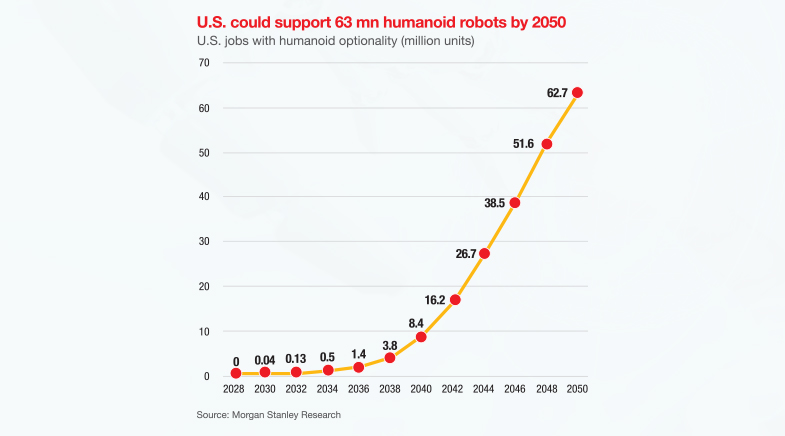
Goldman Sachs estimates that U.S. jobs with 'humanoid optionality', roles that could be supported or partly substituted by humanoid robot, could expand from zero today to over 60 million by 2050. The associated wage exposure could exceed $2.9 trillion by that time, underlining both the scale of opportunity and disruption ahead.
THE AUTOMATION PAYOFF
The earlier generation of robots came with their own advantages and disadvantages. According to McKinsey's 2022 Global Industrial Robotics Survey, executives reported particularly positive impacts on safety and quality. About 68% rated improvements as positive or highly positive, while 57% reported higher consistency and fewer errors.
However, views on efficiency and cost were more mixed. While 37% saw positive impacts on speed, 63% rated it as neutral. A majority reported neutral or negative impacts on production capacity (92% combined), cost per unit (86% combined), and operation uptime (85% combined).
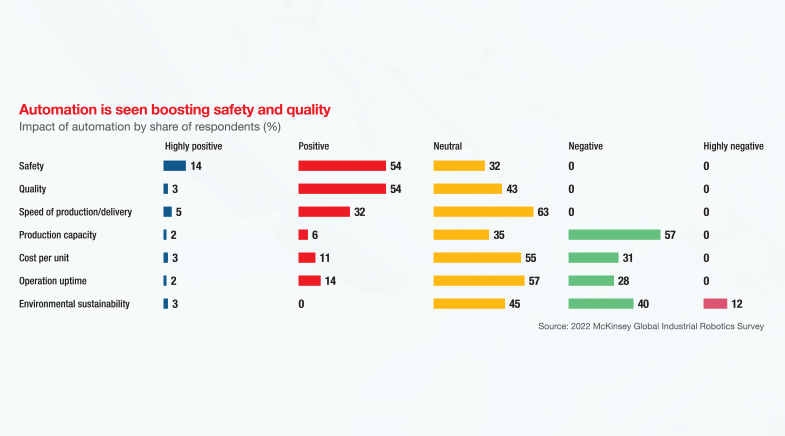
Perceptions of sustainability were also mixed. A combined 97% of respondents viewed environmental outcomes as neutral (45%) or negative/highly negative (52%), reflecting the energy and material costs of deploying large robotic systems. That balance may shift as systems become more efficient and powered by renewables.
THE HUMAN ELEMENT
Some of the biggest questions are about the future of work. Historical data suggest that technology rarely eliminates employment outright but reshapes it. Goldman Sachs research shows that in the U.S., occupations that did not exist in 1940 now account for most of net job growth, including technicians, professionals, and service roles.
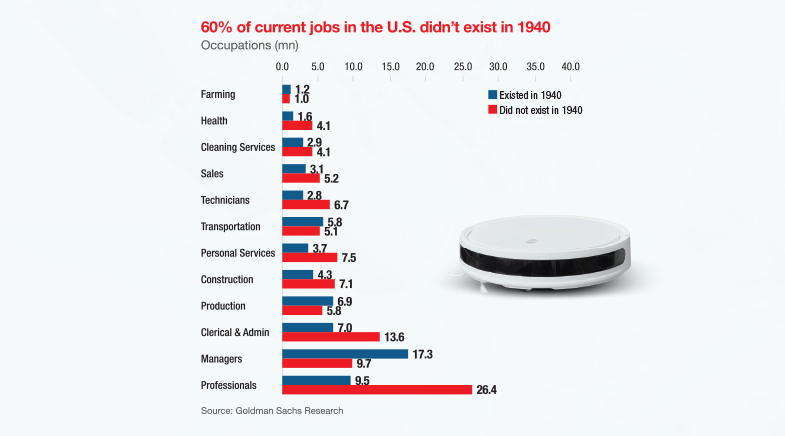
The rise of humanoid and intelligent robots could follow a similar path. New roles will emerge in robot maintenance, AI oversight, data annotation and human-robot collaboration. Yet, displacement risks remain concentrated in logistics, manufacturing, and basic service work. A Morgan Stanley research report estimates in the U.S. alone there could be demand for 63 million humanoid robots by 2050.
To mitigate disruption, economists emphasise large-scale reskilling programmes, public-private collaboration, and updated labour policies to ease transitions. Countries leading in industrial robotics are investing in training and AI integration.
THE NEXT TRANSFORMATION
Robotics is moving from precision automation toward autonomous intelligence. Industrial robots continue to expand manufacturing productivity, while intelligent and humanoid systems signal a shift toward human-like adaptability. The challenge for policymakers and businesses is no longer whether robots will reshape the economy, but how to ensure that humans remain at the centre of the transformation.









X marks the spot
In 1930, a farm boy discovered what was formerly our solar system's ninth planet.

Hunting for Majoranas
Why is the scientific community so eager to look for the reclusive Majorana modes?



Have a
story idea?
Tell us.
Do you have a recent research paper or an idea for a science/technology-themed article that you'd like to tell us about?
GET IN TOUCH