

Chip to fight disease
-
- from Shaastra :: vol 05 issue 02 :: Feb 2026
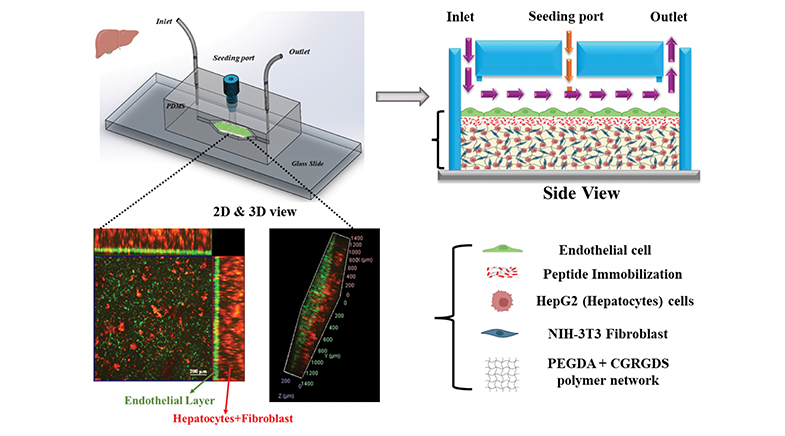
Membrane-free liver-on-a-chip mirrors the organ.
Researchers have fabricated a membrane-free liver-on-a-chip system that mimics the organ's architecture and function and is expected to improve understanding of liver diseases. The model, developed by a team at the Indian Institute of Technology (IIT) Kanpur, will help test drugs and reduce the need for animal testing.
An organ-on-a-chip is a transparent device in which living cells are arranged to behave like organs. These chips are now being used as a step in drug testing between cell culture and animal testing, as they circumvent the need to sacrifice an animal if the drug fails at the chip stage.
The body's liver cells are arranged in different layers, separated by an extracellular matrix. To create this layered structure — key to the liver's functionality — on chips, scientists have been separating different cell layers using artificial porous membranes. However, adding a membrane can cause problems, such as stiffness. "With membranes, we cannot have the proper natural cell-to-cell communication," says Preeti Sati, a researcher at IIT Kanpur and the first author of the team's study published in Advanced Healthcare Materials (bit.ly/Liver-Chip).
The team led by IIT Kanpur Professors Sri Sivakumar and Sandeep Verma solved this problem by replacing the membrane between the cells with a jelly-like peptide-hydrogel. The hydrogel allowed oxygen and other nutrients to diffuse — a property similar to that of the extracellular matrix. The team added liver cells and support cells to the hydrogel and placed it in hexagonal chambers. They then put endothelial cells over the hydrogel to mimic the liver architecture.
The team replaced the membrane between the cells with a jelly-like peptide-hydrogel.
It effectively mirrored the liver architecture and kept the three types of cells found in the liver in a healthy state for 16 days. The chip generated albumin and urea, which are produced by a healthy liver, and also produced CYP enzymes, which break down drugs. The team tested the effect of acetaminophen, a drug known to cause liver injury, on the chip and found that high doses of this drug were injurious to the chip liver, as in an actual liver. "We (now) want to create disease models like liver cirrhosis or the fatty liver model on this chip to screen drugs," says Sivakumar.
Anil Kumar P.R., Scientist G at the Sree Chitra Tirunal Institute for Medical Sciences and Technology, points out that the device operates through tangential perfusion over the endothelial layer, allowing efficient nutrient and oxygen diffusion through the porous hydrogel. "This supports cell viability, tissue-like organisation, liver-specific functions and drug metabolism over extended culture periods," Kumar, who is not associated with the study, adds.









These scientists have shattered the glass ceiling
Scientists at Tel Aviv University have made self-healing, adhesive molecular glass out of a little piece of protein.
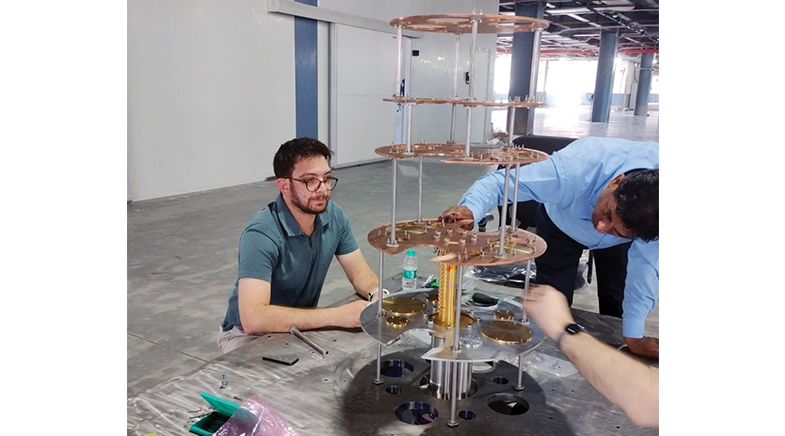
Quantum jump
India's first open-access quantum computer is ready to roll.
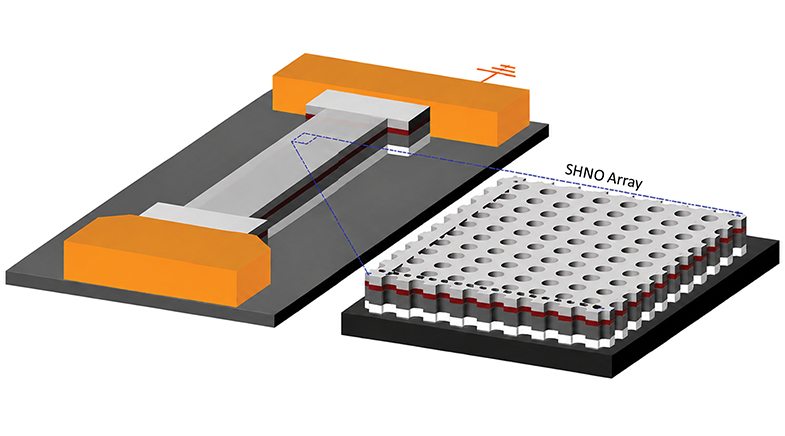
In sync with the future
Spinning up to a potentially novel computing platform.



Have a
story idea?
Tell us.
Do you have a recent research paper or an idea for a science/technology-themed article that you'd like to tell us about?
GET IN TOUCH