

Moves like light, acts like matter
-
- from Shaastra :: vol 05 issue 03 :: Mar 2026
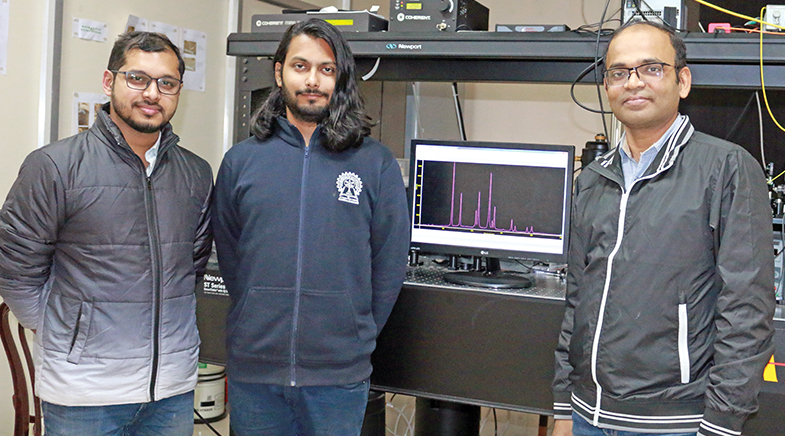
Way to control polarization may lead to new photonic devices.
Among the many remarkable properties of light is polarisation — the direction in which its electric field oscillates. Now, researchers at the Indian Institute of Technology (IIT) Kharagpur have demonstrated a new way of controlling polarisation. Instead of bulky external optics, they control it from within a microscopic structure where light and matter merge into a new hybrid entity. The researchers achieved this by embedding an atomically thin anisotropic material — a class that exhibits different physical properties, such as conductivity and refractive index, along different directions — within a microcavity, which enabled them to generate strong light-matter hybrid states called polaritons.
These polaritons move like light but interact like matter. This is because inside a microcavity, light can be trapped between ultra-thin mirrors. If the confinement is strong enough, the photons inside begin interacting intensely with excitons — bound pairs of electrons and holes inside the material. They are lightweight, fast, and responsive, making them ideal candidates for next-generation photonic devices.
Inside a microcavity, a specially engineered semiconductor structure, light can be trapped between ultra-thin mirrors.
The study, led by Sajal Dhara, Associate Professor in the Department of Physics, has appeared in Physical Review B (bit.ly/Light-Polarisation). It is significant for other reasons, too. The polarisation state of scattered light has long been considered the fingerprint of a material. This is because Raman scattering is a process in which light interacts with vibrations or excitations within a material, resulting in a shift in energy.
This study demonstrates that Raman scattering can be manipulated through cavity quantum electrodynamics independent of crystal symmetry. "We show that the polarisation of Raman emission can be continuously adjusted and even have its handedness reversed, suggesting that Raman polarisation is not strictly governed by crystal symmetry when the optical surroundings are engineered appropriately," Dhara explains.
The ability to control Raman polarisation using cavity electrodynamics opens new possibilities for engineered light-matter interactions in photonic systems. Such controls may lead to polarisation-programmable photonic devices, in which the polarisation state of emitted light can be tuned by external parameters, such as excitation energy or pump polarisation. This may benefit future optical communication technologies.









The shape of things
Scientists are studying the relation between the geometry of DNA nanocages and their ability to enter cells.

Cloudy with a chance of radiation
Poor weather in Paris sparked the discovery of a new property of matter.

Magnificent magnesium
Oh Mg! This new biomaterial is drawing the interest of researchers making medical implants.



Have a
story idea?
Tell us.
Do you have a recent research paper or an idea for a science/technology-themed article that you'd like to tell us about?
GET IN TOUCH