

Never a dal moment
-
- from Shaastra :: vol 05 issue 01 :: Jan 2026
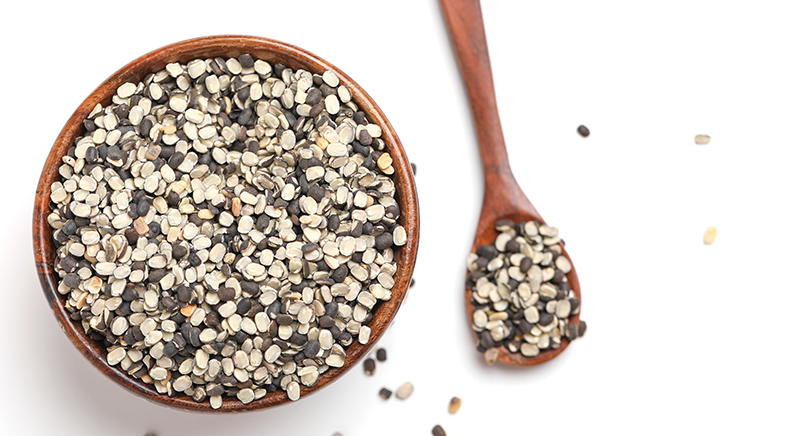
A one-pot method converts pulses into porous activated carbon.
Using mung beans and urad dal, researchers from the Bengaluru-based Defence Bioengineering and Electromedical Laboratory (DEBEL) have developed nitrogen-enriched activated carbon that can capture carbon dioxide.
Activated carbon's textural properties, such as the surface area, pore size and pore volume distribution, enable it to adsorb impurities and pollutants from air, water, and other liquids. However, in a new study published in Biomass and Bioenergy (bit.ly/Carbon-Nitrogen), the researchers report that they have enriched the activated carbon in nitrogen, making it suitable for capturing CO2. Because of its chemical structure, nitrogen is slightly basic. And CO2, being a weak acid, interacts easily with the nitrogen in the activated carbon, explains Sanchita Sil, the lead author of the study and a scientist at DEBEL. "The presence of nitrogen moieties in the system (activated carbon) increases both the selectivity and efficiency (of CO2 capture)," she says.
The bean-derived activated carbon showed a well-developed microporous structure.
Following a green chemistry approach, Sil and her colleagues used mung beans and black urad beans — both naturally rich in nitrogen — as biomass precursors. A simple one-pot chemical activation method using zinc chloride (ZnCl2) was employed to convert the pulses into porous activated carbon. This approach eliminates the need for additional nitrogen-doping steps, making the process both cost-effective and environmentally friendly. ZnCl2 acts as an activating agent; its presence shapes the textural properties, such as pore shape and depth, of the activated carbon.
Conversion of beans into activated carbon occurs via pyrolysis at 450-750°C. Unlike combustion, pyrolysis takes place in the absence of oxygen. As a result, the material doesn’t burn to ashes but is chemically transformed into activated carbon or charcoal. As the researchers increased the pyrolysis temperature, the percentage of nitrogen moieties in the activated carbon decreased. This could be due to nitrogen's low thermodynamic stability at high temperatures, the researchers note in the paper. The highest percentage of nitrogen —5.86% in mung bean and 6.23% in black urad — was observed at 450°C. As a control, the researchers also subjected grape seeds to the same pyrolysis process, but found only 1.78% nitrogen at 450°C.
The bean-derived activated carbon showed a well-developed microporous structure and a high specific surface area of approximately 937 m²/g, which is crucial for gas adsorption applications. Its CO2 capture ability at 25°C is about 3.29 millimoles per gram (mmol/g) at 1 bar pressure and approximately 7.98 mmol/g at 10 bar.









India Inc on 'Net Zero' path
For India to realise its emissions commitment, industry will need to step up. It appears that companies are taking the lead.


Physicists who made quite a mark
Other than mathematics, theoretical physics is the one area where Indians have made their presence felt on the world stage.
Come rain or shine
Despite the inclement hiccups, weather nowcasting has taken off.



Have a
story idea?
Tell us.
Do you have a recent research paper or an idea for a science/technology-themed article that you'd like to tell us about?
GET IN TOUCH