

Two's company; three's a crowd
-
- from Shaastra :: vol 05 issue 02 :: Feb 2026
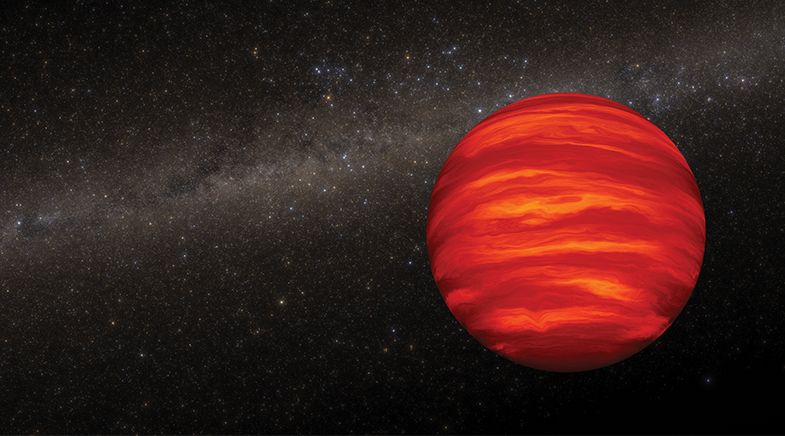
Study challenges old concept about lonely brown dwarfs.
A strange celestial body caught the attention of Guwahati University researcher Ali Hasan Sheikh while he was exploring blue straggler stars (BSS) — stellar objects that appear to stay young by gaining mass from other stars. Sheikh had earlier shared his interest in the stars with his research guide, Biman J. Medhi, and was examining them further when he spotted the curious object. And that led to a collaborative study — with a finding that has intrigued the researchers.
The study (bit.ly/Brown-dwarf) describes how the researchers observed a BSS orbiting a brown dwarf, a celestial object that is heavier than a planet but too small to be a star. The discovery challenges the widely held concept that brown dwarfs drift alone. "According to the current understanding of binary stars, this system shouldn't exist," Sheikh adds.
Using archival data from the Chile-based Very Large Telescope (VLT), the researchers measured tiny changes in the orbital motion of the BSS, which sits in a star cluster (NGC 2243) around 11,000 light-years away. These regular shifts revealed the presence of the till then unidentified stellar companion, whose mass was about 5.6% that of the Sun.
Interactions among the three bodies could have disturbed the inner pair and eventually caused them to merge.
Sheikh initially thought it could be a white dwarf, a low/medium-mass star. But its mass indicated that it was a brown dwarf. The researchers found the star orbiting the brown dwarf in 5.6 hours. That was also intriguing: the proximity should have led to the destruction of the fragile brown dwarf.
A baffled Sheikh discussed the finding with his collaborator, Annapurni Subramaniam, Director of the Indian Institute of Astrophysics in Bengaluru. Subramaniam said this was a triple-star system. Of the three stars, two were a close pair, and the third was orbiting farther away. Interactions among these three bodies could have disturbed the inner pair and eventually caused them to merge — creating a blue straggler star.
Sabyasachi Pal, an astrophysicist at the Indian Centre for Space Physics (ICSP), West Bengal, points out that the brown dwarf's orbital period of less than 6 hours was significant. "The detection of a brown dwarf companion to a fast-rotating blue straggler star opens a new opportunity to study stellar formation mechanisms of such a unique system," Pal says.









How AI helps put down forest fires
As instances of wildfires increase, AI and data are being tapped to predict, detect and manage forest fires.

Breaking ground
Digital technologies are streamlining operations and improving safety measures in mines, saving time, money, and lives.

How 'bat power' cures
Unveiling the secrets of bat biology could lead to therapies for human diseases.



Have a
story idea?
Tell us.
Do you have a recent research paper or an idea for a science/technology-themed article that you'd like to tell us about?
GET IN TOUCH