

Alert eye on the sky
-
- from Shaastra :: vol 04 issue 11 :: Dec 2025
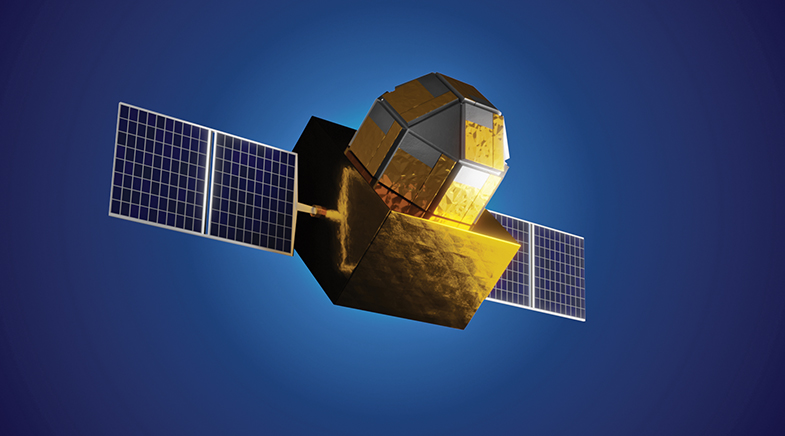
Missions to boost multi-messenger astronomy with rapid, all-sky alerts.
Astrophysicist Varun Bhalerao believes the word daksha — Marathi for "alert" — captures the spirit of the proposed Daksha space mission he leads. The idea aligns neatly with the project's tagline: Indian eyes on transient skies. Over the next five years, Daksha proposes to build two high-energy space telescopes capable of capturing the universe's most fleeting phenomena, from supernova explosions to neutron-star mergers.
In August 2025, gravitational-wave detectors picked up ripples from a merger of neutron stars lighter than the Sun — an extraordinary observation that challenges current theories of such cosmic collisions. These brief, high-energy events are often invisible to optical telescopes because their signatures lie in the X-ray and gamma-ray regions. Detecting them is vital: they offer rare clues to how the universe works.
"This is precisely where India's proposed Daksha mission would have been transformative," says Bhalerao, who teaches at the Indian Institute of Technology Bombay. "With higher sensitivity than existing missions, Daksha would have the best opportunity to catch the brief, tell-tale flashes of gamma rays or X-rays that often accompany neutron star mergers, and this would be broadcast to the world within minutes for further studies," says Bhalerao. The collaborative project, which started in 2018, awaits a financial sanction from the government.
MACE catches the highest-energy particles from the ground; Daksha's two telescopes, orbiting on opposite sides of the Earth, will scan the skies.
To fully understand these events, astronomers also need powerful ground-based partners. The Major Atmospheric Cherenkov Experiment (MACE), a gamma-ray telescope at Hanle, Ladakh, built by the Bhabha Atomic Research Centre (BARC), will be an ideal companion for Daksha: while MACE catches the highest-energy particles from the ground, Daksha's two telescopes, orbiting on opposite sides of the Earth, will scan the skies.
Daksha aims to strengthen multi-messenger astronomy by providing rapid, sensitive all-sky alerts for high-energy transients — delivering sub-minute notifications that will trigger global follow-ups of gravitational-wave, neutrino and gamma-ray events. MACE conducts very-high-energy (VHE) gamma-ray observations of candidate sources, enabling detailed studies of active galactic nuclei, bright galaxies with a supermassive black hole at their centres, dark-matter-rich dwarf galaxies, and neutrino-linked events. These events emit gamma rays with an energy about a trillion times that of normal light.
Space-based Daksha and ground-based MACE aim to capture light beyond the visible range, unlike optical telescopes. Together, they seek to strengthen India's contributions to global multi-messenger astronomy, a field that combines different cosmic "messengers" — such as electromagnetic waves, gravitational waves, neutrinos, and cosmic rays.
"The universe is inherently multi-coloured, its 'colours' ranging from radio to gamma rays. The ability to combine the information from a variety of wavebands has made multi-messenger astronomy more powerful than ever as a probe of the universe around us," says Biman Nath, an astrophysicist at the Indian Institute of Science Education and Research Mohali.
ABSOLUTE PRECISION
MACE, among the largest gamma-ray telescopes in the world, is a Cherenkov telescope, which is a ground-based device that detects high-energy gamma rays from space by observing the Cherenkov radiation produced when these rays hit the Earth. Operational since 2021, it indirectly detects gamma rays. "When a gamma ray enters the Earth's atmosphere, it generates a shower of particles. When the charged particles among them have energies high enough to travel faster than the speed of light in the atmosphere, they emit Cherenkov radiation — faint flashes of a bluish light," explains Mohamed Rameez, an astroparticle physicist at the Tata Institute of Fundamental Research, Mumbai.
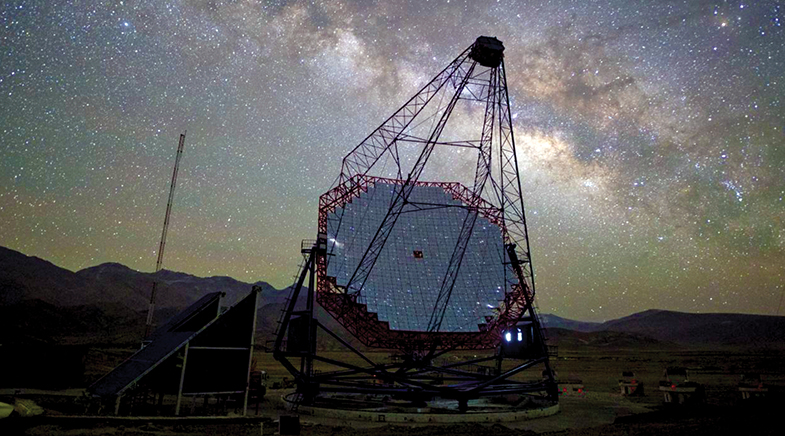
On January 26, 2025, MACE detected a strong gamma-ray signal from a distant blazar, OP 313. A blazar is an extraordinarily bright and energetic galaxy with a supermassive black hole at its centre.
"Across all cosmic messengers, whether neutrinos or gamma rays, the number of events drops sharply at higher energies," Rameez says. So, to detect gamma rays that are a billion and trillion times energetic than visible light, scientists need vast instruments because only a few such particles hit an area of tens to hundreds of square metres in a year. MACE, a 21-metre-long imaging telescope, has become crucial for high-energy gamma studies. MACE also has the longitudinal advantage of being located in the East, while most gamma-ray observatories are in the West. This allows MACE a window for follow-up observations, making it an essential player in the electromagnetic component of upcoming multi-messenger efforts involving gravitational-wave and neutrino detectors.
To increase the coverage area, the MACE team plans to build two more telescopes for stereoscopic observations, which, Rameez explains, will require nanosecond-level synchronisation between the telescopes using systems such as a White Rabbit network, a high-precision timing and data synchronisation technology used in major scientific experiments.
Researchers worldwide now stay connected through a common global alert system, with notifications even delivered via apps.
With its telescopes synchronised to nanosecond accuracy, MACE will ensure that signals detected by different telescopes can be combined correctly. This precision will allow the array to reconstruct the direction and energy of incoming gamma rays with much higher accuracy.
Rameez, with a student, implemented MACE within the sim_telarray simulation framework, a program for imaging atmospheric Cherenkov telescopes. It allowed the team to model multi-telescope configurations and optimise the array's geometry and performance.
When Daksha is approved and implemented, it will complement MACE by pursuing three primary scientific goals. First, it could significantly improve the localisation of gravitational-wave events, essential for identifying electromagnetic counterparts. Bhalerao notes that heavy elements such as silver, platinum and gold are produced in neutron-star mergers. Second, Daksha could help measure how fast the universe is expanding, offering clues to settle the long-running debate over the exact value of the Hubble constant, the rate at which the universe is expanding. Third, its observations will shed light on what happens inside neutron stars, the densest known objects, by studying the radiation they produce when they collide.
GLOBAL COLLABORATION
Different telescopes work together in multi-messenger astronomy by sharing alerts in real-time. When a telescope detects an unusual event, such as a burst of light or a gravitational wave, it sends an immediate automated alert to observatories around the world. Nath points out that coordinating such multi-messenger observations is challenging and must often happen within minutes. "But once detected, gamma rays open a window into some of the most violent and energetic environments in the cosmos."
MACE was built to enable real-time multi-messenger follow-ups across a wide energy range. Researchers worldwide now stay connected through a global alert system, with notifications even delivered via apps such as Astro-COLIBRI, a platform that aggregates real-time multi-messenger alerts. When IceCube (a neutrino observatory in Antarctica) and LIGO-Virgo (gravitational-wave detectors) send alerts, they provide only a rough sky region. So, telescopes need to scan those areas — and MACE participates in these follow-up efforts.
"We are already an active member of an international multi-wavelength observation program of the Whole Earth Blazar Telescope (WEBT)," a representative of a BARC team, preferring anonymity, told Shaastra in an email interview. WEBT is a global network of telescopes that work together to monitor blazars, extremely active galaxies with jets pointed towards the Earth. "Recognising the astronomical importance of the MACE site, a consortium of institutes from Poland, Switzerland, and the Czech Republic has also expressed interest in an international collaboration," the representative adds.
Real-time communication is the backbone of multi-messenger astronomy. Bhalerao is hopeful about future coordination and partnerships with neutrino observatories and other gamma-ray telescopes worldwide. Daksha's sensitivity, he notes, could make it the starting point for multi-messenger studies for the next decade or more.
With Daksha watching from space and MACE from Earth, India is preparing to keep the universe firmly within its alert gaze.








Connect the dots
Ultrathin films made from tiny carbon quantum dots on a metal oxide conduct electricity at low temperatures.

Big breakthroughs in cancer fight
From pancreatic cancer to melanoma, scientists are turning previously ‘untreatable’ cancers into manageable, and in some cases highly survivable, diseases…

Scalpels and sketches
Spanish anatomist Santiago Ramón y Cajal made fundamental discoveries in neuroscience.



Have a
story idea?
Tell us.
Do you have a recent research paper or an idea for a science/technology-themed article that you'd like to tell us about?
GET IN TOUCH