

Big little tactics
-
- from Shaastra :: vol 05 issue 05 :: May 2026

Plants rely on photosynthetic tricks to survive lethal heat.
Scientists have long been curious about the survival mechanisms of plants under extreme heat conditions as well as the impact of rising atmospheric temperatures on plant life and crop production. While palaeobotanists dig deep into the past to understand plant behaviours in surmounting trying conditions, molecular biologists turn to advanced scientific tools to unravel the molecular mechanisms involved in the adaptive process.
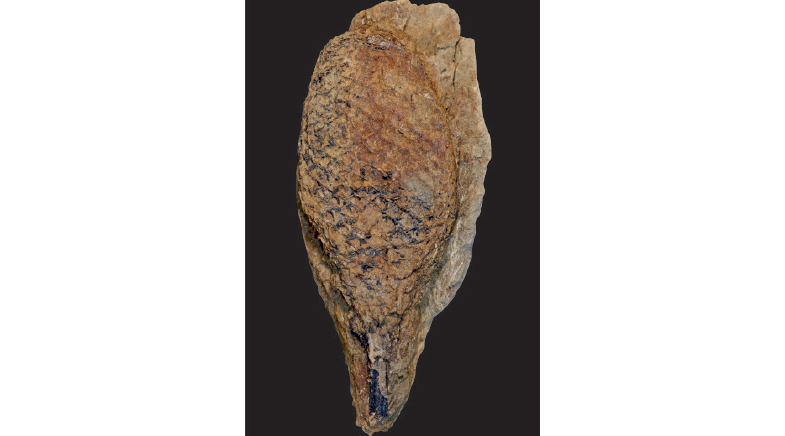
Zhen Xu, a palaeobotanist at the University of Leeds in the U.K., has been studying how a certain class of diminutive plants survived the Permian–Triassic (P-T) mass extinction about 252 million years ago. That was one of the most cataclysmic events recorded in geological history: it wiped out over 80% of ocean species and nearly 90% land-dwelling animal groups. Volcanic eruptions on a massive scale had triggered extreme global warming, pushing atmospheric carbon dioxide (CO2) to roughly four times the pre-extinction levels and sending equatorial land temperatures soaring above 45° Celsius.
Diverse forests of woody, seed-bearing plants had covered much of the land before the P-T extinction. But the disaster wiped out the most prevalent plant life till then. What took over the planet instead were small, herbaceous plants called lycophytes, a distant relative of the modern-day quillworts. These humble plants dominated land ecosystems worldwide for nearly five million years. Scientists have long wondered how these plants survived lethal conditions.
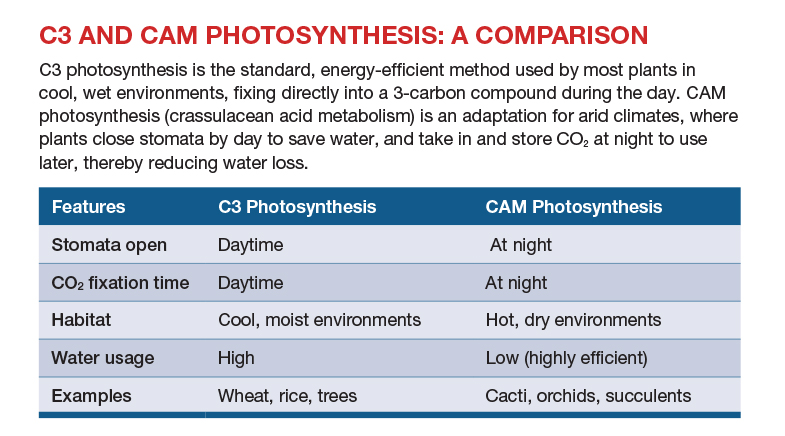
CAM works by keeping leaf pores closed during the scorching daytime to prevent water loss and opening them at night.
Xu and her collaborators from Chinese and U.K. institutions have come up with a compelling explanation. In a paper published in Nature Ecology & Evolution in April (bit.ly/Lycophytes), they observed that the ancient lycophytes were likely to have used a special photosynthetic trick, called the CAM (crassulacean acid metabolism) photosynthesis, to ride out the difficult phase — akin to the strategy used by cacti and succulents today to thrive in hot and dry environments.
"Our study provides a deep-time perspective on how terrestrial ecosystems respond to extreme warming," says Xu. "While our findings highlight a potential survival mechanism, they also underline the complexity of plant responses to climate change. Understanding these trade-offs is critical for predicting future ecosystem function," she adds.
The Earth had in the past experienced warming events that were, in some instances, more intense than present-day events. "By studying how plants responded during those intervals, we can better understand the potential trajectories of modern ecosystems under ongoing climate change," remarks Xu, who has examined fossils from southern China using carbon isotope chemistry and computer climate simulations.
CAM photosynthesis is distinct from C3 photosynthesis, which is the predominant photosynthetic process. Unlike C3 photosynthesis, in which CO2 is taken in during the day to fix a 3-carbon molecule and is currently used by about 95% plant species, CAM plants work differently by taking in CO2 at night and using it during the day to conserve water.
CAM works by keeping leaf pores (stomata) closed during the scorching daytime to prevent water loss and opens them at night, when temperatures drop, to absorb CO2, thereby storing it as an acid to be used for photosynthesis the next day.
"We show that during the P-T mass extinction, some plants likely survived extreme heat by shifting towards a CAM photosynthetic strategy that improves water-use efficiency and stress tolerance," says Xu, who commenced studying Triassic lycophytes in 2014 during her PhD in China.
CAM, she observes, is not restricted to ancient plants and occurs across modern plant groups such as angiosperms and gymnosperms. "This suggests that the underlying physiological and genetic toolkit is widespread and could play an important role under future warming."
TWO IN ONE
CAM is particularly interesting because it is flexible in some modern plants; they can switch between C3 and CAM depending on environmental conditions, which means these plants do not have to wait for long-term evolution to respond to environmental changes. They can adjust their physiology relatively quickly under stress conditions such as heat or drought, argues Xu.
She, however, flags a concern. A large-scale shift towards CAM could reduce ecosystem productivity and alter both carbon cycling and food webs, as CAM is less efficient than C3 photosynthesis. "Before we can fully evaluate its role in future climate scenarios, we need more research on how widespread this flexibility is, and how large-scale shifts in photosynthesis would impact ecosystems and the global carbon cycle," Xu says.
Focused on another aspect of survival, researchers at the Indian Institute of Science Education and Research (IISER) Kolkata are working to understand the molecular mechanisms involved in making a plant adjust to hotter temperatures. In a study published recently in Science Advances (bit.ly/Twoproteins), the IISER team led by Sreeramaiah N. Gangappa, Associate Professor in the Department of Biological Sciences, found that a tug of war between two proteins — PIF4 and HY5 — decides how plants respond to increasing ambient temperatures. Plants grow taller when PIF4 is active; on the other hand, when HY5 – which acts as a brake – is at play, plant growth becomes more compact.
When temperatures rise modestly — say from a comfortable 22° Celsius to a warmer 27° Celsius — plants respond by growing taller and adjusting their shape. They do so through a process scientists call "thermomorphogenesis", a deliberate strategy to keep the leaves cooler and maintain efficient photosynthesis. Understanding how the process works at the molecular level is significant for agriculture because as global temperatures climb, crops need to adapt.
The IISER scientists identified that a class of proteins called LRB tips the balance towards growth when temperatures rise. The LRB proteins, scientists found, are in fact transcription factors which work through a dual mechanism. Firstly, they physically latch onto HY5 protein and tag it for destruction through the cell's waste-disposal system called the proteasome. When HY5 is destroyed, its braking effect on PIF4 — the growth gene — is removed. In the second step, LRBs bind to PIF4 and protect it from being broken down, which ensures growth acceleration.
Researchers created mutant plants that lack functional LRB genes to test their hypothesis. Without the particular gene, plants grew in the same fashion irrespective of whether they were kept at normal or "warm" temperatures. "Since PIF4 is a transcription factor, it is a key regulator of downstream genes," says Gangappa. "Such plants, which lack LRB genes, will not be able to see 'warm' temperature," he says.
These insights, observes Gangappa, highlight two aspects. The first entails understanding how plants sense warm temperatures and how they adapt to them. The second focuses on using this knowledge to make plants temperature-insensitive – in other words, climate-resilient.
Global crop yields are impacted by rising temperatures, and the trends are expected to worsen. Identifying molecular switches that govern how plants respond to warmth is a step towards engineering crops that can better tolerate or strategically adjust to a hotter climate without sacrificing yield or immunity.









Road to clean air
Technology that maps pollution levels may let drivers breathe easy.
The exo factor
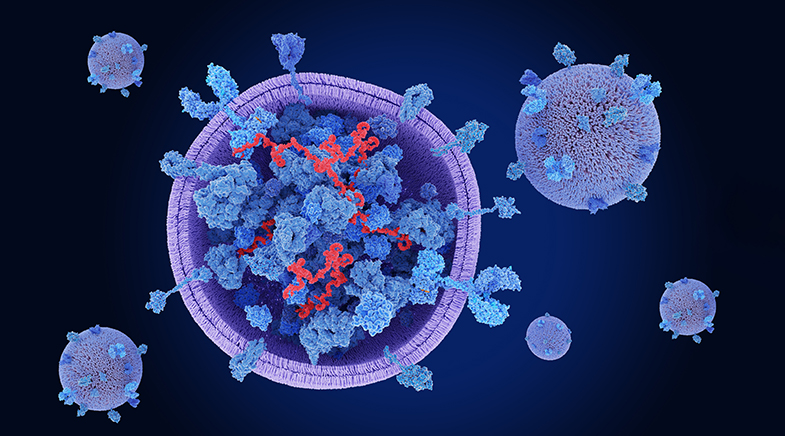
Can a type of cell secretion be turned into a safe vehicle for drug delivery? Researchers believe so.

What goes up...
...must come down, but will rise yet again, thanks to reusable rockets.



Have a
story idea?
Tell us.
Do you have a recent research paper or an idea for a science/technology-themed article that you'd like to tell us about?
GET IN TOUCH