

Harnessing heat
-
- from Shaastra :: vol 05 issue 07 :: Jul 2026
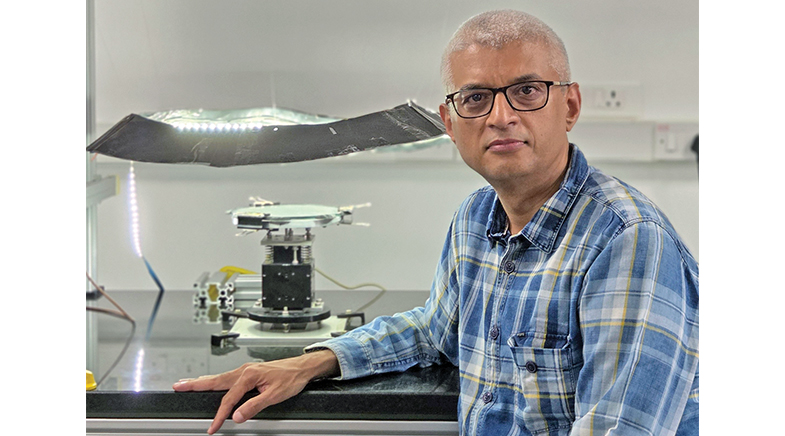
Researchers recreate the 'Stirling engine' in a tiny plastic bead.
Physicist Rajesh Ganapathy has coaxed a tiny plastic bead no bigger than a grain of sand to behave like a heat engine. By hiding a steel ball bearing inside the bead and rattling it on a vibrating platform, he and his colleagues at the Jawaharlal Nehru Centre for Advanced Scientific Research (JNCASR), Bengaluru, have shown that an object far too large to be jostled by the random thermal motion of molecules can nevertheless obey the same thermodynamic rules as microscopic heat engines.
All heat engines – from the steam engines that powered the Industrial Revolution to the internal combustion engines that power automobiles – rely on the same key idea: heat can be converted into useful work. One example is an engine invented in 1816 by the Scottish clergyman Robert Stirling. In the Stirling engine, a sealed gas is alternately heated and cooled. As the gas expands and contracts, it pushes a piston, converting heat into mechanical motion. While not as widespread as steam or internal combustion engines, Stirling-cycle devices have found niche applications in ultracold refrigeration, solar thermal power generation, and experimental space power systems.
The JNCASR researchers have now recreated the Stirling engine in a plastic bead measuring just 4 mm x 2 mm (bit.ly/stirling-bead). "Our starting point for this work was this question: can we use some form of external energy, perhaps vibrations, to mimic the thermal energy of gas molecules?" says Ganapathy, Professor of Physics at JNCASR. The random motion of gas molecules in a container is characterised by temperature, which represents their average kinetic energy. "But a plastic bead is so large that collisions with surrounding gas molecules cannot set it into thermal motion," says Ganapathy. "The bead has no associated thermal energy. It is a completely athermal object."
Five years ago, Ganapathy led an effort to design a micron-sized heat engine. Instead of using a mix of gas and fuel, the researchers used a tiny gel-like colloidal bead suspended in water and directed its motion with a laser beam, similar to how a piston works in a classical engine (bit.ly/micrometer-stirling). "The colloidal bead in a liquid essentially behaved like a gas molecule," says Ganapathy. "While working on that project, we asked: instead of water molecules bombarding the colloidal particle from outside, what if a tiny particle could be imparted motion from its inside?"
The team embedded a 1.5-mm steel ball bearing inside the bead and placed it in a magnetic trap – a magnetic field that confines its motion – on a vibrating platform. As the platform vibrated, the steel ball rattled inside the bead, pushing it in random directions. "If we disregard the steel rattler and consider only the plastic bead, we see a sand grain-sized bead behave like a thermal particle," says Ganapathy. By adjusting the strength of the vibrations, the researchers controlled the bead's effective – or artificially imparted – temperature, while tweaking the magnetic field squeezed or relaxed its motion, much like a piston compresses or expands a gas.
These controls allowed the researchers to put the bead through a Stirling engine cycle. The bead served as the gas; the vibrations acted as artificial hot and cold reservoirs by setting its effective temperature; and the magnetic trap mimicked the piston that compresses and expands the gas. Although the bead itself does not become hot, the artificially generated fluctuations corresponded to effective temperatures as high as 1015 kelvin – the level of random motion a microscopic particle would experience in an extremely hot thermal environment.
The team included students Niloyendu Roy, Pragya Arora, Suman Maji, and collaborator Ajay Sood, a physicist at the Indian Institute of Science, Bengaluru, and currently Principal Scientific Adviser to the Central government.
The big surprise was that thermodynamics reigned even when the random motion driving the engine came not from molecular heat, but from mechanically generated vibrations, says Sood. The bead followed the same broad thermodynamic rules that govern classical heat engines. In particular, it reproduced the expected trade-off between power and efficiency, producing more power at the expense of efficiency, just as thermodynamics predicts. Ganapathy says: The bead behaves in a manner predicted by the same equations proposed by Stirling over 200 years ago."








The unfolding world of robotics
The art of origami gives shape to cutting-edge technology.


Secret lives of leaves
Life on Earth is sustained by leaves' ability to capture sunlight and convert it into biologically usable energy.




Have a
story idea?
Tell us.
Do you have a recent research paper or an idea for a science/technology-themed article that you'd like to tell us about?
GET IN TOUCH