

Heat of the matter
-
- from Shaastra :: vol 05 issue 02 :: Feb 2026
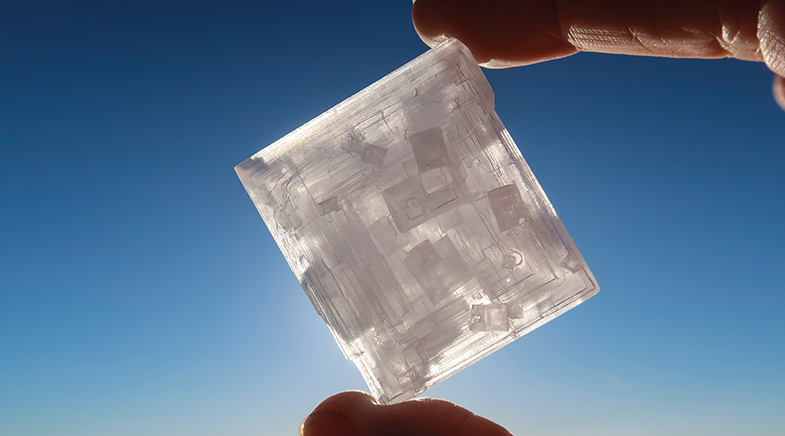
Researchers pave the way for new applications of chromium nitride.
Bivas Saha's laboratory looks somewhat like a scene from a sci-fi film. The light is subdued, and the only sounds you hear are the hum of an air-conditioner and the clicks of instruments. At the centre of one of these instruments is a small table, with gun-like objects pointing at it. This is where a single crystal is being grown, to a thickness of about ten times that of a human hair. From the guns stream atoms of the crystal's constituent elements. Tremendous care and hours of growth are required to produce a crystal with the constituents measured to exact ratios.
Chemistry textbooks hold that elements combine in definite proportions, depending on their valencies, to form crystalline solids in perfect ratios. For example, NaCl has sodium and chloride ions in a 1:1 ratio. In reality, defects and deformations may prevent the crystal from having a perfect ratio. But a perfect ratio is absolutely crucial for Saha's experiment.
Saha, an Associate Professor, and his team from the International Centre for Materials Science at the Jawaharlal Nehru Centre for Advanced Scientific Research (ICMS-JNCASR), Bengaluru, are deeply engaged in growing and studying large single crystals of novel materials. One such material is the semiconductor chromium nitride, which is puzzlingly different from most semiconductors in its capacity to convey heat. It has several applications, and understanding its anomalous thermal conductivity enables better handling of similar materials.
Chromium nitride is a hard and shiny substance — so hard that it can be used in drill bits. According to Saha, the material's electronic, optical, and thermal properties can enable new devices — such as solar mirrors, absorbers, directed emitters (a part of transistors), and photonic radiative cooling, which is commercially used to keep surfaces cool.
Though the peculiar heat-conducting properties of chromium nitride had been predicted theoretically, these had not been observed in an experiment. The capacity to conduct heat is measured by thermal conductivity. In most semiconductors, thermal conductivity decreases with increasing temperature. But Saha's group demonstrated an increase in chromium nitride's thermal conductivity beyond approximately 280 K (8-9° Celsius). The team not only fabricated micrometre-sized chromium nitride crystals but also figured out why they exhibited this peculiar behaviour.
"In general, the idea of finding materials whose thermal properties can be tuned is important because in the semiconductor industry you want to manage the heat load," says Mandar Deshmukh, Professor, Department of Condensed Matter Physics and Materials Science, Tata Institute of Fundamental Research, Mumbai.
Saha's experiment on chromium nitride called for a relatively large single crystal — a few micrometres in size — with a near-perfect ratio of chromium to nitride. The first challenge for the ICMS-JNCASR team was to produce the material with the correct proportions of the two elements. It was a daunting task, Saha says. "We needed to maintain the vacuum, the temperature and the steady, slow growth for nearly 33 hours at a stretch," he explains.
The next challenge was to measure the lifetimes of short-lived lattice vibrations, which carry heat within a crystal. To do this, the team employed a technique called inelastic X-ray scattering, which can be conducted only at a few facilities, such as the U.S.-based Argonne National Lab and the SPring-8 facility in Japan. Saha's team approached SPring-8. The Japanese centre did not have the facility to measure the temperature dependence of the lifetimes, but developed it especially for this experiment, Saha says.
By characterising this material and showing that the coupling of its thermal vibrations to its magnetism lies at the heart of its anomalous behaviour, the group has opened the way to many potential applications and to extending the concept to other materials.
Hiroshi Fukui, from the Precision Spectroscopy Division of Japan Synchrotron Radiation Research Institute, of which SPring-8 is a part, welcomes such partnerships. He says, "If you are interested in exploring thin film dynamics... we encourage you to perform your experiments with us." If there is sufficient demand, the Japanese centre is also willing to expand the facility to embrace low-temperature experiments.








A new organelle on the block
Scientists find a nitrogen-fixing cyanobacterium living as an organelle inside a marine alga.

It's the science, silly!
Curiosity‑driven scientific inquiry, seemingly without a 'use', isn’t a luxury. It forms the foundation of innovation.

World of research: August 2026
A round-up of some recent striking studies.



Have a
story idea?
Tell us.
Do you have a recent research paper or an idea for a science/technology-themed article that you'd like to tell us about?
GET IN TOUCH