

To the Moon and back
-
- from Shaastra :: vol 05 issue 04 :: Apr 2026
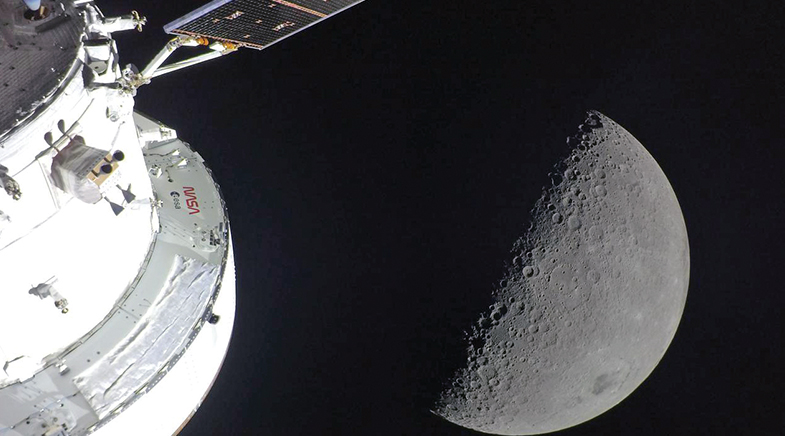
A ready reckoner for Artemis II's Moon Mission.
Artemis II's 10-day voyage around the Moon and back was not just a test drive for the U.S. National Aeronautics and Space Administration, which is planning future human landings on the Moon. It was a critical mission of scientific discovery and technology — almost everything the crew did advanced understanding for future missions. In the process, they notched an eclectic set of firsts: most planned, some impromptu.
THE VOYAGE
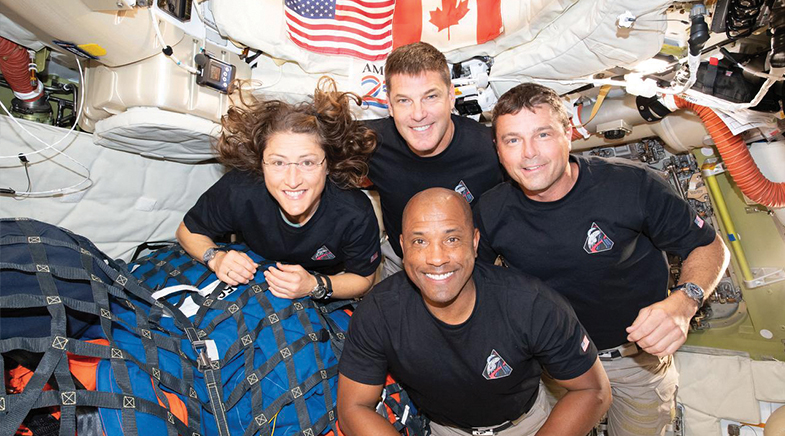
Commander Reid Wiseman, Pilot Victor Glover, and Mission Specialists Christina Koch and Jeremy Hansen (Canadian Space Agency) took off on April 1 on the 11,18,624-km-long journey, travelling to the far side of the Moon, then using lunar gravity to slingshot the craft on a trajectory back home. At 406,771 km, before it turned back, the spaceship broke Apollo 13's record for the farthest humans from Earth.
THE MISSION
The Artemis Mission is named after the Greek goddess associated with the Moon. She was Apollo's twin. The spacecraft is called Orion after Artemis's celestial hunting partner. Each craft has its own name, too. This one was Integrity.
WHAT THEY SAW
- The far side of the Moon for around seven hours, observing regions previously not seen by humans. About 20% of the far side was sunlit during their time.
- A solar eclipse lasting 57 minutes. The Moon appeared as a black disc, haloed by sunlight.
- An earthset, when the Earth dipped below the lunar horizon. It was followed by an earthrise, 40 minutes later, on the other side.
WHOM THEY SPOKE WITH
- U.S. President Donald Trump and Canadian Prime Minister Mark Carney.
- The crew of the International Space Station. This was the first such ship-to-ship call.
- Their families, Command Centre and the media.
WHAT THEY DID
- Exercised on the flywheel — a specialised gym.
- Studied 30 target points on the Moon, including Orientale Basin and Hertzsprung Basin. Named two craters, one after their spaceship, Integrity, the other after Wiseman's late wife, Carroll.
- Donned and inflated spacesuits to check for damage due to microgravity.
- Demonstrated cardio-pulmonary resuscitation and choking response action.
- Performed manual pilot manoeuvres.
- Took pictures.
- Fixed a temperamental toilet and Microsoft Outlook glitches.
SCIENTIFIC EXPERIMENTS & DEVICES
- A Virtual Astronaut Tissue Analog Response (AVATAR): carrying bone marrow cells of the crew to study the impact of deep space on the immune system.
- Artemis Research for Crew Health and Readiness (ARCHeR): wearable devices to gather health data.
- Immune Biomarkers to test saliva and blood.
- M-42 EXT radiation detectors to measure cosmic radiation inside the capsule.
- Orion Artemis II Optical Communications System to test high-bandwidth laser communications from deep space.
- 32 cameras.
WHAT NEXT
- Artemis III — To test the integration of the spaceship with commercial Moon landers.
- Artemis IV — Return to the Moon.
- Artemis V — Begin building a base on the Moon.
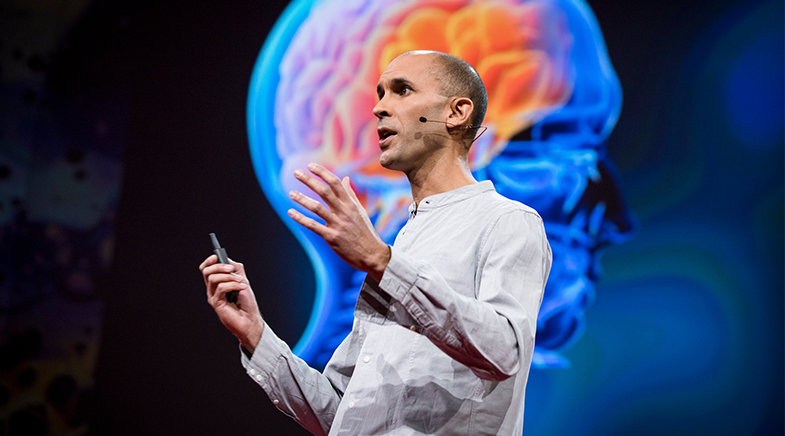








'Consciousness is THE central phenomenon of our brains'
Cognitive neuroscientist Anil Seth on his channelling of science to answer some foundational questions that border on philosophy.
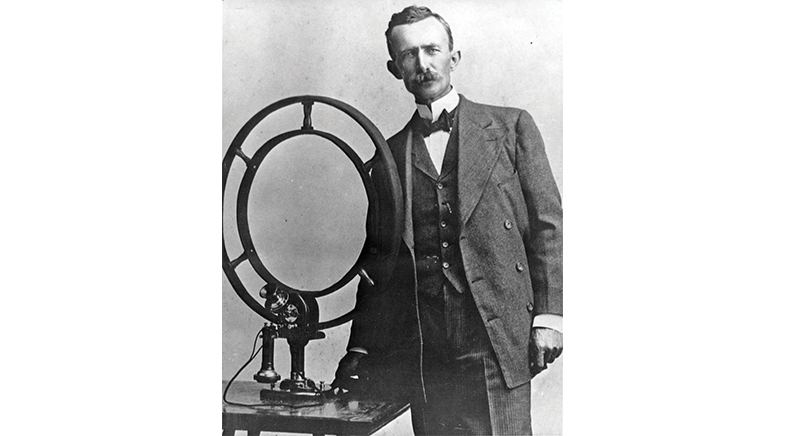

Voices without wires
An eccentric American farmer was one of the earliest pioneers of wireless communication.
Coming full circle
Transitioning to a circular economy is critical to addressing climate change, and the economic and other losses through wastage.



Have a
story idea?
Tell us.
Do you have a recent research paper or an idea for a science/technology-themed article that you'd like to tell us about?
GET IN TOUCH