

Mystery of the monsters
-
- from Shaastra :: vol 05 issue 03 :: Mar 2026
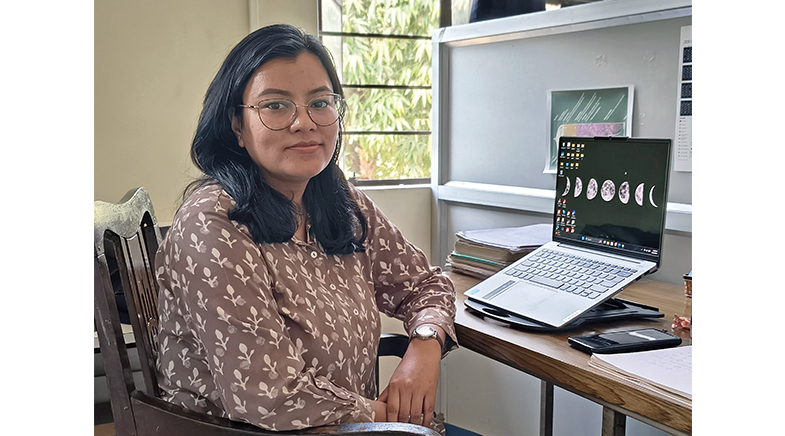
Nirmali Das felt as though the James Webb Space Telescope (JWST), orbiting the Sun 1.5 million km from Earth, had stolen 500 million years from her calculations. Das, a physics research scholar at Gauhati University, had been racing to understand how the universe might assemble supermassive black holes — about a billion times the Sun's mass — within its first billion years, barely enough time for so much mass to accumulate. But the JWST, built to peer deeper into the universe's past than any observatory before it, had revealed that some of these cosmic giants had emerged within 500 million years after the Big Bang. For Das, and for astrophysicists elsewhere in the world, the Webb images deepened the mystery of these early behemoths.
Black holes, conceived in the early 20th century through the mathematics of Albert Einstein and first confirmed by observations in 1971, are objects with staggering gravity — so strong that not even light can escape them — and stark reminders that physics is incomplete. No one knows what happens to matter sucked into a black hole. Stellar-mass black holes emerge when stars roughly 10 times or even more massive than the Sun exhaust their fuel and collapse under their own gravity. Astronomers estimate that the Milky Way Galaxy itself harbours tens of millions of stellar-mass black holes. But supermassive black holes, found at the centres of nearly every galaxy, are monsters: a million, a billion, or more than 10 billion times the Sun's mass. The Milky Way's core has a four-million-solar-mass black hole.
The Milky Way itself harbours tens of millions of stellar-mass black holes. But supermassive black holes at the centres of nearly every galaxy are monsters.
"The birth of the earliest supermassive black holes has been among the biggest open questions in cosmology," says Priyamvada Natarajan, Professor of Astronomy and Physics at Yale University, who has spent two decades developing theoretical ideas for how they might emerge. The puzzle is not just their enormous masses, but that they were in place in the universe's infancy. Standard models, in which black holes emerge from the remnants of dead stars and grow by feeding on matter or by colliding into each other, struggle to explain how they achieve their supermassive sizes so quickly. Natarajan has combined theory with computer simulations to predict alternative birth pathways for supermassive black holes, including unusual scenarios in which massive black hole seeds emerge directly from collapsing clouds of gas, bypassing the stellar stage and acquiring a head start in mass to grow even more.
Five years ago, Das also set out to tackle the puzzle of supermassive black holes. Unlike models that began with exotic seeds, her approach opened with a simpler question: what if the constraint was not only physics, but time itself? "We asked ourselves: what properties of the universe would facilitate their birth, and we approached this question through time," Das says. "How much time do they need to grow? Can cosmological models explain how the universe assembled enormous black holes so quickly?"
Astronomers have known for long that something unusual must have happened in the first billion years to account for the supermassive black holes.
The questions shift the focus from how supermassive black holes grow so quickly to whether the universe's age — the cosmic stopwatch — would allow time for that growth. If black holes seemed to be maturing too fast, perhaps the clock they were racing against needed closer scrutiny.

Cosmological models serve as that clock. They describe how space expands and how matter and energy have shaped that expansion since the Big Bang nearly 13.8 billion years ago. Since the late 1990s, the main cosmological model has been the Lambda Cold Dark Matter model (ΛCDM), which describes the universe as roughly 5% ordinary matter, 27% dark matter, and 68% dark energy — the still-enigmatic agent of accelerated expansion. The model has been extraordinarily successful, reproducing the web-like large-scale structure of the cosmos: galaxies arranged in patterns that resemble filaments and walls and span hundreds of millions of light-years.
But concerns have emerged regarding the ΛCDM model. Observations from the Dark Energy Survey, which mapped more than 150 million galaxies between 2013 and 2019, have hinted that the universe's expansion history may not align perfectly with expectations. And the discovery of enormous black holes in the early universe adds a different kind of pressure on the cosmic timeline itself.
Against that backdrop, theoretical astrophysicist Sanjeev Kalita, a faculty member in the Department of Physics at Gauhati University, with a long-standing interest in cosmological models, encouraged Das to explore the formation of supermassive black holes under ΛCDM and alternative cosmological models. "By changing numbers in the mathematical blueprints that make cosmological models, we introduce subtle changes in the universe's properties to test whether alternative cosmologies can stretch the time available for the growth of supermassive black holes," Kalita says.
Their study, published in the Monthly Notices of the Royal Astronomical Society, shows that relatively small black holes — ranging from 30 times to 600 times the Sun's mass — can, under the right conditions, grow to weigh hundreds of millions or even a billion solar masses (bit.ly/Massive-Seeds). Their growth depends on the size and spin of the seed black holes and how efficiently they feed on surrounding gas or stars. By testing ΛCDM and carefully tuned alternatives, Das, Kalita, and postgraduate physics student Ankita Kakati found that modest shifts in cosmological parameters could stretch the clock just enough to give these giants time to form.
"Our results keep the room open for alternative candidate cosmological models — should they be needed," says Kalita. But small black hole seeds, their study suggests, would need to accumulate mass at a rate beyond a limit calculated by British astrophysicist Arthur Eddington in the early 20th century. Eddington showed that radiation emitted by infalling matter pushes outward, counteracting gravity and imposing a natural ceiling on growth. To reach supermassive scales within 500 million years, black holes would require episodes of "super-Eddington" feeding — phases when inflow overwhelms the balance and growth accelerates dramatically.

Astronomers have known for more than two decades that something unusual must have happened in the first billion years to account for the supermassive black holes. Surveys since the late 1990s have uncovered quasars powered by black holes with masses a billion times that of the Sun less than a billion years after the Big Bang. Their existence prompted some to imagine alternative birth pathways. Natarajan proposed nearly two decades ago that, under special circumstances and at specific sites in the early universe, where one galaxy is influencing the behaviour of gas in another, instabilities in giant clouds of hydrogen gas — the primordial raw material for all matter in the universe — might cause the gas to collapse directly under gravity, forming a heavy black hole seed without first becoming a star. These would be heavy seeds, weighing at birth between 1,000 and 100,000 solar masses. In 2017, she predicted the specific sets of spectral fingerprints such objects might imprint on their host galaxies (bit.ly/Spectral-Fingerprints).
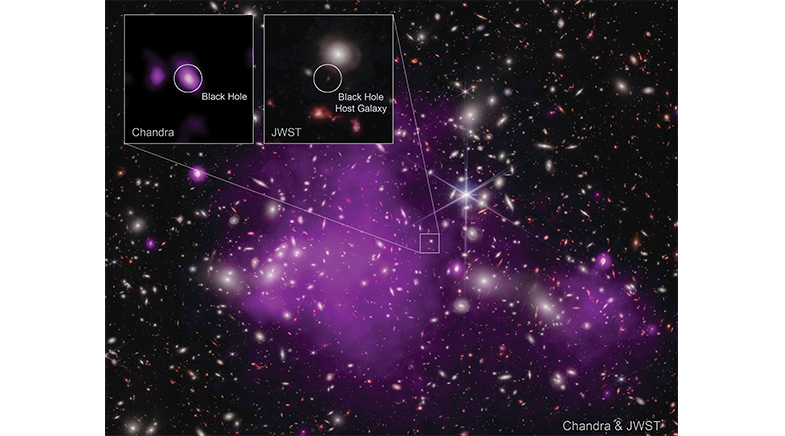
In 2023, a colleague studying data from the JWST and the Chandra X-ray Observatory called Natarajan on a Zoom call and shared an intriguing result. A candidate galaxy named UHZ1, observed as it was 13.2 billion years ago — barely 470 million years after the Big Bang — displayed signatures matching her earlier predictions. "It was a dream come true," says Natarajan.
Across the Atlantic, Lucio Mayer, a theoretical astrophysicist at the University of Zurich, and his colleagues have explored another pathway for supermassive black holes — the merger of two galaxies. In a 2024 study (bit.ly/Another-Pathway), the Zurich group described what they call the first fully realistic large-scale simulation of a merger-driven scenario: the collision of two hefty, gas-rich young galaxies some 600 million years after the Big Bang. The impact funnels enormous quantities of gas toward the centre of the newly merged system. Within a million years, that inflowing gas settles into an extremely compact central disc, which contracts under its own gravity, grows denser and hotter, and ultimately collapses into a black hole. Such a merger, the team reports, could create a black hole with a mass between 1 million and 100 million solar masses.
The emerging discourse is no longer about how early supermassive black holes formed. It is about how many pathways might have led to them. Did some begin life already massive? Did others start small and grow through bursts of super-Eddington feeding? Or did cosmology provide slightly more breathing room than once assumed? The answer, says Kalita, may lie in keeping multiple possibilities open. Small seeds may suffice, provided they are fed fast enough, and the cosmic clock allows additional time.
The Gauhati University researchers' calculations intersect intriguingly with another surprise from the JWST's deep surveys. For decades, astronomers have documented a tight relationship between the mass of a galaxy's central black hole and the total mass of its stars, with the black hole typically accounting for well under 1% of the stellar mass. But the calculations predict that some early galaxies should host disproportionately massive black holes, with masses comparable to the stellar gas mass in the galaxies.
That prediction aligns with the properties of tiny crimson specks scattered across the early universe in JWST images. Astronomers call them "little red dots". They are not rare oddities but appear on virtually every image of deep extragalactic space, but only within a limited epoch — between roughly 600 million and 1.5 billion years after the Big Bang. They appear to harbour black holes so massive that their black hole-to-stellar mass ratios range from 10% to 100%, far exceeding the proportions seen in mature present-day galaxies.
Rohan Naidu, a postdoctoral research scholar at the Massachusetts Institute of Technology, calls them "the most stunning surprise" from the JWST. The emission patterns resist easy classification. They do not resemble classic quasars, nor do they behave like ordinary star-forming galaxies. Instead, their light carries unusually strong Balmer breaks, features consistent with thick reservoirs of hydrogen gas absorbing and reprocessing radiation from an intensely active black hole.
In a 2025 study, Naidu and collaborators proposed that the little red dots are compact, gas-rich cocoons surrounding rapidly growing black holes and called them "black hole stars" (bit.ly/Red-Dots). Instead of stars powering them through nuclear fusion, their energy comes from the accretion: gases spiralling inward towards the black hole, heating up and radiating intensely. Much of that radiation, however, is trapped and reprocessed by the hydrogen envelope, producing the distinctive glow that the JWST detects.
In January 2026, researchers reported further evidence supporting the idea that little red dots were modest supermassive black holes shrouded in dense gas.
In January 2026, researchers from the U.K. and Denmark reported further evidence supporting the idea that little red dots were modest supermassive black holes shrouded in dense gas. The accumulating data suggest they represent a transitional phase, a brief window when black holes ballooned inside compact, embryonic galaxies and grew at extraordinary rates. Although they are among the smallest black holes ever discovered, they still have a mass of 10 million solar masses. Their disappearance after 1.5 billion years hints that they evolved into more familiar galactic structures as star formation caught up and growth stabilised.
"The dense cocoon of gas around provides the fuel they need to grow very quickly," says Darach Jafar Watson, Professor at the Niels Bohr Institute, University of Copenhagen, Denmark. "Most of the (astrophysics) community now agrees that little red dots are a supermassive black hole surrounded by dense gas, leading to an extraordinary growth rate." It is possible, says Watson, that these black holes are growing at super-Eddington rates.
The accumulating evidence from the first billion years might leave astrophysicists spoilt for choice. "What is beginning to emerge is the possibility that there are multiple channels for the birth of supermassive black holes," Das says. "And that shouldn't be a surprise at all, given the enormous range in their masses — from the four-million-solar-mass black hole at the centre of our own galaxy to the largest ever detected that weighs 66 billion solar masses," she says. "That diversity may simply reflect different initial conditions and different channels of formation."
See Also :








A bird's-eye view of drones
A bird's-eye view of a nascent drone industry that is taking wing and is being harnessed in a variety of civilian and military applications.
Genome Diaries
Twenty-five years after the human genome was drafted, research in India is yielding life-saving results.

The men who knew infinity
Indian mathematicians continue to do research that is noticed around the world.



Have a
story idea?
Tell us.
Do you have a recent research paper or an idea for a science/technology-themed article that you'd like to tell us about?
GET IN TOUCH