

Peak warming
-
- from Shaastra :: vol 05 issue 08 :: Aug 2026
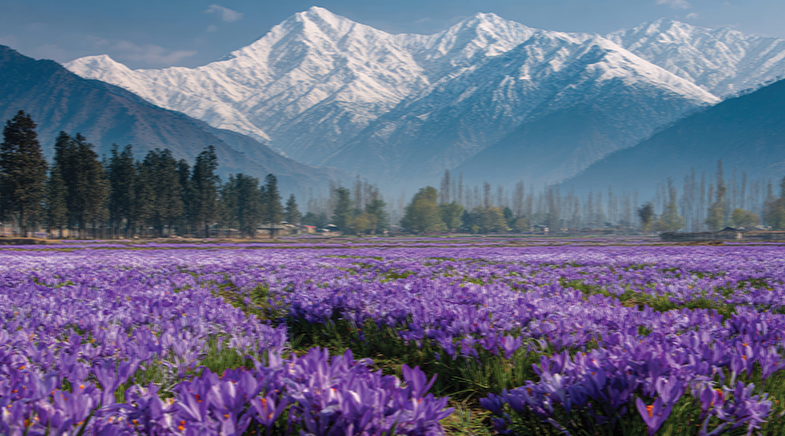
Temperatures are soaring in the Himalayas.
In the summer of 2026, multiple cloudburst events hit Jammu and Kashmir (J&K). Extreme weather events, such as cloudbursts, wherein a large volume of water pours down in a short span of time, are becoming more frequent partly due to climate change, indicated by, among other factors, temperature spikes. Globally, the average temperature has been rising by 0.2°C per decade since 1975. In India, the mean temperature rise is in line with the global increase, but regionally, some areas are warming faster.
In the Western Himalayas, high-elevation regions are warming faster than low-elevation regions, a July 2026 study reports. High-altitude locations in J&K, such as Gulmarg and Pahalgam, have warmed by up to 1°C in the past two decades, the study shows. "We have something to worry about; 1°C is too much for 20 years," says J. Kuttippurath, Associate Professor at the Indian Institute of Technology Kharagpur and corresponding author of the study published in Scientific Reports (bit.ly/JK-2026).
The researchers focused on J&K because, as an ecologically sensitive mountainous region, it experiences extreme weather and climate. Any climate change signals appear in extreme regions first, Kuttippurath points out.
The study used modelling data and ground-based temperature observations for the period 1980-2024 at elevations ranging from 367 m (Jammu) to 2,740 m (Pahalgam). While Jammu did not show significant daytime warming, mid-elevation valleys such as Srinagar saw a 0.3°C rise per decade. Anthropogenic pollution in Jammu might be the reason behind this trend, as aerosols reflect incoming radiation.
Mid-to-high elevations saw night-time warming. Temperature increase at night means the warming is continuous, says Kuttippurath. In addition to regional differences, the study found warming to be intense at higher altitudes during winter.
These temperature trends hint at elevation-dependent warming in the Western Himalayas. The warming will be faster as you go up, Kuttippurath explains. The phenomenon is influenced by multiple factors, one of which is known as the snow-albedo feedback. While snow reflects most of the Sun's radiation, the melting of snow and glaciers due to global warming exposes the dark surface underneath, which absorbs and reradiates the heat. The melting of snow and glaciers combined with warm conditions also leads to more evaporation of water. Water vapour is a greenhouse gas. Moisture and clouds trap the outgoing radiation, preventing cooling at night.
Kuttippurath's earlier work (bit.ly/JK-2023) had examined regional temperature trends across India during 1980-2020 and observed "a high warming trend" (of about 0.3°C per decade) in the Western Himalayas in pre- and post-monsoon seasons. He will next look at the Northeast region, where he had found a similar warming trend in the winter and post-monsoon seasons. The Himalayan region, especially its Western range, is warming faster than any other region in India, and faster than most mountainous regions in the world, Kuttippurath says.
Higher temperatures due to climate change can result in extreme precipitation. The hydrological cycle has changed, says Kuttippurath, comparing it to boiling water in the kitchen. On a low flame, water takes time to boil, but it boils faster when the heat is cranked up. That means you are pumping more water vapour into the atmosphere in a short period of time, he explains. More water vapour forming in a shorter window leads to more rainfall in that shorter window.
Rising temperatures can also impact the snow cover, soil moisture content, and photosynthesis — all of which are essential to the region's horticulture. Kashmir's apple, saffron, and walnut production has been hit both in quantity and quality in recent years.
Greenhouse gas emissions must be cut, insists Kuttippurath. In the meantime, farmers can change farming patterns. He suggests that the government implement region- and season-specific adaptation policies. Each season needs its own climate emergency map, he says.
See also:









Oil's well that ends well
Used cooking oil is a renewable starting material for polymers.

Rice is nice
Molecular scissors are giving new shape to the much-loved cereal.

Squashing the superbug
A platform to combat antimicrobial resistance brings together diverse stakeholders from India and the world.



Have a
story idea?
Tell us.
Do you have a recent research paper or an idea for a science/technology-themed article that you'd like to tell us about?
GET IN TOUCH