

Scaling the summit
-
- from Shaastra :: vol 05 issue 03 :: Mar 2026
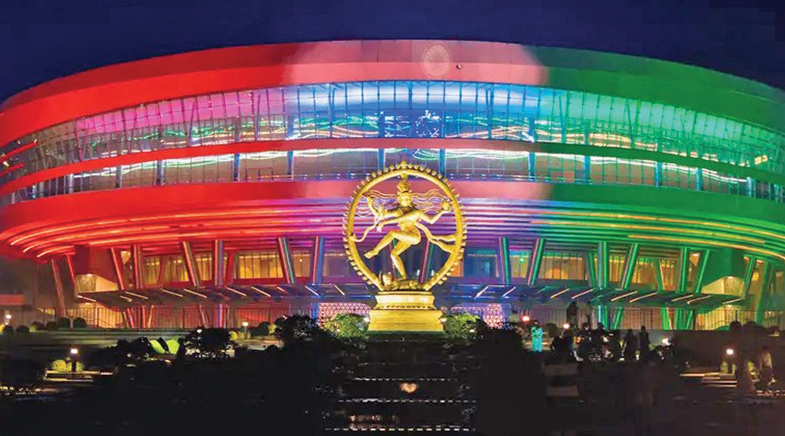
A lookback at the AI Impact Summit 2026 that New Delhi hosted in mid-February.
If India itself was on display at the event, the delegates got a crash course on what the country is: crowds, chaos, and yet, strangely, a method in the madness. While the artificial intelligence (AI) summit started with the regular confusion of a Great Indian Wedding, some semblance of order fell into place by the second day.
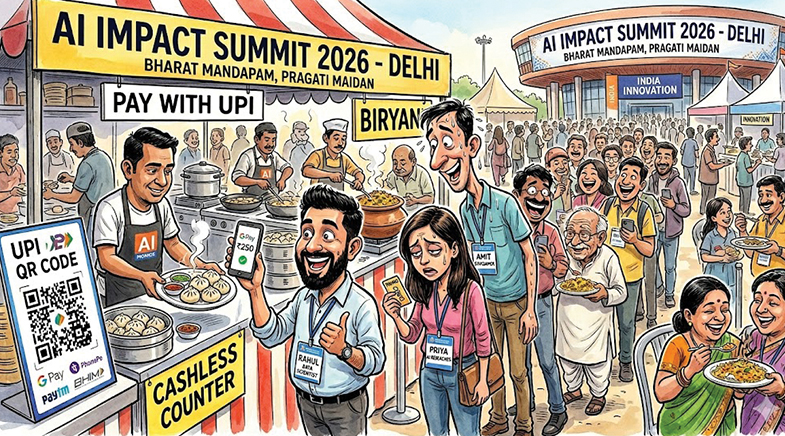
The largest of the four AI summits to date recorded over five lakh footfalls during the six-day event that opened on February 16. The country's digital prowess was on full show, with the Digi Yatra portal facilitating entry and the Unified Payments Interface (UPI) used to purchase biryanis, chholey bhature, and momos from the food court. Occasionally, the internet was slow, but given the number of users and burps, it was only a hiccup.
*****
The summit drew a respectable smattering of world leaders and tech captains, even though French President Emmanuel Macron preferred Mumbai's Marine Drive for his social media-trending morning jog. Some absences went unremarked. Apple's non-presence was explained as a deliberate strategic move, and not as a snub to the event. The tech giant doesn't appear to see AI as a separate vertical, but rather as embedded in Apple Intelligence.
But it was Bill Gates's "will-he-won't-he" drama that had Bharat Mandapam abuzz. First, there was a hint that he might not turn up; then there was righteous indignation from the Gates Foundation, which issued a statement emphasising his attendance. Gates finally bowed out, the foundation said, "to ensure the focus remains on the AI Summit's key priorities". Unlike other absentees, Gates was in India all the while.
*****
It was a week of pledges and commitments. First, there was the Guinness Book of World Records-worthy pledge made by 2,50,946 individuals in 24 hours for AI Responsibility. Then, the Reliance and Adani groups pledged a combined $210 billion towards domestic AI development. India joined the U.S.-led Pax Silica initiative on strategic technologies and critical minerals. The summit ended with the New Delhi Declaration, with everyone lustily joining the aspirational commitment to guide AI on a path directed by the philosophy of Sarvajan Hitay, Sarvajan Sukhay (Welfare for all, Happiness of all). It helped that the commitment is non-binding.
*****
During all this show of camaraderie, OpenAI boss Sam Altman and his bête noire, Dario Amodei of Anthropic, made a viral show of their (non) relationship status when they refused to hold hands after Prime Minister Narendra Modi brought the tech chiefs on stage for an impromptu show of solidarity and a photo-op. Altman later said he was confused and didn't know what to do. We could have suggested that he ask OpenAI.
*****
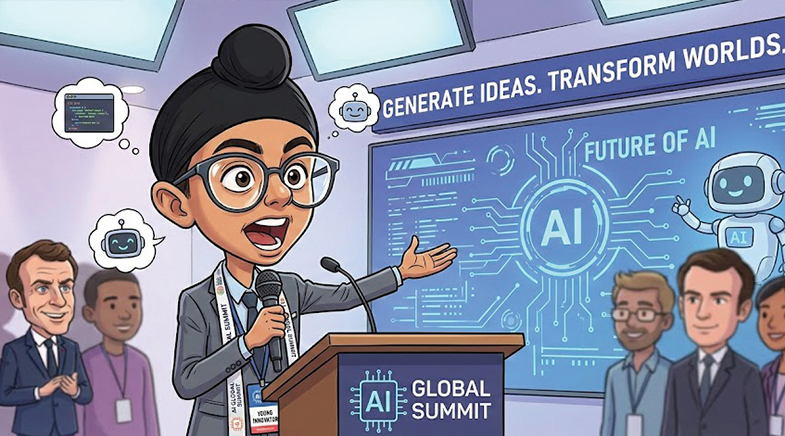
Bill Gates didn't give his keynote address, but a pocket-sized speaker's keynote had the audience enthralled. Ranvir Sachdeva, an eight-year-old coder, spoke on "I to the Power of AI". His voice is years away from breaking, but little Sachdeva has already broken a few records, including being the youngest person invited to the 2024 United Nations General Assembly Summit of the Future. Sachdeva, who is said to have been coding since he was three, has also authored a book titled Are You Born with AI?
*****
China could have been the elephant in the room, not sending a delegation because it was the Chinese New Year holiday. Except that a Made-in-China robot-dog became the star attraction at the expo, when an overenthusiastic faculty member of Galgotias University from Greater Noida claimed the doggy was homemade. The red-faced organisers promptly asked the university to vacate, but the damage was done. For the rest of the summit, the vast, empty kiosk remained a much-visited spot. It didn't help matters when an investigation revealed that the university kiosk was larger than the combined space allotted to four Indian Institutes of Technology and a research institute in that hall.
Galgotias, meanwhile, may become a verb. At the Bihar State pavilion, representatives of NeoGenTech, a start-up from Patna, went blue in the face telling visitors that they were "not pulling a Galgotias". The pretty humanoid standing there was (in)completely Made in Bihar — there is still work left on her legs. Otherwise, the humanoid can make hand and face gestures, and speak in several regional and foreign languages, including, well, Mandarin.
*****
The summit has brought in an entirely new lexicon. It may, for instance, no longer be enough to talk sagely about AI; you need to be certain that AI is indeed Sovereign AI. It is entirely another matter that what constitutes Sovereign AI is open to interpretation. The previously colonised Global South is wary of falling into a new colonial trap unless AI is trained on regional ethos, language and data, thus upholding Atmanirbharta, never mind if it means re-inventing the wheel. Michael Kratsios, head of the U.S. delegation at the summit, had a different — and entirely American — take. He famously said that while complete technological self-containment was unrealistic, real sovereign AI meant owning and using the best-in-class technology. Which is, yes, you guessed right, Made in America.
*****
India Inc. displayed a range of products developed by training AI models for a linguistically diverse population. Bengaluru-based start-up Sarvam AI showcased two models: Sarvam-30B, trained on 30 billion parameters and designed for real-time multilingual conversational tasks, and Sarvam-105B, trained on 105 billion parameters and suitable for complex reasoning, understanding long documents, and enterprise applications. Indian Institute of Technology (IIT) Bombay's Bharatgen Param 2, trained on 17 billion parameters, works on 22 Indian languages and is designed for use in governance, healthcare, agriculture and education. Other indigenous products on display were those from Gnani.ai, Soket AI Labs, Gan.AI, Avataar, and Genloop.
PM Modi did a photo-op with Kaze, Sarvam's AI-powered voice-and-vision smart glasses. These spectacles enable the wearer to understand surroundings, translate languages, and interact hands-free in real time. There was a good range of eyewear, with Jio showcasing its AI-features-enabled JioFrames, and the Ministry of Tourism displaying AI-powered wearables for heritage appreciation.
*****
Data is king, they say. Keeping data secure is a pressing enough concern. Add to it the issue of sustainability, and data storage is throwing up new challenges. Indian start-up NeevCloud has decided to take on the space challenge and is packing up its data centre infrastructure, including GPUs and servers, to launch later this year on board a rocket from Agnikul Cosmos, an IIT Madras start-up known for its 3D-printed rockets. Since 2025, only a few organisations have deployed small data centres in orbit. With solar energy to power the data centres and passive radiative cooling for thermal regulation, space storage offers tantalising benefits, in theory at least. But how the operator will fix a problem at the data centre and how it will shield the data centre from cosmic wrath are issues to ponder.
*****
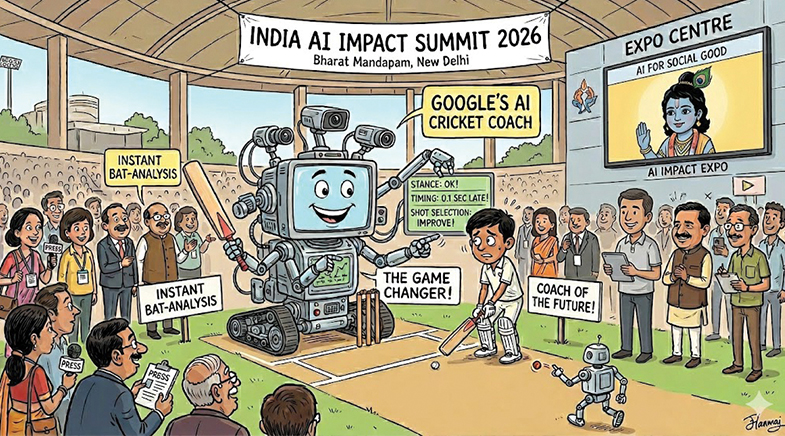
Artificial intelligence is essentially software. Even its hardware components, such as GPUs and VRAM, aren't exactly crowd-pullers. So most pavilions at the expo used baits such as robots and holograms to draw visitors. Jio Intelligence's holograms of Lord Krishna and Arjuna were a hit. The company also showcased how the AI-powered OTT series, Mahabharat: Ek Dharmayudh, was made. The Google pavilion scored a sixer in cricket-crazy India by setting up a simulated pitch where people could bat, bowl, and receive feedback from a real-time AI coach. Booths where people could have their speech translated into another language, in their own voice, also drew visitors. The knowledgeable may have looked askance at the granddad, who, with his little grandson, was asking people, "Robot kahan hai? (where are the robots?)". But let's not forget the two braved the chaotic traffic and crowds to spend a day at this venue to see something new. And that, certainly, is the road to deep learning.








Red alert!
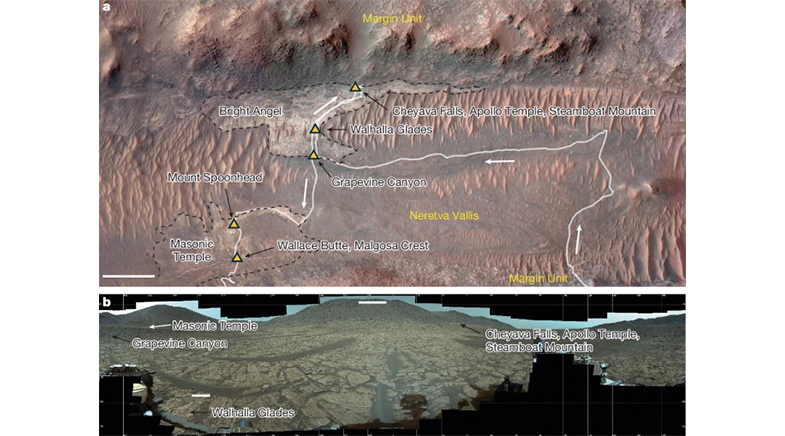
Are the 'leopard spots' on Mars signs of ancient life? Time will tell.


Have a
story idea?
Tell us.
Do you have a recent research paper or an idea for a science/technology-themed article that you'd like to tell us about?
GET IN TOUCH