

Window to the world
-
- from Shaastra :: vol 05 issue 01 :: Jan 2026
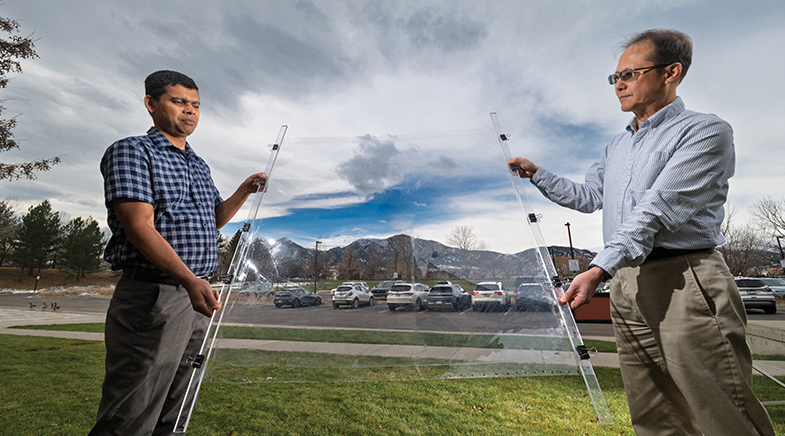
A transparent and heat-insulating material may serve critical sectors.
Eldho Abraham was a graduate student when he realised his interest lay in developing novel nanomaterials with diverse applications. As a PhD student at Mahatma Gandhi University in Kottayam, Kerala, he began extracting nanomaterials from cellulose and exploring their potential applications in nanocomposites. This fascination with cellulose-based nanomaterials led him to the laboratory of Oded Shoseyov, Professor of Protein Engineering and Nanobiotechnology at The Hebrew University of Jerusalem, where, as a postdoctoral scholar, he synthesised water-repelling and oil-absorbing aerogels — cellulose-based highly porous structures that could be used to tackle oil spills or oil-water separation in industry.
A turning point in Abraham's life came in 2017, four years after his PhD. His expertise with cellulose-based aerogels landed him another postdoc position: this one at the lab of Ivan I. Smalyukh, Professor of Soft Matter Physics at the University of Colorado Boulder. Currently a Senior Scientist in Smalyukh's lab, Abraham is part of a team that has developed a highly energy-efficient metamaterial that may be used in areas ranging from building windows to defence and aviation.
Tests show that MOCHI achieves 99% optical transparency — higher than conventional glass.
When Abraham joined Colorado Boulder, Smalyukh — who had won a U.S. Department of Energy (DoE) project to develop thermally insulating, sustainable window technologies — was putting together a team of young researchers to help achieve the project's ambitious research goals. The focus of DoE then was to reduce energy loss in modern buildings, which consume nearly 40% of the energy produced worldwide to maintain a comfortable temperature range and provide lighting. The buildings are thermally insulated from the outside environment through their walls, but the transparent windows let heat and light flow in and out.
Windows may constitute only one-tenth of the exteriors of buildings, but they leak as much as 30% of a building's heating or cooling energy. The DoE estimates that cumulative energy loss through windows in the U.S. accounts for 5% of total energy consumption, resulting in an annual cost of around $40 billion.
For the DoE project aimed at plugging this loss, Smalyukh's team developed thermally insulating aerogel films by extracting nanocellulose from bacterial and wood sources, thereby improving a building's thermal insulation. The new material, which the scientists showed can be produced cost-effectively in bulk, has a visible-range (800 nm-400 nm) light transmission of 97-99%, better than that of glass, and a thermal conductivity lower than that of still air (bit.ly/Building-Glazing).
The technology enabling the production of this window-insulation material, which can be retrofitted at about $1 per square foot, has been patented. A start-up, in which Abraham is a partner, has bought the patent from the university to commercialise the technology.
NEED FOR TRANSPARENCY
"While the project met all milestones put in place by DoE, we felt that transparency could be further improved," Abraham says. So, the team synthesised what was supposedly the most transparent material in the world, using inorganic polysiloxane (silicone) instead of cellulose, with a visible-range transmittance rate above 99%, compared to a maximum of 92% even in 'extra clear' glass. The material, known as a Mesoporous Optically Clear Heat Insulator (MOCHI), can be fabricated as thick panels or as thin sheets to be attached to the interior surface of windows. At present, MOCHI is produced only in laboratory settings and is not yet commercially available. However, durability tests show that it achieves about 99% optical transparency — significantly higher than conventional glass.
The metamaterial, reported in a December 2025 issue of Science (bit.ly/Window-Coating), is based on a silicone gel with a unique internal architecture. Embedded within the gel is a dense network of microscopic pores with diameters ranging from 2 to 50 nanometres (1 nanometre is one-billionth of a metre). "Such materials are extremely rare in the field of transparent aerogels," says Abraham, one of the key authors of the Science study.
MOCHI's key properties — optical transparency, thermal insulation, and mechanical durability — are significantly superior to those of cellulose-based aerogels, including earlier versions developed by the same research group.
DUAL ROLE
It isn't easy to achieve both heat insulation and optical transparency. Heat transport in solids can be suppressed by phonon scattering (quasiparticles associated with lattice vibrations), by increasing thermal resistance at interfaces, or by introducing microscopic pores. However, these mechanisms often scatter visible light, producing a haze. Aerogels were once considered promising candidates for window insulation due to their low density and thermal conductivity. Yet large variations in pore size and shape led to significant light scattering and structural fragility, preventing their large-scale adoption for window applications.
Overcoming this challenge requires precise structural control across multiple length scales —from nanometres to centimetres — while maintaining chemical and mechanical stability under real-world operating conditions. This is precisely what the Colorado Boulder team appears to have achieved.
Given its flexibility, ultra-thin profile, high transparency, and thermal-insulation properties, MOCHI has a wide range of potential applications.
The researchers synthesised the metamaterial using a self-templating process in which surfactant molecules assemble into interconnected networks of cylindrical micelles: tiny clusters of molecules with both water-absorbing and water-repelling components. This process leads to the formation of silicone gel precursors with two distinct, interpenetrating networks of silicone nanotubes.
Because all characteristic dimensions of these nanotubes are smaller than both the wavelength of visible light and the mean free path of air molecules, the material allows nearly 99% of visible light to pass through while effectively blocking heat transfer. This observation was highlighted by Longnan Li and Wei Li of the Changchun Institute of Optics, Fine Mechanics and Physics in China, in a commentary published alongside the Science paper.
When used as a filler between two glass panes, the material demonstrated a thermal resistance of 2.64 m² K W⁻¹ — comparable to that of conventional wall insulation — while being thinner than standard double-pane windows. Thermal insulation is commonly expressed in terms of R-values. Typical exterior walls have R-values ranging from R-13 to R-23, with higher values indicating better insulation. Windows incorporating MOCHI achieve an R-value of approximately 20, an exceptionally high figure for transparent materials.
According to Abraham, techno-economic analyses suggest that a 3-millimetre-thick version of the material, with air-filled internal spaces, could be produced at roughly ₹100 per square foot. This means that a standard-sized window could be retrofitted for about ₹500.
Given its flexibility, ultra-thin profile, high transparency, and excellent thermal-insulation properties, the material has a wide range of potential applications, Abraham notes. These include possible uses in aviation and space exploration, where instruments and equipment must be protected from extreme thermal environments.
ULTRA COOL
While MOCHI's thermal resistance is impressive, other research groups have reported even more extraordinary transparent cooling materials. In July 2024, researchers from China's Sichuan University attracted widespread attention — and some scepticism — when they claimed to have developed a "photoluminescent" material with a solar reflectance of 104% that could reduce ambient temperatures by up to 16°C. The researchers, led by Hai-Bo Zhao, a polymer chemist, reported that their aerogel-like material was made from gelatin and DNA extracted from salmon sperm in Science (bit.ly/Cooling-Aerogel).
The scientists claimed that the chemical reaction produced by mixing gelatin and DNA gave the material a natural fluorescent property, increasing its ability to reflect light. This mechanism, they argued, boosts visible-light reflectance beyond 100% and delivers large-scale cooling.
The material can be used to create planks that could act as passive cooling materials, helping reduce the need for energy-hungry cooling methods for air conditioning and refrigeration. Under high solar irradiance, the material can lower ambient temperatures by as much as 16°C (under cloudy sky conditions, 5.7°C).
Changyu Shen and Xianhu Liu of Zhengzhou University in China, in a review in Science (bit.ly/DNA-Gelatin), felt that the aerogel may be a potential passive radiative cooling material, but is unstable and has poor resistance to weather. Quoting the Sichuan researchers' data, they said the material's degradation rate exceeds 85% after 45 days, whereas ceramic coolers currently in use last much longer and withstand harsh environmental conditions. However, the polymeric aerogel has several other advantages. It is biodegradable, recyclable, and even self-healing, vital features for a sustainable material.
Abraham says the field is at a very nascent stage of development globally at present. "One can easily think of hundreds of potential applications," he says.
Pradip K. Maji, Professor in the Department of Polymer Science and Technology at the Indian Institute of Technology Roorkee, believes that Smalyukh and his team's achievement is "quite remarkable". Maji, who has been following the team's work, adds that the applications can go far beyond glazing. Many critical areas, such as defence technologies, aerodynamics and space exploration, can benefit from this, he says.










A green light for energy transition
India has to take a multi-pronged path, embracing technology and alternative power sources, to meet its future energy needs.

Brain-inspired chips
Neuromorphic computing won't replace today's AI hardware overnight, but the pressure to find an alternative is growing.



Have a
story idea?
Tell us.
Do you have a recent research paper or an idea for a science/technology-themed article that you'd like to tell us about?
GET IN TOUCH