

World of research: August 2026
-
- from Shaastra :: vol 05 issue 08 :: Aug 2026

A round-up of some recent striking studies.
TWO IN ONE
Standard optical fibre carries entangled particles and regular internet data.
Quantum networks of the future could be built without creating separate channels for their communication. Researchers led by Prem Kumar, quantum physicist at Northwestern University, U.S., showcased this possibility (bit.ly/Q-internet) when they used standard optical fibre to send an entangled pair of photons along with 36 terabits of conventional internet data per second over a 24.4-kilometre distance connecting Evanston and Chicago. Their study showed that entanglement-based quantum communication and high-capacity, commercial-scale data traffic could coexist in real-world telecommunications network.
"We didn't do anything to change the classical system. That operated exactly as it would in commercial communications infrastructure," says Gina Talcott, researcher and lead author of the study.
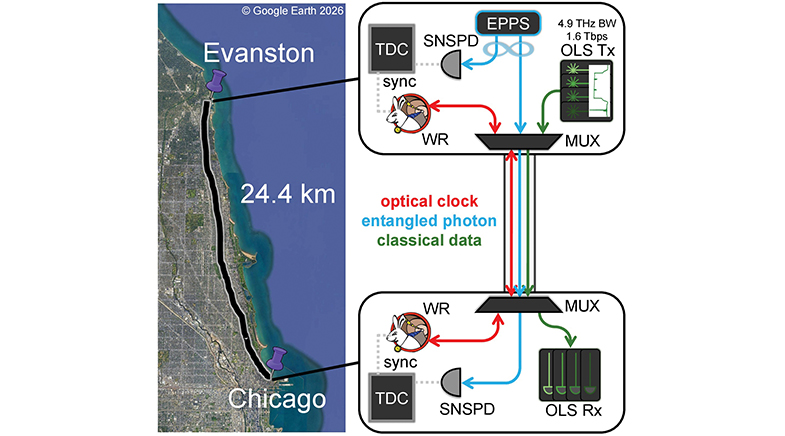
Kumar's group has been working on the coexistence of classical and quantum data for a long time. They had shown that simple quantum states could coexist with classical communication signals. But whether the more fragile quantum entanglement could survive in the noisy environment was unknown. "Our motivation is to interconnect quantum resources, whether they are sensing elements, computing elements, or memory elements," says Kumar.
The background noise of powerful internet signals proved a challenge. Instead of changing the existing communication system, they redesigned the quantum system by transmitting entangled photons at a different wavelength from that used for regular internet traffic. The team also used highly selective optical filters and extremely precise timing measurements to remove the remaining stray photons, thereby allowing the detection of genuine entangled photons.
Kumar's team also collaborates with researchers at Fermilab in the U.S. — one of the world's leading particle physics research laboratories — to develop interconnected quantum sensors to detect the presence of dark matter.
"Quantum communication is still in its early stages, and many of its most promising applications are yet to be realised," says Talcott. The technology could eventually support distributed quantum computing, long-distance quantum communication, quantum sensing and, ultimately, quantum internet, she adds.
The research team is working on technologies to build large-scale quantum networks. Among them is a "quantum wrapper protocol" in which each quantum signal is accompanied by a small classical signal carrying information such as timing and routing. It could help manage the network without disturbing the fragile quantum information. "The next step is to connect real quantum devices such as quantum memories, which would bring distributed quantum computing and a practical quantum internet closer to reality," says Kumar.
YOUNG BODY, YOUNG MIND
Blocking an immune cell receptor helps limit ageing.
Arresting ageing may not be the stuff of dreams for long. New research by scientists from Stanford University, U.S., and Germany's University of Münster has linked immune cells to ageing. Their study shows that blocking the function of an immune cell receptor can curb inflammation and reverse ageing in multiple organs of mice.
Immune cells guard the body against infections. While the body continuously produces them to combat attacks, some, like the neutrophils, live only for a few hours. Dead neutrophils need to be cleared from the system, and the task falls upon tissue-resident macrophages, another class of immune cells. However, as we age, macrophages lose efficiency and dead neutrophils pile up in cells, causing chronic inflammation and tissue damage. Different organs react differently to this accumulation; the brain experiences cognitive decline and memory loss, while the build-up scars the heart and reduces pumping efficiency. The dead cells cause muscle loss and frailty.
The crosstalk between tissue-resident macrophages and neutrophils breaks down in humans as they age.
Researchers showed in the study published in Science (bit.ly/Immune-cells-ageing) that as the body ages, EP2 — a receptor present on tissue-resident macrophages — becomes overactive, disrupting the ability to clear dead neutrophils. To prove their finding, they created mice without the receptor gene and compared them with normal mice as they aged. The mice with the missing receptor had better memory and heart function, less cognitive decline, lower stress, a leaner body, higher strength, and healthy biomarkers in the blood. Targeting the receptor through a drug in aged mice reduced the level of dead neutrophils in the body, that is, restoration of the macrophage function.
Scientists studied datasets in a bid to extend the finding to humans; the mechanism of immune cell clearing, they found, is conserved in humans as well. Also, the EP2 receptor was found to be overactive in ageing heart and liver datasets, while ageing organs displayed an accumulation of dead neutrophils. Through advanced computer modelling, the researchers showed that crosstalk between tissue-resident macrophages and neutrophils breaks down in humans as they age. This toxic build-up was found in cases of liver injury, obesity and cancer in humans, hinting that the cleaning mechanism, when disrupted, can cause disease.
Future studies, the team suggests, should assess whether the impaired clearance of senescent neutrophils occurs in human tissue-resident macrophages, and if drugs that block EP2 receptors can restore the defect. If it works, age will remain just a number.
LOST IN TIME
Global language diversity has shrunk over millennia.
Around 7,500 languages are spoken across the world today, a significantly diminished number compared to 1,000-3,000 years ago when humans spoke as many as 20,000-75,000 languages. A study (bit.ly/linguistic-diversity) by a trans-national group of researchers, published in Science, used computational modelling tools to understand the changes in linguistic diversity since the Holocene began around 12,000 years ago.
Humans spoke approximately 4,500-6,200 languages at the beginning of the Holocene. As population grew, so did the spoken languages, and it peaked around 1,000-3,000 years ago, a time frame researchers call the golden age of language diversity. But linguistic diversity suffered an "exceptionally rapid collapse" over the next two millennia when expanding societies kept replacing smaller language communities.
The researchers developed a computational model using ethnographic data from 171 contemporary hunter-gatherer groups as a proxy for early human populations. Members within the groups shared the same language and culture, quite like the hunter-gatherer groups of the early Holocene, leading researchers to the assumption that each group represented a single language in the early Holocene. The model then used the estimates of ancient global population to infer the likely number of languages in the early Holocene. Languages kept pace as the population and number of groups grew, but failed to do so after a point. As technological innovation, agriculture, and availability of stable food increased, societies grew, and many groups ended up sharing the same language.
The team examined multiple trajectories of possible changes in linguistic diversity across millennia, and irrespective of the trajectory, they found that language diversity declined about two millennia ago. According to them, modern-day language diversity is not an unbiased representation of past languages, but an imprint of those that survived the decline.
Loss of language diversity, however, is not a stand-alone phenomenon; the number of languages prevalent in the present and the early Holocene is similar. Over the past 500 years, "a large systematic decrease in linguistic diversity, in parallel with the spread of a handful of behemoth languages, such as English, Spanish, Mandarin, Arabic, and Hindi, has continued", observe the researchers. Half of the world's languages are endangered, and about four disappear every year. "This results in the loss of cultural and scientific knowledge embedded in minority languages and contributes to the unequal development in science, technology, medicine, and education that predominantly benefits speakers of the world's largest languages," they add.








Science Revision
When India begins a new research foundation, it is useful to revisit the model that inspired it.

The nutrition paradox
Malnutrition is, of course, acute in low-income countries. But even in affluent countries, dietary choices impact health.
India Inc on 'Net Zero' path
For India to realise its emissions commitment, industry will need to step up. It appears that companies are taking the lead.



Have a
story idea?
Tell us.
Do you have a recent research paper or an idea for a science/technology-themed article that you'd like to tell us about?
GET IN TOUCH