

Age is a number, but now revised
-
- from Shaastra :: vol 05 issue 11 :: Nov 2026
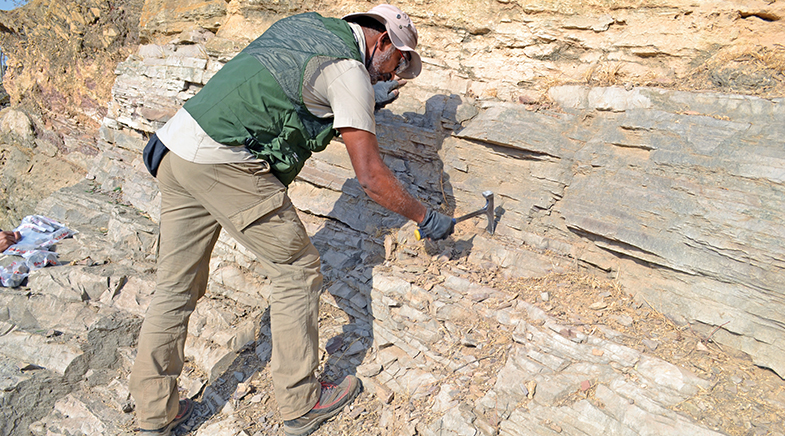
Microfossils in India's Vindhyan Basin help reconstruct the Earth's past.
The crescent-shaped Vindhyan Basin, spanning several Indian States, is known for its rich mineral deposits, including limestone and sandstone. For palaeontologists, the basin's ancient rocks are a goldmine, unravelling the mysteries of early life on Earth.
Indian and Chinese researchers recently studied the basin's rocks to date the origin of shell-forming single-celled complex organisms using a new dating methodology. They found that the organisms originated about 969 million years old, considerably older than the earlier estimate of 750–800 million years. The study also shows that the basin stopped accumulating sediments 969 million years ago, and not 600 million years ago as previously thought. By providing a revised age for the complex organisms and the basin, the study, published in Gondwana Research (bit.ly/vindhyan-basin), helps reconstruct the Earth's past.
The team, led by Santosh Kumar Pandey of the Lucknow-based Birbal Sahni Institute of Palaeosciences, dated the layered rocks formed by these ancient, vase-shaped microfossils (VSMs). These single-celled amoebas could not produce their own food and instead ingested organisms or organic matter. The microbes built armoured shells around themselves to escape predation and survive harsh environmental conditions on Earth. The VSMs thus mark a significant period: the shift from photosynthetic organisms to predator-driven food webs.
The VSMs mark a significant period: the shift from photosynthetic organisms to predator-driven food webs.
Geologists generally date sedimentary rocks by measuring the age of volcanic ash in them. However, the Vindhyan Basin limestone has no ash layers. So, the team used an image-guided, laser-ablation calcite uranium-lead dating method. They first looked for calcite in these rocky structures, as calcite contains tiny amounts of uranium. They fired the laser to measure the uranium decaying into lead. As this occurs at a predictable rate, the ratio of the two gives an estimate of when the rocky structure was formed. "This dating technique always gives you an absolute age," says Pandey. Based on the uranium-to-lead ratio, the scientist concluded the limestone was 969 million years old, plus or minus 26 million years, as were the shell-forming single-celled complex organisms.
"The oldest VSM record till now was around 750 million years ago, so we have pushed the evolutionary history of these organisms to approximately 1,000 million years ago," Pandey says. By comparing them with fossils from other regions of the world, the study also disproves the long-held assumption that these organisms increased in size throughout evolutionary history.



Building blocks
Nick Lane's book shines a light on the energy cycle that all organisms use and on puzzles such as the origin of life.



Have a
story idea?
Tell us.
Do you have a recent research paper or an idea for a science/technology-themed article that you'd like to tell us about?
GET IN TOUCH