

Catching carbon, deftly
-
- from Shaastra :: vol 05 issue 11 :: Nov 2026
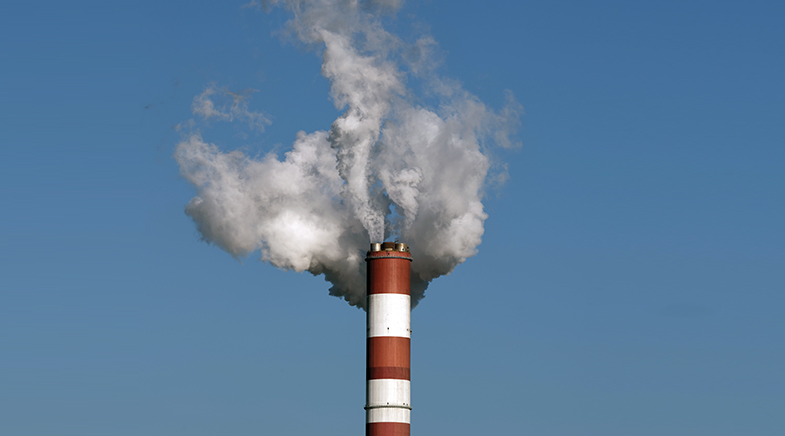
A new membrane distinguishes between CO2 and N2.
Capturing carbon dioxide (CO2) — released by power plants, cement factories, steel plants, and other industries — before it enters the atmosphere is a major climate goal. Industrial exhaust gases, commonly called flue gases, contain a mixture of gases, predominantly nitrogen (N2), along with CO2. Carbon is often captured with a membrane, a thin material that works like a very selective sieve, letting CO2 through faster than nitrogen. Membranes also use little energy and take up little space.
Now, researchers at the Indian Institute of Science Education and Research (IISER) Bhopal have designed a membrane made of hollow straws from a plastic called polyacrylonitrile, mixed with graphene. Akshay Modi, an Assistant Professor of Chemical Engineering at IISER Bhopal, and his student Animesh Jana have reported their work in ACS Applied Engineering Materials (bit.ly/hollow-fibre).
For the study, the scientists modified graphene's surface chemistry to see whether it would improve the membrane's ability to distinguish between CO2 and N2. In addition to ordinary graphene, they tested three other graphene variants with additional surface functionalisation — graphene carrying amine, hydroxyl, and carboxyl groups. Their experiments showed that the graphene variant with hydroxyl groups performed better than the others because its — OH groups bond well with plastic, helping the graphene spread evenly rather than clumping. Plain graphene performed the worst.
Over 15 times more CO2 passed through the optimised membrane than N2.
The team, which also tested different concentrations of hydroxyl-functionalised graphene, found that the performance was best at 0.1% by weight. The optimised membrane had very high selectivity for CO2; over 15 times more CO2 passed through the membrane than N2.
A problem with polymer membranes is plasticisation — that is, prolonged exposure to CO2, particularly at elevated pressures, causes them to swell or change their internal structure. Such changes can eventually reduce the membrane's ability to separate gases.
"We let the membrane run for 60 days continuously, but there was no deterioration in its performance,” Modi says. However, the test was conducted with simulated gas. Real flue gas is hot, wet, and contains impurities such as sulphur compounds that can damage membranes.
The study offers a materials-engineering strategy that could help create more efficient, compact systems for capturing CO2 from industrial emissions. However, its commercial potential will depend on its ability to scale up, long-term durability, and economics. The team will now test the membrane for longer durations with compositions similar to the flue gas.



Too vast to last
Fresh energy across a galaxy cluster may keep its giant glow alive.


When data hits the bull's eye
Data analytics is helping sportspersons sharpen their skills and selectors scout for talent.



Have a
story idea?
Tell us.
Do you have a recent research paper or an idea for a science/technology-themed article that you'd like to tell us about?
GET IN TOUCH