

Too vast to last
-
- from Shaastra :: vol 05 issue 02 :: Feb 2026
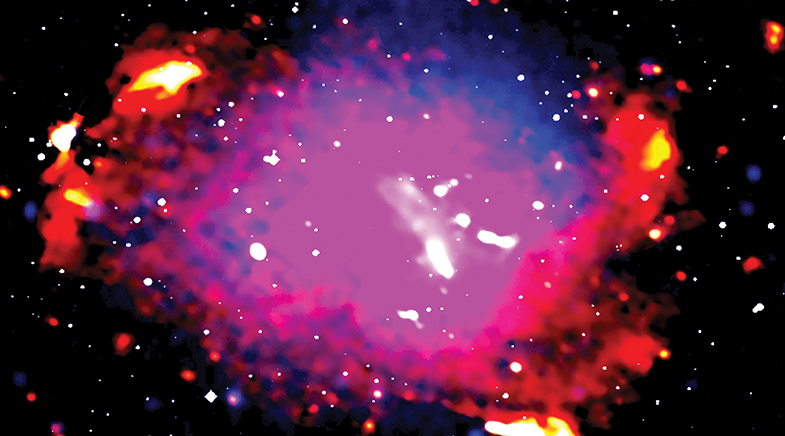
Fresh energy across a galaxy cluster may keep its giant glow alive.
About five billion light-years from Earth lies a titanic collection of several thousand galaxies bound by their mutual gravitational attraction. Known as the Abell 2163 cluster, it is among the most extreme regions in the universe. Such clusters occasionally collide and merge, causing dense clouds of superheated gas to slam into each other at thousands of kilometres per second. These collisions drive shock waves that heat the gas between the galaxies to tens of millions of degrees, creating a plasma whose electrons, accelerated near the speed of light, emit radio waves and X-rays.
Three years ago, Ruta Kale, a faculty member at the National Centre for Radio Astrophysics (NCRA) in Pune, asked research scholar Ramananda Santra to turn his attention to Abell 2163 to study the radio emissions produced by electrons moving through magnetic fields across the cluster. Over several weeks, Santra measured the strengths and patterns of those emissions using the array of thirty 45-metre parabolic dish antennas now known as the upgraded Giant Metrewave Radio Telescope (uGMRT), located near Narayangaon, about 80 kilometres north of Pune.
"Abell 2163 is a cosmic laboratory for studying matter under extreme conditions," says Santra. "By studying such clusters, we hope to gain fresh insights into how galaxies interact, how energy gets transported across the full cluster, and how intensely hot plasma behaves."
What makes Abell 2163 especially compelling is the sheer scale of that transport. Using low-frequency radio observations with the uGMRT, the NCRA team, along with collaborators in Italy and the United States, found that the radio emissions stretch across the entire cluster, over nearly 10 million light-years (bit.ly/Second-Largest). That makes Abell 2163 the second-largest known radio source associated with a galaxy cluster, surpassed by the Abell 2255 cluster, which spans roughly 16 million light-years.
PAST ISSUES - Free to Read
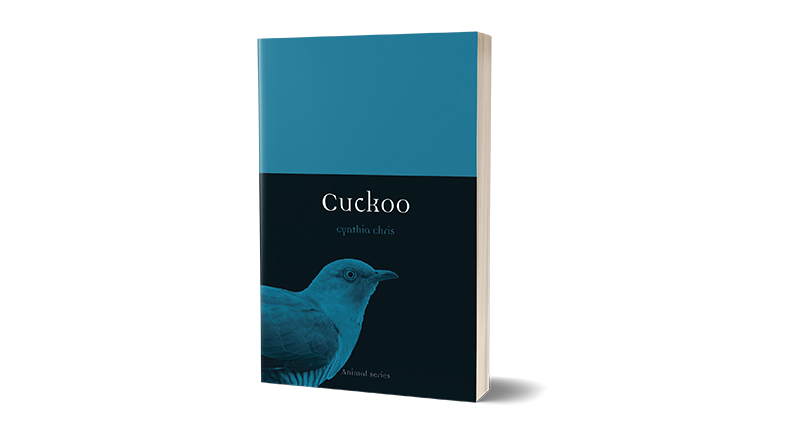








Going cuckoo!
The natural and cultural history of a mesmerising bird.
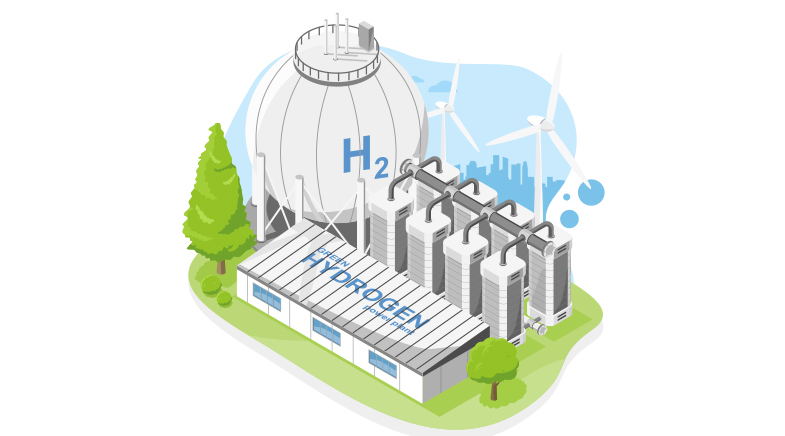
The H factor
Hydrogen is moving from pilot projects to industrial deployment, testing if it can deliver on its promise.

The big biometrics shift
Biometrics technology promises greater security, but it also raises troubling questions.

Have a
story idea?
Tell us.
Do you have a recent research paper or an idea for a science/technology-themed article that you'd like to tell us about?
GET IN TOUCH