

Getting the right signal
-
- from Shaastra :: vol 05 issue 11 :: Nov 2026
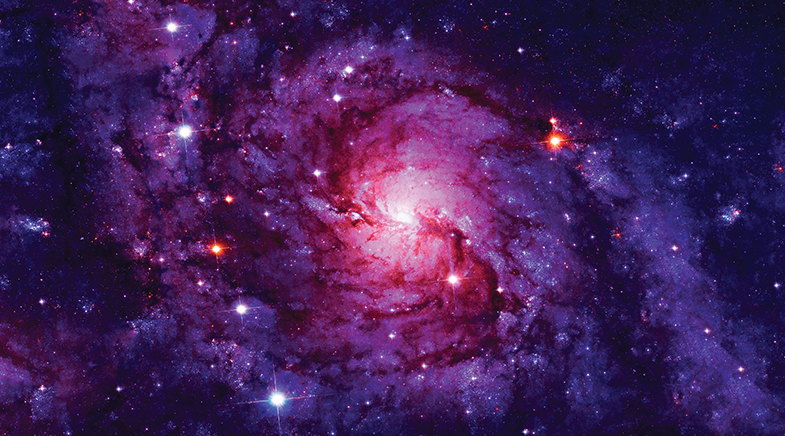
H1 line from distant galaxies throws light on star formation.
Using a giant radio telescope located nearly 80 kilometres north of Pune, a group of astrophysicists has detected the H1 21-centimetre line in very distant galaxies, nearly 8 billion light-years away (bit.ly/distant-galaxies). The spectral line is an astronomical clue to star formation, measuring the average amount of hydrogen present at that distance.
"If you observe the oldest galaxies and then come to the present, you can ask the question: what is the star-formation-rate density," says Balpreet Kaur, the first author and a postdoctoral scholar at the National Centre for Radio Astrophysics (NCRA-TIFR), Pune. This first increases, peaks around 8–9 billion years ago, and then starts to decrease. "We have studied the stars at the time of this peak," she says. Why this declined after that epoch is an important open question in astronomy, she adds.
This is the second such detection ever. The first, in 2018, was also by the NCRA-TIFR, but focused on a patch of the sky called Deep 2. The present study focuses on the COSMOS patch. "The COSMOS results validate the Deep 2 one... It's good to confirm it by observing a totally different part of the sky," says NCRA-TIFR astrophysicist Nissim Kanekar, who was a part of both teams.
Within one billion years, the hydrogen mass of galaxies had fallen by a factor of three.
The study requires inputs of accurate redshifts of the component galaxies — or, equivalently, their distances from Earth. In 2018, Kanekar, along with another NCRA-TIFR faculty member Jayaram Chengalur and his PhD student Aditya Chowdhury, detected the average 21-centimetre signal at these redshifts. The study was published in Nature in 2020. "This was the very first time it has been detected at these redshifts," says Kanekar. Just within one billion years, the hydrogen mass of galaxies had fallen steeply, by a factor of three, they found. "This was astonishing and never seen before."
This led to Kaur's work in the COSMOS field, using the Giant Metrewave Radio Telescope array. "The reason to go to COSMOS was also that we can go one step further… see how the H1 properties depend on morphology (the type of galaxy)," he adds. There is also the possibility of studying single galaxies in detail, he says.
Mayuri Rao, an astrophysicist at the Raman Research Institute, Bengaluru, describes it as a "difficult" problem. "The team has done a great job," she says.


How AI keeps our roads safe
Researchers are leveraging AI and data science to make Indian roads safer.

For the long haul
Efforts at building quantum computers and communications are taking root in India, overcoming the struggles of the early movers in the field.

Where engineering meets medicine
Our Cover Story package continues the pattern of picking up paradigm shifts that will produce lasting change in our lives.



Have a
story idea?
Tell us.
Do you have a recent research paper or an idea for a science/technology-themed article that you'd like to tell us about?
GET IN TOUCH