

Light in the dark
-
- from Shaastra :: vol 04 issue 11 :: Dec 2025
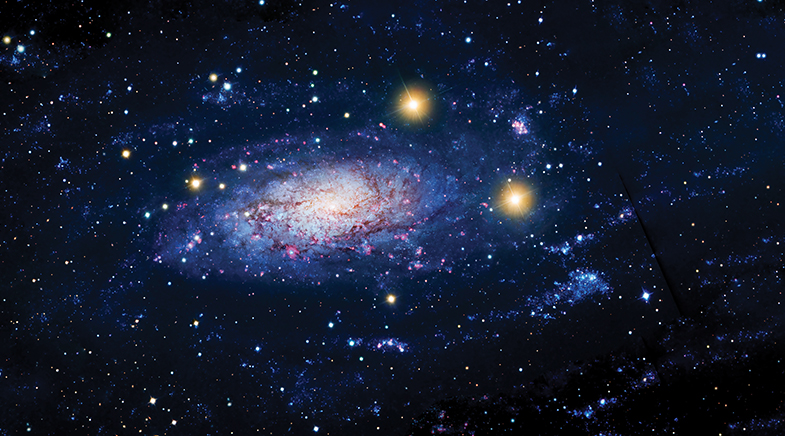
Has a researcher detected dark matter in the Milky Way?
Theoretical astrophysicist Tomonori Totani noticed something unusual while analysing the gamma-ray data from the Fermi gamma-ray telescope in August 2024 in his lab in Tokyo. Some regions of the sky appeared brighter in gamma rays than the models predicted, and known astrophysical sources could not explain the excess. "I wondered if this extra signal could be coming from dark matter," says Totani, who teaches at the University of Tokyo. If his hunch was right, it would be the first direct evidence of dark matter.
Totani writes in a recent paper (bit.ly/darkmatter-wimp) that he might have detected dark matter that lies at the heart of the Milky Way galaxy. Dark matter — dark because it does not emit light — does not interact with other particles in the universe, and is thus elusive. Yet, it dominates the universe: there is over six times more dark matter than the matter that makes up stars, planets, and everything in the visible universe.
Since dark matter should be densest at the Milky Way's centre, Totani examined that region. He found the gamma-ray excess growing toward the centre and forming a halo-like pattern, unlike the flat disc pattern of known cosmic sources. This shape matched what scientists expected from the galaxy's dark-matter halo.

Totani also saw that the gamma-ray energy peaked sharply around 20 GeV, unlike the broader spectra produced by cosmic processes. Such a sharp peak is a possible signature of dark-matter annihilation: when two dark-matter particles collide, they destroy each other and release energy as gamma rays.
"This result is certainly very interesting and encouraging for those searching for particle dark matter in the universe. However, the possibility of an astrophysical explanation (other than dark matter) cannot be ruled out," says Sourov Roy, an astrophysicist at the Indian Association for the Cultivation of Science, Kolkata.
Together, these clues support the idea that dark matter may be made of Weakly Interacting Massive Particles, or WIMPs. These heavy, invisible particles can occasionally annihilate themselves, producing gamma rays. In the paper, Totani suggests that his findings match several WIMP predictions. He adds that scientists need to detect similar WIMP-like signals from other regions or galaxies before they can confirm dark-matter annihilation.
"It needs further confirmation from independent groups analysing the Fermi dataset," says Ranjan Laha, an astroparticle physicist at the Indian Institute of Science, Bengaluru. "The study implies that we are starting to probe deeper into our understanding of the nature of dark matter, but we have not yet found it. The community has been working hard on discovering the nature of dark matter, and I am sure that a positive signal will be discovered soon," he adds.









Computers come alive
Fungal bodies may help make analogue computers one day.

The learning curve
The ability to learn and their utility as tools for thinking give neural networks and Artificial Intelligence their unique place in human history.




Have a
story idea?
Tell us.
Do you have a recent research paper or an idea for a science/technology-themed article that you'd like to tell us about?
GET IN TOUCH