

Light, water and motion
-
- from Shaastra :: vol 05 issue 07 :: Jul 2026
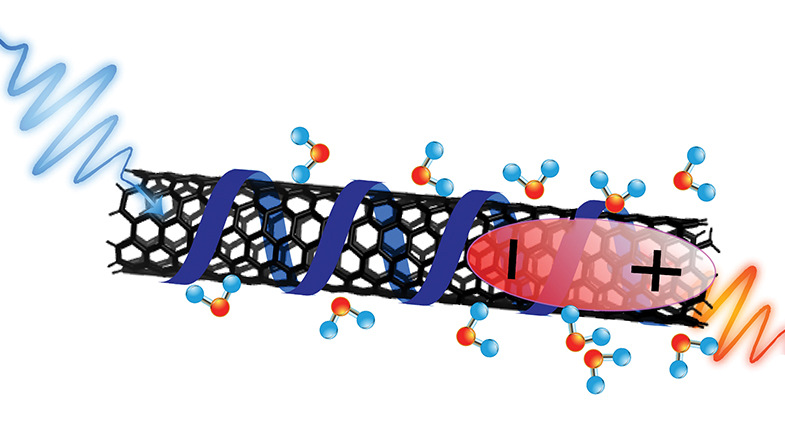
Carbon nanotubes exhibit light-induced quantum friction in water.
In a scientific observation that would seem counterintuitive, a team of Indian and German researchers has discovered that light can slow down movements in the nanoworld. In normal conditions, light is expected to heat particles or set them in motion. However, the researchers, who conducted experiments with fluorescent carbon nanotubes, found, to their surprise, that they moved more slowly when irradiated with light.
"This was totally unexpected," says Krishan Kanhaiya, Assistant Professor at the Indian Institute of Technology Hyderabad. With Amity University's Tanuja Kistwal, Kanhaiya was the first author of the team's study published in Nature (bit.ly/quantum-friction). The two were postdoctoral researchers at Ruhr University Bochum in Germany when the study was conducted. It was led by an interdisciplinary team comprising three Ruhr University professors: Sebastian Kruss, Marialore Sulpizi, and Martina Havenith.
The discovery shows that the boundaries between solids and liquids blur at the nano-level.
Particles drift randomly in water jostled by water molecules in all directions due to what is known as Brownian motion. The scientists found that when these are tiny, semiconducting nanoparticles, such as single-walled carbon nanotubes, a quantum phenomenon kicks in. The team examined the movement of the nanotubes under a microscope. Once the tubes were excited via light, they behaved as though the surrounding water had suddenly become more viscous. "Since these are semiconducting nanotubes, they will generate excitons — electronic excitations that lead to the fluorescence — which interact with the surrounding water molecules to decelerate their movement," Kanhaiya says.
When the team introduced deliberate defects in the nanotube's crystal structure — tiny chemical imperfections that trap the exciton in place and stop it from travelling — the light no longer slowed the nanotube. A trapped, stationary exciton doesn't create the fluctuating dipole that resonates with water, so there is no resultant friction. This proved it's the mobility of the exciton that matters, not just its presence. This seems to be a fine example of quantum friction, a phenomenon that has not been adequately understood in the past.
Using powerful terahertz (THz) spectroscopy, the team experimentally demonstrated immediate coupling between the nanotube and water.
This knowledge that friction can be controlled at the interface with the liquid through electronic excitation in the solid opens new doors in materials science and nanotechnology.
The discovery shows that the boundaries between solids and liquids blur at the nano-level. Controlling this friction with light offers potential for applications in which transport processes at very small length scales have to be precisely steered.










Turning up the heat
Researchers are looking at multiple ways to capture, store, and release thermal energy.



Have a
story idea?
Tell us.
Do you have a recent research paper or an idea for a science/technology-themed article that you'd like to tell us about?
GET IN TOUCH