

Measure for measure
-
- from Shaastra :: vol 05 issue 10 :: Oct 2026
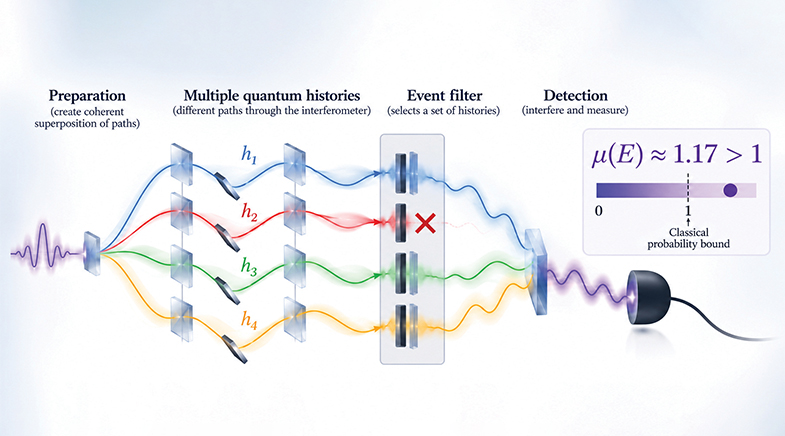
For the first time, researchers have measured the "measure" of a quantum system. The experimental result, shown by a team at the Raman Research Institute (RRI), Bengaluru. closely matches the theoretically predicted value.
The quantum measure is a concept in quantum mechanics formulations known as measure theory, pioneered by American physicist Rafael Sorkin. In measure theory, instead of looking at a system's state at a single point in time, the formulation analyses the entire "history" — or paths a quantum particle takes over time.
In the experiment at the RRI, a laser beam is split and made to traverse four different paths. The four paths are the four histories. "Our experiment has been going on for a long time. The evolution of this idea, with Rafael Sorkin, has taken three years," says team member and RRI Professor Urbasi Sinha. A paper on this — authored by Sinha, her former PhD student Sanchari Chakraborti, and Sorkin (bit.ly/quantum-measure) — was published in Quantum in September 2026.
In a seminal 1994 paper in Modern Physics Letters, Sorkin, who died on September 12, 2026, introduced the system histories approach to quantum experiments. The question was whether it was possible to select quantum systems based on the histories undergone.
By manipulating the beam's polarisation, the ancilla, the RRI researchers devised a filter that blocks just one of these four histories and lets three pass through and be measured. "The experiment tells us that this quantity… is experimentally accessible. Theorists can perhaps use this to their benefit," says Sinha.
The team devised a filter that blocks one of four histories and lets three pass through and be measured.
According to Sinha, measuring the measure is the first significant aspect of the experiment. Measuring a value greater than 1 is the second important one. "1.25 is the theoretical prediction, but given all the experimental errors and corrections, and losses, our modified expectation is 1.18. And we measure 1.17," she says.
Sumati Surya, Professor at RRI and former PhD student of Sorkin, says the experiment is the first of its kind to attempt to "measure" quantum measure. "It realises Sorkin's proposal from nearly a decade ago," says Surya, who works on Sorkin's discrete approach to quantum gravity, which can be framed in the language of quantum measures. "What is clever about this particular construction is that the 'events' are collections of 'non-serial' histories, and hence can be isolated without being observed, thanks also to the presence of an ancilla," she says.








Chemical puppeteers
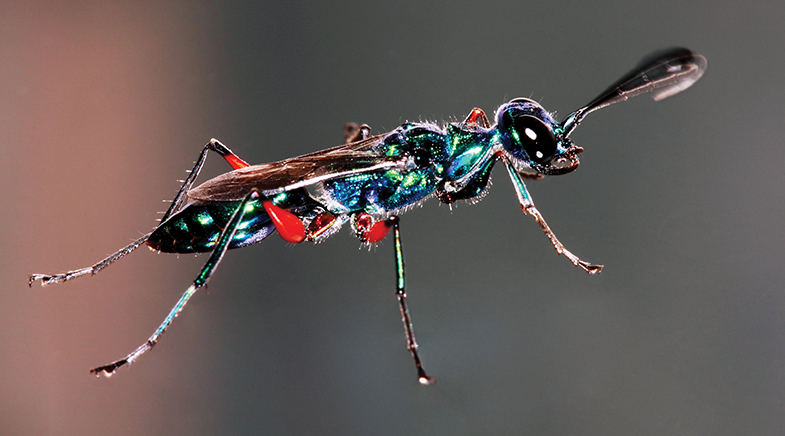
They're in your backyard, and they're deadly at creating 'zombies'. Their evolutionary adaptation holds exciting possibilities for biomedical research.
2025: A space odyssey
Action in space: a quick look at a year full of activity.



Have a
story idea?
Tell us.
Do you have a recent research paper or an idea for a science/technology-themed article that you'd like to tell us about?
GET IN TOUCH

