

New light on dark matter
-
- from Shaastra :: vol 05 issue 09 :: Sep 2026
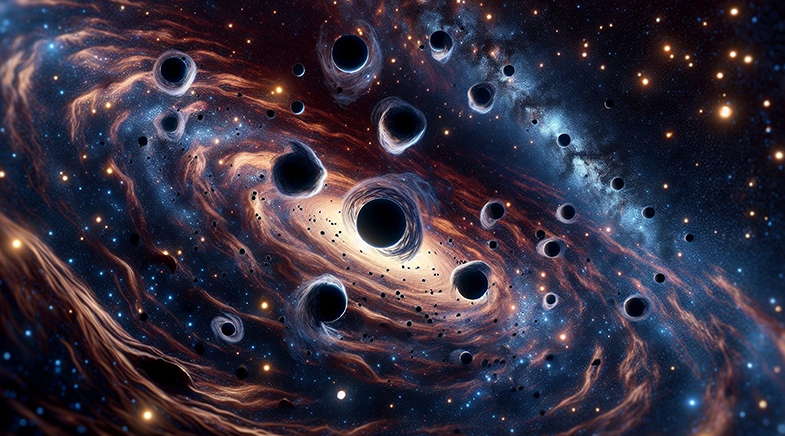
Researchers propose a test to detect PBHs.
A talk at the physics department of the Indian Institute of Technology Bombay (IIT-B) by research scholar P. George Christopher, and the ensuing discussion, have led to a paper that may solve a longstanding puzzle in physics. It suggests a novel method to detect primordial black holes (PBHs) — atom-sized particles with masses equivalent to an asteroid. If the method works, it could end the search for dark matter.
The paper (bit.ly/novel-method ) — by Christopher, postdoctoral scholar K. Hari, and Physics Professor S. Shankaranarayanan, all from IIT-B — has won the top prize in the prestigious 2026 Gravity Research Foundation's international essay competition.
Dark matter — undetected so far — is believed to constitute 27% of the universe, acting as the gravitational glue that holds it together. Physicists have hypothesised that dark matter consists not of exotic dark particles, but huge numbers of PBHs made of normal matter. The PBHs compress masses equal to hundreds of trillions of tonnes into the size of an atom. This makes their gravity so intense that light cannot escape from their surface.
The researchers propose detecting PBHs by probing the surrounding environment. Christopher explains that when a PBH drifts through a cosmic cloud of hydrogen, its extreme local gravitational curvature acts like a violent tidal wave on the microscopic scale. This phenomenon, rooted in quantum mechanics, physically warps the hydrogen atoms, splitting their internal energy levels — like a prism splitting white light into a rainbow. "This is the first proposal to use curvature-induced corrections to the hydrogen atom's atomic energy levels as a quantum probe for the existence of primordial black holes," he says.
Undisturbed interstellar hydrogen gas normally absorbs radio waves at 9.9 gigahertz (GHz). Under the intense gravity of the PBH, this single line splits into a cluster of thousands of lines spanning a 2 GHz bandwidth. The researchers call it a "Gravitational Spectral Radio Forest".
"The resulting 'radio forest' is so structurally unique it cannot be mimicked by any other known astrophysical phenomenon," Shankaranarayanan says. This gives astronomers a definitive signature to hunt for. "Our present calculation is a proof of principle, and more realistic modelling is necessary to determine the detailed properties of the signal that an observer should search for," he says.
While existing facilities may not be able to detect this delicate signature, upcoming facilities could confirm or deny the existence of PBHs using this approach. And if they do confirm it, the picture of dark matter may need to be re-examined.








A link to life
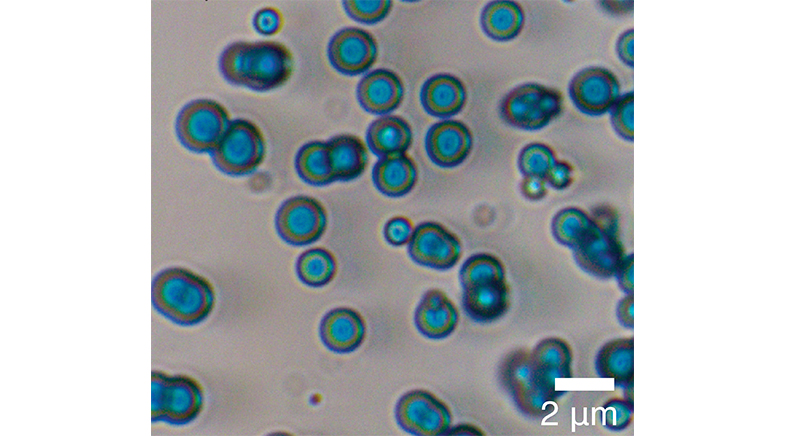
'Protocells' synthesised from a chemical cocktail could bridge a gap in origin-of-life studies.
The hole truth
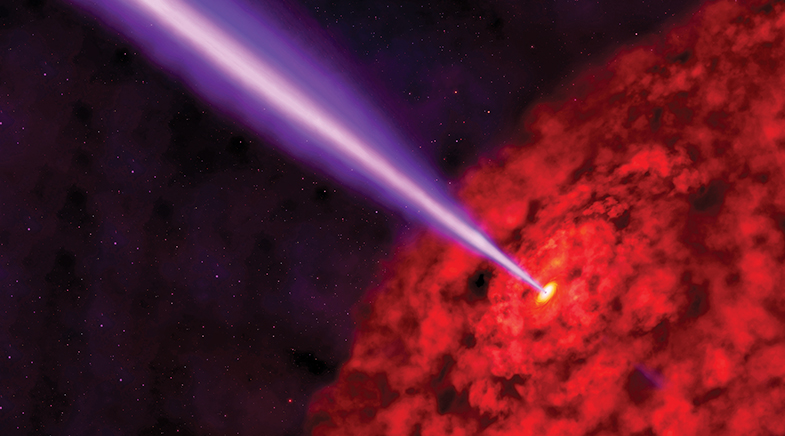
Do many black holes grow even when obscured? A survey will tell.




Have a
story idea?
Tell us.
Do you have a recent research paper or an idea for a science/technology-themed article that you'd like to tell us about?
GET IN TOUCH