

Opposites align, save resources
-
- from Shaastra :: vol 05 issue 05 :: May 2026
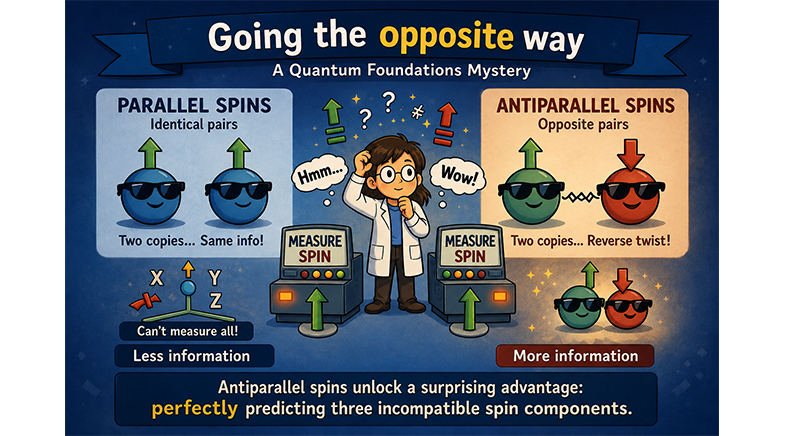
Multiple quantum systems together clear uncertainties.
In 1927, German physicist Warner Heisenberg mathematically established that it was impossible to determine the position and momentum of a quantum particle simultaneously. By the late 1920s, it was also understood that measuring a spin along different directions simultaneously was not possible. Another stalwart of quantum physics, Niels Bohr, posed a deeper question: was this limitation due to the act of measurement, or was it built into the structure of nature itself? Bohr was convinced it was the latter.
A recent study (bit.ly/Spin-Measure) led by Manik Banik at the S.N. Bose National Centre for Basic Sciences, Kolkata, proposes a new way to address the uncertainty of the quantum system. "The real question is not just about uncertainty; it is whether we can design a device that gives us both pieces of information at once. Bohr showed that we cannot," Banik says.
A quantum particle has a spin in three directions — X, Y, and Z — but measuring one makes measuring the spin of the other two unpredictable. Banik and his team studied pairs of particles with spins either aligned in the same direction (parallel) or in opposite directions (antiparallel). They showed that when two particles are prepared in opposite directions, they can together reveal information about all three directions, something parallel pairs cannot do. This is because the particles are linked in a subtle quantum way, so the useful information lies not just in each particle, but in the relationship between them.
A quantum particle has a spin in three directions. Two opposite particles can reveal information about all three directions.
Earlier, researchers tried to measure two or more properties of a quantum system by compromising its precision. These measurements do not yield exact values, but can still provide useful information about multiple properties. "The power comes from probing multiple systems jointly, using quantum correlations," says Banik. Measuring multiple quantum systems together is effective because their shared quantum relationships reveal more information than what is gleaned by looking at them separately. Banik's group showed that, with the right set-up, this could be done effectively, explaining how information is stored and accessed in quantum systems.
Their finding can help make efficient quantum communication systems without data wastage. Also, the technique could reduce the number of measurements required during the testing of a quantum system, saving time and resources.









Coming up: A landslide map of India
A nationwide early warning system for landslides is in the works.

Your Brain, Outsourced
How AI takeover of mental tasks influences your memory, attention, and expertise.

A whale of a puzzle
These gentle giants of the oceans share their ancestry with hippos, and other species discovered in a Himalayan sea.



Have a
story idea?
Tell us.
Do you have a recent research paper or an idea for a science/technology-themed article that you'd like to tell us about?
GET IN TOUCH