

Power walk, light on
-
- from Shaastra :: vol 05 issue 09 :: Sep 2026
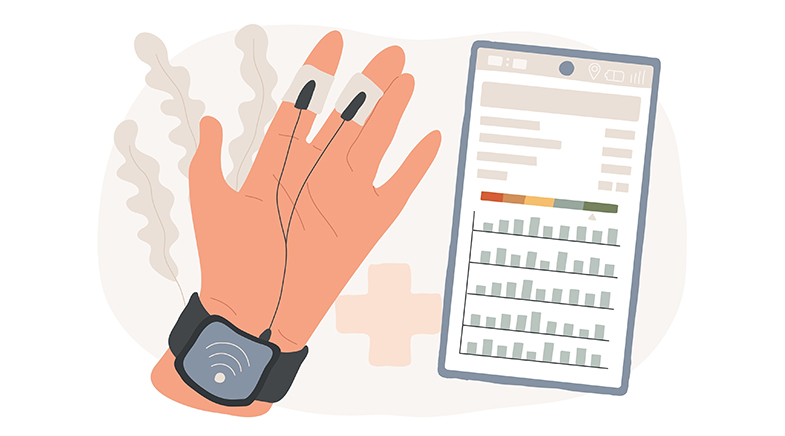
Team develops biosensors that run on everyday movement
Researchers at the Indian Institute of Technology Madras (IIT-M) have found a way to convert everyday movement into electricity. Dinesh Kumar, now a postdoctoral researcher at DGIST, South Korea, has developed a wearable device that converts human vibrations into an electrical output. The device, a triboelectric nanogenerator (TENG), produces electrical energy when two materials alternately come in contact and pull away. “Because it does not need any external power source, it can be used for energy harvesting,” Kumar says. His work was published in the Chemical Engineering Journal in August (bit.ly/TENGwithAgNW).
Working under IIT-M Professors R. Jayaganthan and N. Arunachalam, Kumar experimented with a polyvinylidene fluoride matrix as the device’s base material. Any triboelectric device needs materials with two opposite surface charges; in this case, these were polyvinylidene fluoride (PVDF) and polycaprolactam (PA6). As they came into contact and separated, electrons transferred from one material to the other. But on their own, the dielectric potential between the two was not high enough to make the product commercially viable.
This is because PVDF naturally exists in the alpha phase, where neighbouring fluorine atoms in the molecule are oriented in opposite directions, partially cancelling the generated dipole. For the dipole to get stronger, Kumar needed to bring the PVDF to its beta phase. He had previously done so by mixing ionic solutions into the PVDF matrix; this time, he used silver nanowires.
PVDF naturally exists in the alpha phase. For the dipole to get stronger, Kumar needed to bring it to its beta phase.
"Silver nanowires... hold oxide and hydroxyl groups on their surface. These molecules alter the chain positions of carbon and fluorine bonds in the PVDF to transform it into the beta phase," he says. The nanowires turned 90% of the material into the beta phase, increasing the triboelectric voltage output. "Silver also creates localised trapping sites for electrons, which are almost like interconnected micro-capacitors," he says.
The best results came with 7% silver in the mixture — any more made it counterintuitive, and the charge leaked. With this, the device could produce 270 volts, and power an array of 90 LEDs.
"We showed a proof of concept that this device can be commercially scalable, as body movement and vibration sensors," says Kumar. "We tested them by wearing them around different parts of the body, including the neck, the fingers, the wrists, the elbows, the knees and the ankles."








No stone unturned
Archaeologists are piecing together the story of the hominin occupation in South Asia, envisaging the lives of the people.
Guillain-Barré syndrome: a nervous breakdown
What we know so far about the rare neurological disorder that has triggered a health alarm in parts of India.

The fuzzball googly
Physicists tackle a 50-year-old paradox sharpened by Stephen Hawking.



Have a
story idea?
Tell us.
Do you have a recent research paper or an idea for a science/technology-themed article that you'd like to tell us about?
GET IN TOUCH