

Something fishy in water bodies
-
- from Shaastra :: vol 05 issue 08 :: Aug 2026
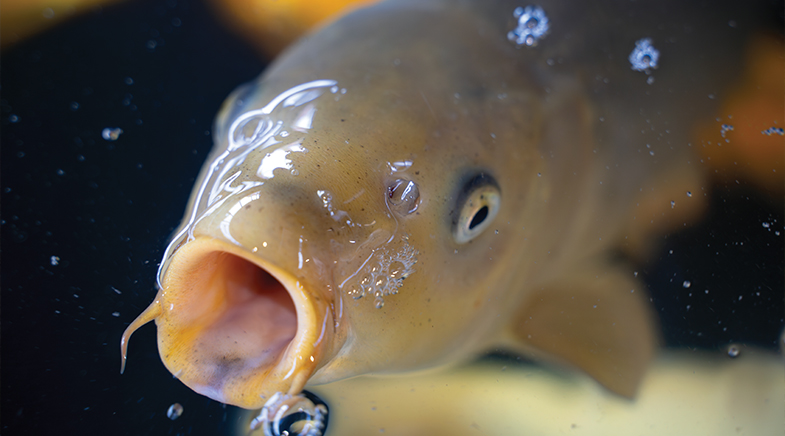
A database details the impact of chemical inputs on aquaculture.
Fisheries production in India, the world's second-largest producer, is growing at an annual average of almost 9%. The growth — from 95.79 lakh tonnes in 2013-14 to 197.75 lakh tonnes in 2024-25 — is largely driven by aquaculture in ponds, tanks and reservoirs, which has outgrown capture fisheries — fishing in natural water bodies — and is projected to supply most of the country's aquatic dietary protein by 2050. On the flip side, aquaculture farmers' reliance on chemical inputs — to maintain these high yields and ensure healthy fish — has also grown. Among these inputs are antibiotics, disinfectants, parasiticides, biocides, anaesthetics, and immunostimulants.
A new study, published in Cell Reports Sustainability (bit.ly/fish-toxicity), describes a database that compiles 690 such chemicals used globally. Called ReCAnt (Resource on Chemicals used in Aquaculture and their Ecotoxicity), the database was developed by The Institute of Mathematical Sciences (IMSc) and the National Centre for Coastal Research, both based in Chennai. The database also provides information on the chemicals' toxicity profiles and bioaccumulation potential. It looks at which species are endangered, how the chemicals disintegrate, and what regulations govern them in India and elsewhere. This is the first attempt to document the aquaculture chemicals used across the globe, the researchers stress.
This is the first attempt to document aquaculture chemicals used across the globe.
Of the 690 chemicals included in the database, 359 are compounds, 317 mixtures, and 14 other chemical entities, including nanomaterials, biological macromolecules, and minerals. Only 71 of these are classified as actively used. It listed the toxic effects of 215 chemicals. The researchers found that copper sulphate had the most extensive data records for acute and chronic toxicity, followed by sodium hypochlorite for acute toxicity and atrazine for chronic toxicity.
The researchers also analysed the regulatory profile of the aquaculture inputs and found that 57 chemicals in the database had some form of regulatory information associated with them. Most of these were regulated within the U.S., followed by the European Union, and India.
The database should strengthen the government regulatory system, says Areejit Samal, one of the authors of the paper and a Professor of Computational Biology at IMSc. The data on the downstream effects of different aquaculture inputs could help regulators make well-informed decisions. Samal and his colleagues believe that the database may also steer companies developing aquaculture products away from toxic aquaculture options.









India's tryst with 5G
With a collaborative tech development project, India has begun its efforts to become a serious global telecom player.
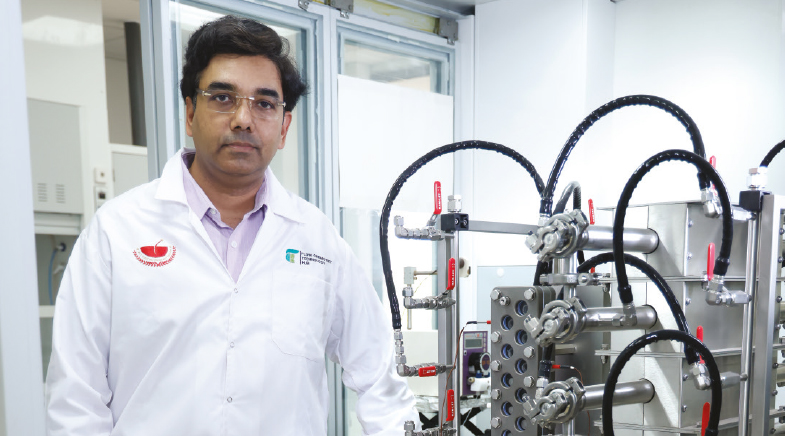
A game-changing pharma innovation
An advanced manufacturing technology promises a safer, faster and cheaper production of medicines. What does it entail?


Matter, and grey matter
Our Cover Story looks at how recent technological advances are transforming neuroscience.



Have a
story idea?
Tell us.
Do you have a recent research paper or an idea for a science/technology-themed article that you'd like to tell us about?
GET IN TOUCH