

Sound therapy saves lives
-
- from Shaastra :: vol 04 issue 11 :: Dec 2025
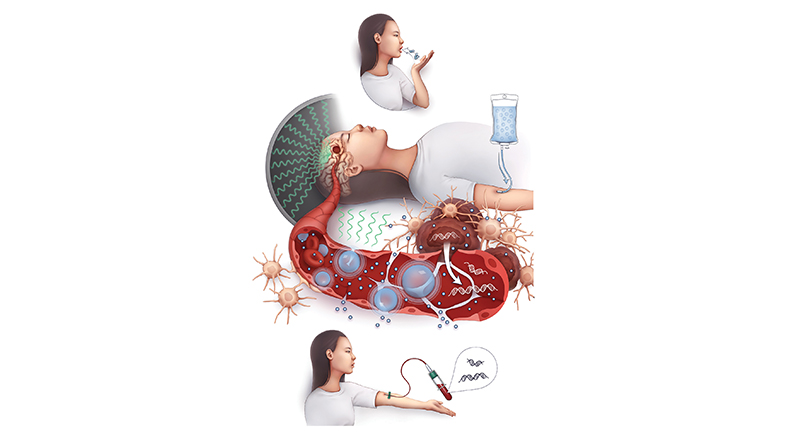
Ultrasound waves may help deliver drugs to the brain.
For over a century, scientists have been working towards delivering effective doses of medicines to the brain, an administration often hampered by the blood-brain barrier (BBB) — a network of cells that protects the brain from toxins and pathogens. Efforts to permeate the BBB have accelerated over the past few decades with technological advances. Now, in a multicentre clinical trial, researchers at the University of Maryland School of Medicine (UMSOM) have used focused ultrasound (FUS) waves to temporarily open the BBB and deliver more of the chemotherapy drug temozolomide to patients with glioblastoma, a cancer with a high risk of recurrence. The results showed a near 40% increase in survival compared with those who received only a standard dose of the drug without the ultrasound, the UMSOM says (bit.ly/umsom-bloodbrain). The findings were published in Lancet Oncology (bit.ly/ultrasound-brain).
Patients in the trial had undergone surgery to excise the tumour, followed by chemotherapy and radiation. Temozolomide was prescribed as an adjuvant to tackle the remaining diseased cells. The researchers injected standard diagnostic microbubbles of inert gas (MB) into the patients' bloodstreams. They used Magnetic Resonance Imaging (MRI) to guide FUS waves through their skulls, creating a controlled, targeted acoustic energy field. Acoustic energy from the FUS caused these bubbles to expand and contract, generating mechanical forces on the BBB. This made it temporarily more permeable to the drug.
Image-guided FUS is being studied for a range of therapeutic and diagnostic uses (see 'The promise of therapeutic ultrasound',). Earlier studies have shown that the BBB can be opened in a controlled manner using MB-FUS. This trial demonstrated that combining MB-FUS with temozolomide was a safe therapeutic approach in high-grade gliomas, the authors wrote.
"We hope this new tool and approach will initiate the new device plus drug(s) combination therapy and clinical trials," says principal investigator Graeme Woodworth, Professor and Chair of Neurosurgery at UMSOM. He adds that the researchers will seek a compassionate use exemption — which allows a gravely ill patient to access unapproved treatment — as a route to bring this to patients who might benefit and to generate more supportive data for wider use.
"This exciting outcome builds on decades of research to enable localised and non-invasive opening of the BBB through intact skulls," says Himanshu Shekhar, Associate Professor and co-lead of the Medical Ultrasound Engineering Laboratory at the Indian Institute of Technology Gandhinagar, who was not involved in the study. "This technology will potentially become clinically available in the next few years following validation." Future trials could use FUS alongside other drugs not administered in brain cancer due to their ineffectiveness in crossing the BBB. "Efforts are ongoing with pharma and biotech partners for new combination therapy clinical trials," says Woodworth.









Crossroads of science
The year 2025 has been a momentous one for science and technology. The impact of this will be felt over the next decade.
Great shakes, it's a quake!
Ongoing research into earthquakes at various time-scales could save countless lives.

Quantum riddles
The physics is puzzling, but some enduring mysteries of quantum mechanics may be a bit closer to being solved.



Have a
story idea?
Tell us.
Do you have a recent research paper or an idea for a science/technology-themed article that you'd like to tell us about?
GET IN TOUCH