

A cosmic riddle
-
- from Shaastra :: vol 05 issue 01 :: Jan 2026
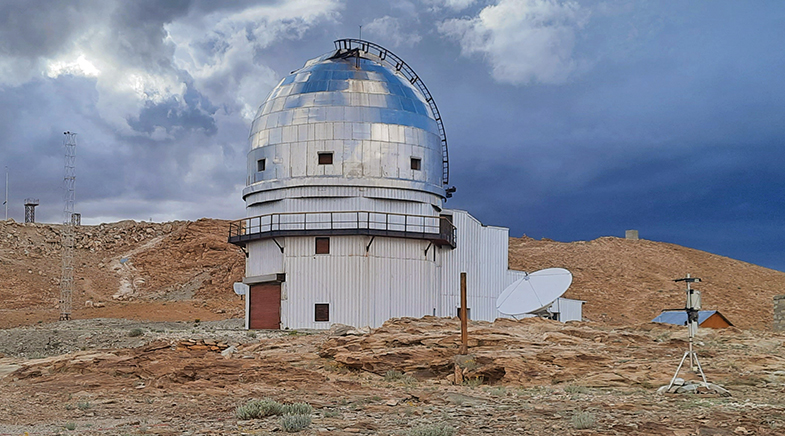
An afterglow from a neutron star merger has astrophysicists aflutter: could this be a unique 'superkilonova'?
Utkarsh Pathak, a PhD student in the astrophysics group at the Indian Institute of Technology (IIT) Bombay, was keeping a routine vigil at the GROWTH-India telescope, at Hanle in Ladakh, when there was a sudden exchange of notes among his professional peers who were also skywatching. Pathak and the others had been keeping watch after getting an alert of a neutron star merger from gravitational-wave detectors in August 2025, eight years after the first neutron star merger had been observed by detectors at the Laser Interferometer Gravitational-Wave Observatory (LIGO). Neutron stars are dense remnants of supernova explosions that are not massive enough to form black holes after the explosion. Pathak immediately messaged astrophysicists at the Indian Institute of Astrophysics (IIA), Bengaluru, and at IIT Bombay. For the next week, the entire team was "living, eating and breathing this event", says Varun Bhalerao, who leads the IIT Bombay group.
Gravitational waves are formed during the merger of two massive objects, like neutron stars or black holes. Once these waves are detected by LIGO, other observatories around the world, including the GROWTH-India telescope, look for electromagnetic (light) counterparts of the event, which arrive later, depending on the nature of the event. Of the dozens of transients – objects that brighten up for a short time – that they observed, all but one were ruled out as the source of gravitational waves. The alert had drawn their attention to the fact that one of the two neutron stars that merged appeared too small to exist.
Neutron stars are the middle rung in terms of size. If a Sun-like star dies, the product is a white dwarf: a ball of densely packed atoms. If the star is more than eight times bigger than the Sun, the core can collapse so strongly that electrons and protons are squished together to form neutrons. The subsequent supernova explosion leaves behind a neutron star at least 1.2 times the mass of the Sun. In the neutron star merger that astronomers observed in August 2025, one of the objects had a mass less than that of the Sun. This, along with the type of electromagnetic signals they were detecting, led them to conjecture that it was a unique event: a superkilonova, a combination of a supernova and a kilonova.
A kilonova is an afterglow of a neutron star merger observed from Earth. Although they are supposed to be common occurrences, only one has been definitively detected on Earth – in 2017, after the merger of two neutron stars detected by LIGO. After the August 2025 event, it brightened up, then dimmed, and then brightened up again. "This is unusual for a standard kilonova," says G.C. Anupama, former Dean and now Visiting Professor at IIA. The second brightening was more like a supernova. So, astronomers speculate, it was a superkilonova, a kilonova within a supernova.
The Indian collaboration decided to follow it. "If it is not just a supernova, we should not miss out on it," says Anupama.
The first observation of the corresponding bright spot in the sky was made by the Zwicky Transient Facility (ZTF) in California. Subsequently, several telescopes around the world, including the Himalayan Chandra Telescope in Ladakh, picked it up.
This raises several possibilities. According to Bhalerao, the "most boring possibility" is that it was a supernova that was behaving strangely. Alternatively, it could be a kilonova with an afterglow not directly aimed at Earth. The most exciting possibility is that it is a superkilonova.
The superkilonova model can account for the sub-solar masses of the constituent neutron stars because a supernova explosion can, in principle, create two neutron stars that can merge within seconds or minutes to produce the kilonova. One unfortunate aspect is that the superkilonova model is new and lacks predictions that can be verified by observation. "Secondly, this source went behind the Sun and will not be visible for a few months, perhaps till February," says Bhalerao. "We are figuring things out," he adds. "In astrophysics, we have zero control over our experiments. The universe decides what happens, and we make inferences based on observation," he says.








The H factor
Hydrogen is moving from pilot projects to industrial deployment, testing if it can deliver on its promise.


Quantum is the key
Quantum technologies promise to secure India's digital backbone.



Have a
story idea?
Tell us.
Do you have a recent research paper or an idea for a science/technology-themed article that you'd like to tell us about?
GET IN TOUCH