

DNA shows a new way
-
- from Shaastra :: vol 05 issue 05 :: May 2026
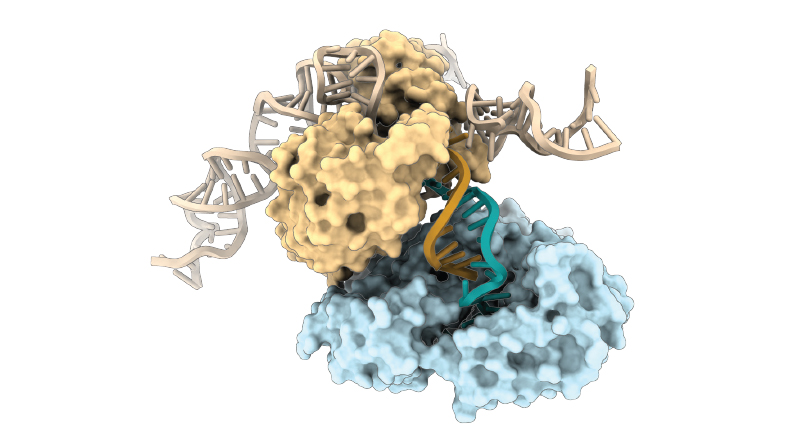
A bacterial enzyme makes DNA in a hitherto unknown method.
Plants and animals synthesise DNA through a well-known method common to all living beings. The two winding strands of DNA are separated by an enzyme. And then another enzyme picks each of these strands and assembles a complementary strand, matching the sequence of the different bases that make up the genetic code in the DNA. This results in two strands of DNA where there was only one in the first place. Now, for the first time, scientists have found a situation in nature where DNA is made by a different method.
Alex Gao, Assistant Professor in the Department of Biochemistry, and his team of researchers at Stanford University were studying specific bacterial enzymes that work against phages — viruses that attack bacteria. Gao and his team found that one of these enzymes, Defense-associated Reverse Transcriptase 3 (DRT3), was making its own DNA without following the usual way of building a complementary strand from an existing template.
The enzyme DRT3 has two components — DRT3a and DRT3b. Each component makes a single strand of DNA, which later come together to make a double-stranded DNA. The team found DRT3a made the DNA in the conventional way, by copying a template. DRT 3b, on the other hand, built a strand of DNA without referring to a nucleic acid template. Instead, it used the amino acids it contained to serve as a blueprint for constructing the new strand. This new strand, built with repeated sequences of bases adenine and cytosine, is also called a Poly(AC) strand.
Their findings, published in Science (bit.ly/DNA-Method) in April 2026, do not invalidate the central dogma of biology — "despite some of the speculation online", says Gao — that genetic information flows from DNA to RNA to protein and not from protein to DNA.
The Drt3b is highly tailored for poly(AC) and is not a general avenue for amino acid-to-DNA information transfer. That is, it can only synthesise a single DNA strand composed of the bases adenine and cytosine. "Moreover, we do not yet know the function of the repetitive DNA product beyond its role in antiphage defence," Gao adds. The main surprise here is that this mechanism provides a rare example in a living organism of a DNA double helix being formed without copying an existing nucleic acid template.
"This paper reports a new phenomenon that can potentially keep biologists busy for years to come," says Sutirth Dey, an evolutionary biologist at the Indian Institute of Science Education and Research, Pune. "There is no known transcription system where the two strands of a double-stranded DNA are made in completely different ways."
Gao and his team also found that the mechanism fails if one strand is mutated while the other remains intact, suggesting that the double-stranded structure matters for this defence mechanism. "This is perhaps the first time when a double-stranded DNA molecule has directly been implicated as a defence molecule, and the way it operates is unknown," Dey says.
Gao adds that the finding has been "inspiring" for the Stanford team because it highlights "just how sophisticated" bacteria can be. This is fundamentally important, for DNA has always been thought of as the molecule that uses an existing template to pass on a genetic blueprint. But DRT3 transcends the conventional boundaries of DNA replication: it builds a DNA without an existing template and uses it as a tool against bacteriophages.
"The broader implication is that it points to a vast reservoir of uncharacterised biology within microbial 'dark matter', where fundamental mechanisms likely remain undiscovered," Gao says. Next, he says, the group will combine high-throughput data mining, gene synthesis, biochemistry, and cryo-EM "to uncover what other capabilities these microbes are hiding".









This glass may be scratch-proof
A graphene oxide-based coating promises to make glass scratch-resistant.

Shaastra: a channel of all knowledge
Shaastra fills a vacuum: the magazine will report, illuminate and critique India's progress as a research nation.

The world @ your fingertips
As the rollout of 5G gets under way, a sneak peek into the early development and benefits of future wireless networks.



Have a
story idea?
Tell us.
Do you have a recent research paper or an idea for a science/technology-themed article that you'd like to tell us about?
GET IN TOUCH