

Forged in fire
-
- from Shaastra :: vol 05 issue 03 :: Mar 2026
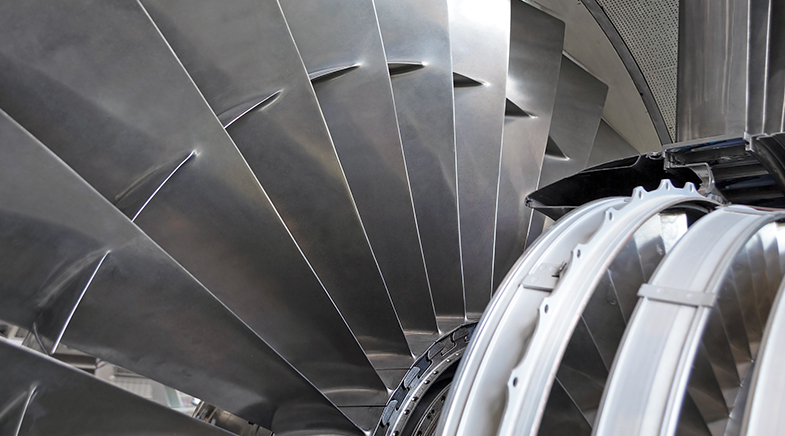
Researchers build a new alloy primed to withstand high temperatures.
Materials used in turbines and aircraft engines are critical to the efficiency of heat engines and propulsion systems. Nickel- and cobalt-based superalloys are predominantly used in the manufacture of gas and steam turbines and in aircraft engines. However, these advanced high-temperature materials can only typically tolerate temperatures of around 1,000° Celsius — a ceiling that limits further gains in efficiency.
An international research team, which includes scientists from the Indian Institute of Technology (IIT) Ropar, has developed an alloy capable of withstanding temperatures about 25% higher than those tolerated by conventional superalloys. The study, led by Nicolas Argibay of the Ames National Laboratory in the U.S., was recently published in Nature Materials (bit.ly/Nature-Materials).
Gas turbines currently generate nearly a quarter of the world's electricity, but their performance — along with that of aircraft engines — is constrained by the temperature limits of nickel- and cobalt-based superalloys.
"We currently use cooling and coating methods to make these engines run very hot, but we are limited by the melting temperature of the materials. If you're able to make something that retains its strength at really high temperatures and push the operational temperature upward, you can significantly improve the efficiency of that engine," says Pratik K. Ray, Associate Professor of Metallurgical Engineering at IIT Ropar and a co-author of the paper.
Several refractory metals — elements with melting points much higher than nickel and cobalt — could, in principle, enable operation at higher temperatures. However, these metals are typically brittle at low temperatures, making them difficult to manufacture and shape into components.
The work potentially lays the foundation for next-generation gas turbines.
The research team addressed this long-standing challenge using machine learning. It developed a computational framework capable of predicting the stability, strength and ductility of alloys based on their atomic composition. The framework allowed the rapid screening of thousands of material combinations.
STRONG AND DUCTILE
By combining certain refractory metals into multi-principal-element alloys — materials composed of three or more elements in significant proportions rather than dominated by a single base metal — the scientists achieved a desirable balance of strength and ductility at high temperatures. Refractory elements vanadium, tantalum and niobium were used in the design. Nickel- or cobalt-based alloys are based on a single metal.
"This was an effort guided by theory. When we did machine learning, we had an idea about metal phases which can withstand high temperature, and the kind of tuning required from an electronic structure standpoint," says Ray. "Machine learning was used like a guide to narrow down the search space." After that, he says, the collaborators carried out density functional theory calculations to assess changes at the electronic-structure level and narrow down the compositions. "We then made the alloy under different conditions to find the strength and the temperatures at which it can last," he says.
According to the researchers, the new alloy could find applications in aviation gas turbines, power generation systems, and even nuclear reactors. However, it is yet to be tested in real-world operating conditions.
The development also has strategic implications for India. "Even though we make fighter aircraft here, we still need to import aircraft engines," Ray notes.
Satyesh Kumar Yadav, Associate Professor of Metallurgical and Materials Engineering at IIT Madras, calls the development significant because it demonstrates that a material can retain both strength and ductility at extremely high temperatures, potentially laying the foundation for next-generation gas turbines.
However, there are several hurdles, he cautions. "It is still to be seen whether this material can perform efficiently in harsh environments. At extremely high temperatures, burning can produce gases, particularly highly reactive oxygen. Nickel-based superalloys have an inherent resistance to oxidation. Refractory metals, on the other hand, have a strong affinity for oxygen. It remains to be seen how these challenges will be addressed."









A bridge too far out
Sikkim's bamboo and cane footbridges, engineered with indigenous ingenuity, are a sturdy alternative to carbon-heavy structures.

High Notes
How technology has enriched music — for both the creator and the connoisseur.

Weight and watch
Pharmaceuticals and wearable technologies are reshaping weight management.



Have a
story idea?
Tell us.
Do you have a recent research paper or an idea for a science/technology-themed article that you'd like to tell us about?
GET IN TOUCH