

Gum's the word
-
- from Shaastra :: vol 05 issue 08 :: Aug 2026
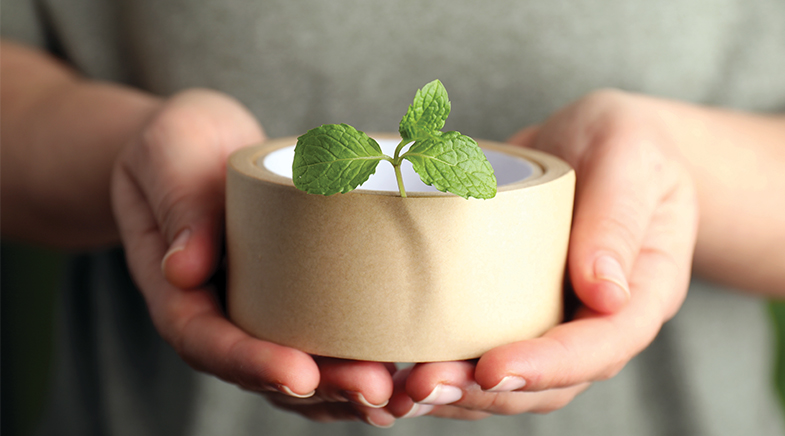
Adhesives are turning green, shaking off their toxic coats.
The gecko's ability to stick to a wall and loosen its grip — seemingly defying gravity — captured the imagination of Animangsu Ghatak while he was working on adhesives as a PhD student in the early 2000s. He recalls reading a research paper published in 2000 that described how the gecko's feet harbour millions of microscopic hairs that allow it to do so. The hair strands together create a strong adherence when the lizard's feet are pressed, and loosen the grip when pressure is relieved. Ghatak believed new adhesives would be like that: "adhere strongly, but also be released easily".
While his early years of research focused on understanding the surface mechanics that enabled strong adhesion, Ghatak, now a Professor at the Indian Institute of Technology (IIT) Kanpur, has developed two products inspired by this work. In 2021, he created a washable mat with microscopic bumps, similar to the hairs on a gecko's feet, that capture dust from the soles of shoes. The mat is reusable, unlike the chemical-based sticky pads currently used in hospitals and elsewhere. In 2022, he published a paper on how his team created a surface pattern of tiny hills and valleys on sheets of paper. These patterned structures keep the ink bonded to the surface after printing. But with no permanent bonding involved, the ink can be wiped away. On normal paper, the ink goes inside fibres and cannot be cleaned. His product is more sustainable than commercial reusable paper based on special chemical inks.
Ghatak points out that such chemical-free bio-inspired technology allows for de-bonding and can help disassemble products after use, enabling a circular economy. He is now developing a single adhesive that can join polymer and metal-based components, minimising the need for screw, nuts, rivets or any other procedures required to join polymer and metal in automotive, aerospace and electronics.
THE GREEN SHIFT
Research into adhesives was earlier driven by two goals: high strength and permanent bonding. The focus today is on adhesive formulations that are sustainable, chemical-free, self-repairing, recyclable and multifunctional, and can de-bond. According to research firm MarketsandMarkets, the global sustainable adhesives market size is projected to grow from $4.5 billion in 2025 to $6.4 billion in 2030 (bit.ly/adhesives-market). Much of this demand is driven by government regulations encouraging companies to use sustainable adhesives. For instance, recent directives in Europe pushing for repairability of electronic products have been driving companies to seek adhesives that de-bond.
In 2025, India introduced a Repairability Index, under which products will be rated on the ease of disassembly and repair to help consumers make informed choices. India's Battery Waste Management Rules of 2022 and the European Battery Regulation of 2023 call for batteries that are easy to disassemble, allowing for recyclability. Regulations in Europe, Japan, China, and the U.S., which minimise the use of formaldehyde in adhesives because it is believed to be carcinogenic and a respiratory hazard, are pushing companies to shift from petroleum-based polymers such as epoxy, polyurethane, acrylic, and urea-formaldehyde to bio-based formaldehyde-free adhesives made from soy, lignin, starch, and tannins.
Companies are responding to the new rules. In 2022, Apple switched from conventional battery adhesive strips to an electrically de-bondable adhesive for its iPhone 16 and iPhone 16 Plus, allowing for better repairability and battery service. Sweden-based international home store Ikea has pledged to replace all fossil-based adhesives in board material used in its furniture with bio-based alternatives by 2030. In 2024, U.S.-based packaging company Packsize and German timber construction company DERIX started using bio-based adhesives.
As more companies seek sustainable adhesives, start-ups and researchers are catering to the demand. D-Glue in the U.S. has developed an adhesive that de-bonds when heated above a specific temperature, with applications in consumer electronics, electric vehicles, and solar panels. Bengaluru-based altM's lignin-based, formaldehyde-free adhesive, set for pilot-plant production in 2026, can be used in woodwork. Spatika Bio-Resin, a formaldehyde-free bio-based adhesive for the plywood and wood industry, developed by Bengaluru-based Varnika Srushti Enterprises, was launched in 2025.
BIO-BASED ADHESIVES
Sustainable adhesives are the answer to toxic adhesives used across industries — from packaging, construction and furniture to automotive, footwear, electronics, and healthcare. Sushanta K. Sahoo, a polymer researcher and Principal Scientist at the Thiruvananthapuram-based National Institute for Interdisciplinary Science and Technology, saw this trend shaping up. In 2022, he began work on a bio-based adhesive composition for use in labels, tapes and sticky notes. For this, he studied waste biomaterials with specific chemical characteristics. He chose cardanol, produced from cashew nut shell liquid, and a by-product of cashew processing. It has a long hydrocarbon chain that provides fluidity for it to be spread over a surface and hydroxyl groups that bond with the surface. Cardanol was further modified, and its double bonds were converted into a ring — two carbons and an oxygen — so that it could combine with sebacic acid to form a polymer. Formaldehyde is generally used for crosslinking the polymer, but Sahoo's team replaced it with the acid derived from castor oil, which has good crosslinking properties. It then added vanillin epoxide, which is derived from wood lignin and has a rigid aromatic ring, to increase the strength, thermal resistance, and peel strength of the adhesive (bit.ly/strong-alternative).
"Nature has given that functionality; we just modified it," Sahoo says. The resultant eco-friendly formaldehyde-free adhesive has a peel strength of 4.82 Newtons per 25 millimetres, better than that of commercial masking tape or acrylic-based adhesives. The study showed this adhesive can endure temperatures up to 180° Celsius, stay in water for five days, and withstand liquid nitrogen, suggesting it is robust across temperature conditions.
Sahoo developed a computational approach to screen plant-based materials in 2023 and, based on the results, developed an adhesive in 2025 by modifying linseed oil, which has strong tack, peel strength and shear resistance. He points out that with so much waste biomass in the country, shifting to bio-based adhesives makes more sense than importing polyurethane for making chemical adhesives.
SELF-HEALING PASTES
Nikhil Kumar Singha, a Professor at IIT Kharagpur, is also working on next-gen adhesives. Inspired by mussels, which remain glued to rocks even in water currents, he has developed a self-healing bio-based adhesive. Mussels secrete a sticky protein liquid, made of a modified amino acid, DOPA, that forms ultra-strong chemical bonds, with which they adhere underwater to rocks, wood, or metal.
Researchers are combining new and traditional methods to develop multifunctional and eco-friendly adhesives.
In 2025, Singha used a similar chemistry to develop a strong, water-resistant, self-healing adhesive. He took epoxidised rubber, derived from natural rubber, added furfurylamine to it, and then mixed it with a linker made of maleimide and DOPA. Further experiments showed that this new adhesive had a lap shear strength of 1.27 megapascals: the glued joint withstood the pressure of a 130-kg load on a 1 cm² overlap before the bond started to slide apart. It is also reusable and regains 92% of its adhesion power when reused. Further, if this adhesive is cut, it repairs itself when heated. He believes this self-healing, reusable, bio-based adhesive, applicable in both wet and harsh environments, can be utilised in advanced coatings, biomedical hydrogels, drug delivery systems, woodwork, metal bonding, and flexible electronics and sensors (bit.ly/mussels-idea).
"If there is a defect, there are some cracks that can be healed by using some external stimuli depending on what kind of functional chemical groups they have in the adhesive," he explains. He adds that the adhesive's self-repairing property increases its life, making it a sustainable choice.
Ancient adhesives were made from tree resins, gums and boiled animal skins, tendons and bones. Scientists then developed chemical glues. Today's researchers are combining traditional and modern methods to develop adhesives that are multifunctional and eco-friendly. And these are not quick-fix solutions.









AI for a reason
For now, AI lacks the ability to solve problems through reason. However, a paradigm shift on that front seems imminent.
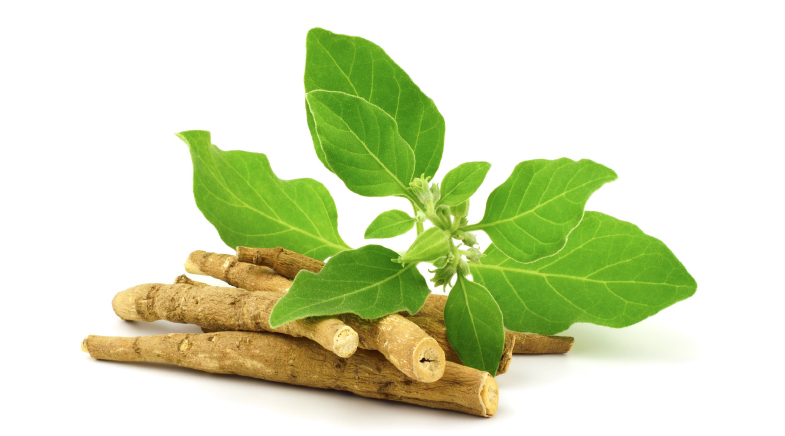
Harnessing the herb
Scientists have known the medicinal properties of ashwagandha for several decades. Now the evidence is getting stronger.

A marketplace for moonshots
Mariana Mazzucato makes a compelling case for reimagining governments and economic systems, to spur innovation and face up to tomorrow’s challenges.



Have a
story idea?
Tell us.
Do you have a recent research paper or an idea for a science/technology-themed article that you'd like to tell us about?
GET IN TOUCH