

Past in a flash
-
- from Shaastra :: vol 05 issue 11 :: Nov 2026
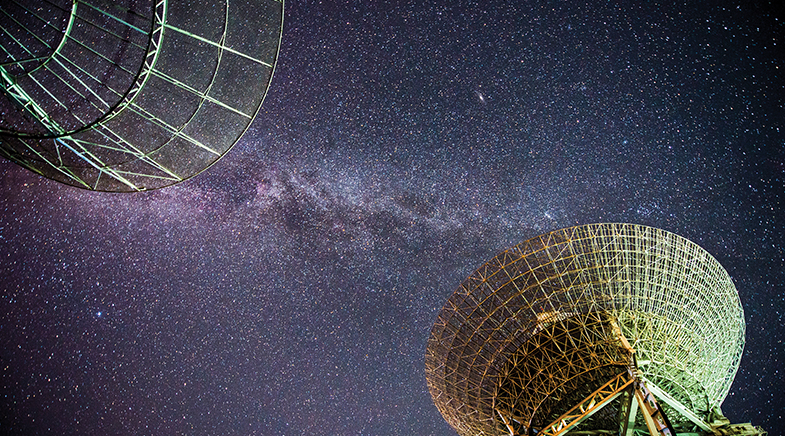
Radio telescope zooms in on 10-billion-year-old fast radio burst.
Astronomers have detected a fleeting, tiny flash of light, born three billion years after the Big Bang. The millisecond-spanning flash of radio waves, called a fast radio burst (FRB), is considered a cosmic messenger from the early universe. Since it was first discovered in 2007, astronomers have viewed FRBs with immense interest. "I think I was one of those people who were convinced from the start that they were real," says Benjamin W. Stappers, astrophysicist at The University of Manchester, England, who helmed the collaborative study published in Science (bit.ly/radio-bursts).
MeerKAT, a radio telescope in South Africa, detected the newest FRB using MeerTRAP, a specialised instrument deployed on it. The system simultaneously searches for brief radio signals across multiple parts of the sky, sampling every 300 microseconds, and then uses machine-learning algorithms to sift through the generated material each day. The FRB was flagged by the software and subsequently examined by researchers.
The signal began its journey before the Earth or even the solar system were born, which also means it had travelled for nearly 10 billion years before it was found by the telescope. "The enormous energy required to produce a burst that remains detectable across such distances was itself striking," explains Manisha Caleb, a radio astronomer at The University of Sydney, Australia, and lead author.
In its journey, the FRB has passed through vast intergalactic space, carrying information about the matter in its path. They reveal the otherwise invisible material through which radio waves travel. Stappers says, "I like to think of it as if we're doing a bit of history, astronomy history."
Astronomers hope that FRBs will deliver clues to enduring mysteries such as the "missing baryon problem" related to missing matter in the universe. When radio waves from an FRB travel through space, they interact with the free electrons in the material between galaxies, leaving measurable imprints. Astronomers can use the imprint to estimate the free electrons along the line of sight and, in turn, infer how much ordinary matter lies between galaxies. Researchers aim to extend such measurements to greater distances and older periods in cosmic history. Stappers observes that distant FRBs could help astronomers investigate the universe's evolution and test cosmological ideas.



For a healthcare revolution
With a large-scale Tech-enabled Health Workers programme, India can deliver world-class primary healthcare.

The speed generation
Scientists used to take decades to develop a new crop. Not any more.

AI all the way
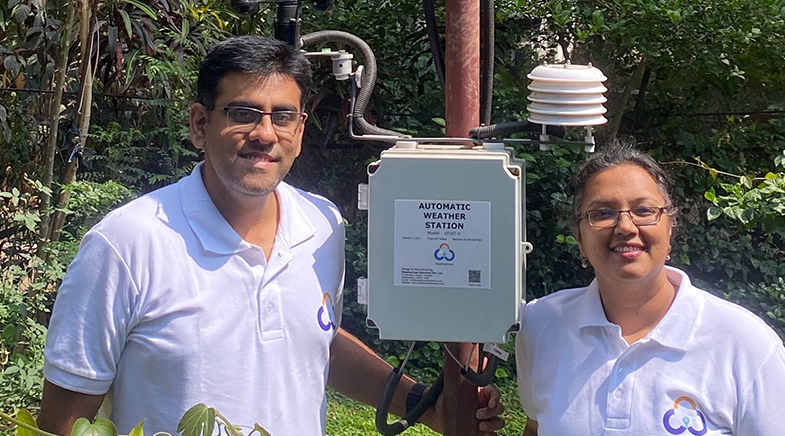
Start-ups zero in on speedy processes, phonemes and weather forecasts.



Have a
story idea?
Tell us.
Do you have a recent research paper or an idea for a science/technology-themed article that you'd like to tell us about?
GET IN TOUCH