

Quantum jump
-
- from Shaastra :: vol 05 issue 04 :: Apr 2026
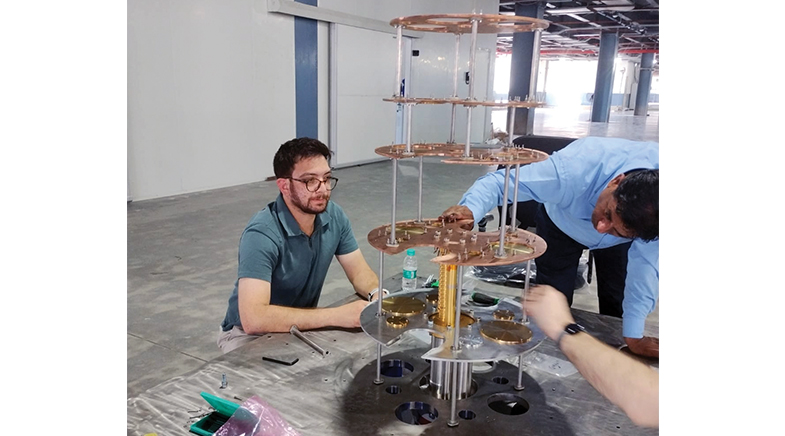
India's first open-access quantum computer is ready to roll.
After receiving his doctorate in electronics from the Indian Institute of Technology (IIT) Delhi, L. Venkata Subramaniam worked for the tech giant IBM for 27 years, rising from a research staff member to heading IBM Quantum India in 2023. Subramaniam was at the peak of his career when he made an unusual decision: to quit his job and build an ecosystem for indigenous quantum technology in India.
In April 2026, at Andhra Pradesh's Amaravati Quantum Valley, dedicated to quantum innovations, the country will see its first open-access quantum computer built by Qbit Force, Subramaniam's start-up incorporated in December 2025. "Our vision is to grow the quantum hardware ecosystem for everyone around us," he says. Researchers and start-ups around the country can use its computers as testing platforms to validate the components they are building, from superconducting qubits and control electronics to dilution refrigerators.
India, Subramaniam stresses, has always led in software. "But, as a country, we don't have too much legacy in hardware," he says. The same rings true for the quantum sector. India's quantum hardware ecosystem is still emerging. Under the government's National Quantum Mission, a few deep-tech start-ups have made a mark: at IIT Delhi, PrenishQ is researching precision diode lasers; in Kanpur, Dimira Technologies is prototyping cryogenic cables; Quan2D in Bengaluru and Quanastra in Delhi are building single photon detectors.
These companies seek to build the critical supply chain components that will eventually encourage the development of more indigenous quantum computers. Bengaluru-based QpiAI is one of the few start-ups in the country assembling superconducting quantum computers; in November 2025, it introduced Kaveri, a 64-qubit quantum processor. But to run quantum applications, including drug discovery, materials science research, and climate forecasting, more powerful quantum computers are being brought to India by companies such as IBM and Rigetti Computing. IBM, in partnership with Tata Consultancy Services, is installing its 156-qubit Heron processor in Amaravati, and Rigetti is bringing a 108-qubit quantum computer to the Centre for Development of Advanced Computing (C-DAC) in Bengaluru.
"Every foreign quantum computer available to us is a black box," says Subramaniam. "These companies will sell you their quantum computers or allow you to run your applications over the cloud. But you cannot touch the hardware." Qbit Force is one of the first indigenous quantum computer systems in which critical components are sourced mainly from Indian labs, universities, and companies.
Building a quantum computer needs 15-20 critical components. The processor with the qubits is one, but reading it requires control systems, flex wiring, amplifiers, and many other components. "No single person makes all these components. So, the first thing you need is a system where people can come and test their components, identify problems, redesign them, fabricate again, and test again. This cycle needs to happen very quickly," says Subramaniam.
Qbit Force's next step is to build the foundry or fabrication facility, a clean room for researchers to manufacture the components they design. The start-up is sourcing cryogenic coaxial cables (to connect the supercooled qubits with the control electronics) from Dipti Gupta, Professor of Metallurgical Engineering and Materials Science at IIT Bombay and founder of Dimira Technologies, and amplifiers (to strengthen weak signals emitted by qubits) from R. Vijayaraghavan, Associate Professor, Tata Institute of Fundamental Research. "Right now, we do not have the infrastructure to test these components at the milliKelvin temperature. So, Qbit Force's facility will be helpful for us," says Gupta.
Subramaniam believes that this is a technology that Indians cannot afford to miss. "People like me, who have built a career in this industry, should take the plunge and help guide the direction in which it is moving."








The AI Engine
Institutions are offering AI courses that could reinvent industries and create growth in the long term.





Have a
story idea?
Tell us.
Do you have a recent research paper or an idea for a science/technology-themed article that you'd like to tell us about?
GET IN TOUCH