

Ring in the old
-
- from Shaastra :: vol 05 issue 03 :: Mar 2026
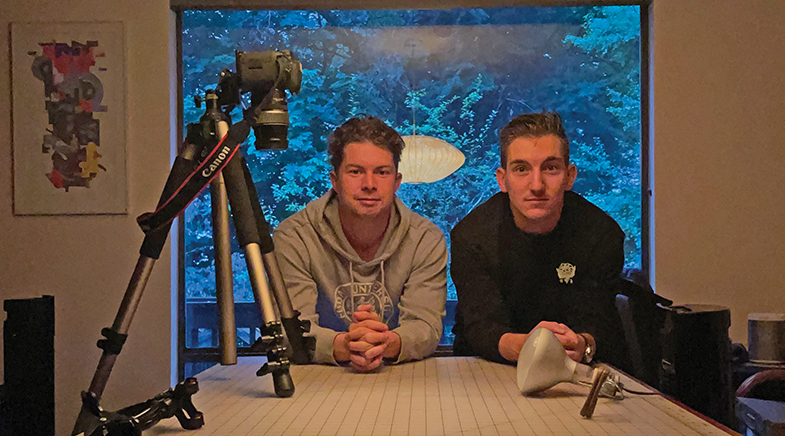
Dumbphone, anyone? A niche set of engineers is helping phone users keen to limit screen time embrace digital minimalism.
Austin Boer's phone is decidedly boring. He holds it up and gives it a dismissive shake: a clean, blank screen with no notifications, no shiny logos on the homepage, and just one app running in the background — a textbox answering the question 'how to make salmon'. In Nevada, U.S., Boer and Brennan Jordan, friends in their early 20s, are building minimalist smartphones out of refurbished Google Pixel 7s. Their company, SLEKE., develops phones designed to reduce distractions by eliminating constant notifications, social media apps and browsers, and the endless scrolling that comes with them.
Digital minimalism — the idea that the use of technology must be intentional and add value, and not just flood the user with more noise — has gained fervent followers since it was first proposed in 2019 by Computer Science Professor and author Cal Newport. The COVID-19 pandemic and the ensuing lockdowns and isolation bolstered the belief that there was a life to be lived beyond screens. Burnt-out Millennials and Gen Z began turning to 'dumbphones' as a form of neo-Luddism.
Recognising a market for those looking to move away from Big Tech, niche start-ups are building smarter versions of basic feature phones. Leading the movement was the Light Phone, which sought to draw the phone back to its original purpose as a tool for communication, nearly a decade ago. Having brought its first devices through crowdfunding, it released its latest model last year. With an austere black-and-white e-ink or OLED displays, it offers a camera, an alarm, a calendar, navigation, and some other essentials. Companies such as Punkt and Mudita, too, have adopted minimalist design principles. These phones are smoother and faster versions of feature phones, yet, at $300 to $700, are priced closer to high-end phones.
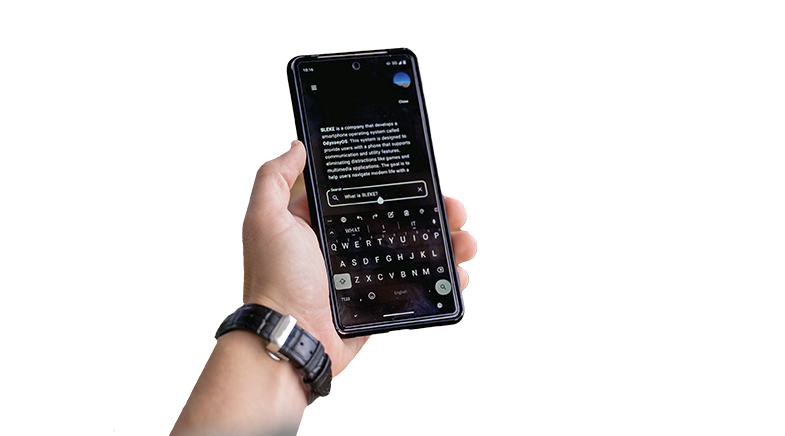
Boer, however, was not content with the lack of functionality in the popular minimalist phones. "We wanted to create something that had all the utility of a smartphone without the distractions," he says on a video call. His motivation came from his experience as an English language tutor in China, Malaysia and Thailand. "We needed Instagram because if there was an emergency back home, friends and family knew to contact us through Instagram. So we didn't want to delete it, but we also wanted to delete it because we were in this beautiful new culture and we were just on our phones the whole time," he says. Boer and Jordan began looking for phones that were smart enough to help them interact with the world and nothing more. "Everybody was asking, 'I want a dumb phone, but I need my banking app, or my baby monitor app'," Boer says, recalling his initial market research.

Companies such as SLEKE. and Wisephone by Techless are filling the middle ground. The phones offer a tool drawer of approved apps for ride-sharing, banking and navigation. SLEKE. does not run a browser, but includes a QR code scanner to open webpages without allowing further browsing. It also runs a Perplexity API in its search bar to answer queries in a text-based format without follow-up hyperlinks. "A lot of users said they still needed a browser to get information. So we provide that in a non-distracting way. The tone is informational, not conversational," says Boer.
The data combined from multiple apps and websites create a detailed profile of the user, in a technique known as crossapp tracking.
In Pune, engineer Dhiraj Chaudhari sought not to modify the smartphone but to allow a planned respite from it. "Smartphones are powerful innovations. The problem is the unrestricted access," Chaudhari says. He founded trring, a digital 'wellbeing' company that sells Bluetooth call-mirroring devices packaged as red rotary phones with keypad dials. Much like any Bluetooth device, from smartwatches to car speakers, users can answer incoming calls and also make calls without unlocking their smartphones. The only difference is in the design: it is screenless and reminiscent of landline phones.
Chaudhari hopes people will use trringphones to create no-scroll zones or hours in their homes. "People often end their day scrolling and start their mornings by touching their phone. We help make bedrooms smartphone-free, while still being connected to the people you need," he says. The company now plans to integrate a voice assistant into the device to help recall phone numbers.
DETOX WITHOUT GADGETS
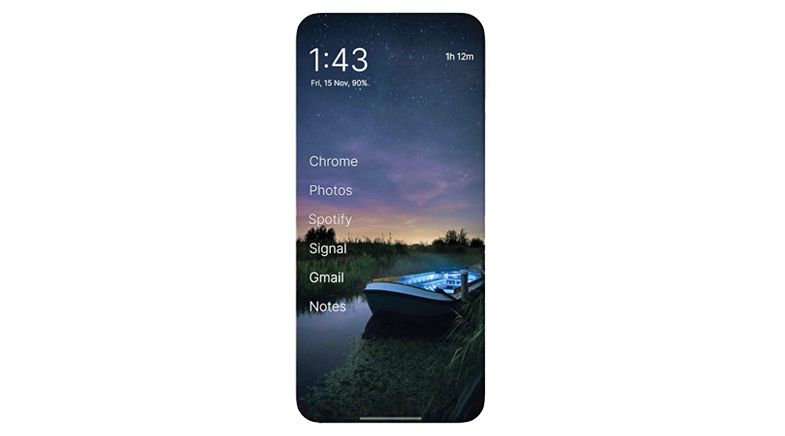
A digital detox need not mean buying more devices, argues Tanuj Mishra, an Android developer based in Delhi. Mishra built OLauncher, an Android app with a minimalist interface. Launchers are apps that allow users to customise how the device — the home screen, the app drawer or the user interface — looks.
In 2020, Mishra began searching for launchers to make his phone's interface more minimalist. "I remember the first time I saw my screen time shoot up to nine hours per day, and I could not even remember what I had done for those nine hours," he says. Unimpressed by the launchers available on the app store, Mishra set out to make his own app, made it open-source and forgot about it. In two months, OLauncher crossed 10,000 downloads, and in five years, over 2 million. The interface replaces logos and widgets with text-only names.
ENGINEERED ADDICTION
While minimalist launchers are available on iOS (iPhone Operating System) as widgets, they are easier to load on Android, as the latter is an open-source project. This means that anyone can use the core of Android to build their own operating systems. However, after Google acquired Android in 2005, most commercial phones license Google's mobile services, which pre-install Google apps such as Gmail, Google Maps, and YouTube. In return, they get access to the Play Store and the apps developed on it. Through its Play Store, Google provides the apps with technical infrastructure such as payment gateways, push notifications and location services.
Phones are engineered to constantly collect user data. The data enable targeted advertising, a key revenue source for Google. Mishra underlines how the Android ecosystem incentivises keeping users online. "Most banner ads you see — in apps or on websites — are served by Google. So the more you use your phone, the more ads can be shown," he says. "The smartphone architecture is built around learning about the user," Chaudhari adds. "It learns what you click, where you touch the screen, how long you look at certain content, how long you use an app, what time of day." Both Android and iOS have targeted advertising built directly into their architecture. Although users can opt out, each account gets a unique ID that app creators can attach any data to. This could be a weather app that knows the city you live in or are travelling to, a map app that uses your GPS, a web browser that links every website you visit to your profile, or a social media app that saves each post you like.
The data combined from multiple apps and websites create a detailed profile of the user, in a technique known as cross-app tracking. While iOS requires apps to specifically ask permission to cross-track, in Android, the option to toggle it off is more than a few clicks away, hidden in the phone's settings. For a few years, Google experimented with privacy sandboxing, techniques to prevent apps and websites from cross-tracking data and from embedding third-party cookies. In October 2025, however, it officially discontinued this line of innovation.
LOGGING OFF IS HARD TO DO
Is social media addictive? The jury is out.
Social media and tech giants are in the dock. Around 1,600 lawsuits have been filed by over 350 families in the U.S., holding companies such as Meta and Google accountable for deteriorating mental health among teens. In January 2026, The Tech Oversight Project, a Washington-based advocacy group, released unsealed court documents, including internal emails, that pointed to how social media platforms valued youth engagement over safety.
Little academic research, however, has been conducted on the addictive nature of social media. Sridharan Devarajan, Associate Professor at the Centre for Neuroscience, Indian Institute of Science, Bengaluru, says that people tend to accept online validation or criticism at face value. Algorithms are designed to give people what they like to see or hear, and confirm existing biases. "There is some evidence using neuroimaging techniques that engaging with social media activates reward centres in the ventral region of the brain (associated with dopamine release)."
In his paper studying short-form video content, LMU Munich researcher Francesco Chiossi found that such media, which rapidly switched context, negatively affected prospective memory, or the ability to remember and execute a previously planned action.
While studies such as these associate social media with poor cognition, others connect them with better language and social skills. The outcomes, Devarajan says, depend on what the authors have set out to show. "The issue is the lack of a large-scale, randomised study," he says.
So, minimalist phones often design their forked versions of Android operating systems. Operating systems (OS) such as LightOS, MuditaOS K, and OdysseyOS run modified Android, by stripping away Google services and blocking apps — particularly social media — by DNS (Domain Name System) allowing only certain websites. The result is a lightweight OS that is more memory-efficient. Technically, this could be achieved with a regular smartphone by uninstalling or blocking distracting apps, using a minimalist homescreen, and a greyscale display. But it would rely on the user's restraint, unlike minimalist phones that take away the option entirely.
BIG TECH ALTERNATIVES
In February 2026, a group of 15 developers met for a hackathon following FOSDEM, the annual software engineering conference in Brussels, Belgium. These young men and women were working on postmarketOS, an open-source Linux-based software designed to increase the lifespan of smartphones and tablets. Unhappy with the rising influence of big tech companies, software engineer Oliver Smith in 2017 envisioned postmarketOS with sustainability and control built into its ethos. Around 200 developers globally are contributing to this software, which seeks to revive Pixel 3a, OnePlus 6T, Samsung Galaxy S III, and other phones that have stopped receiving updates from their manufacturers. This way, phones need not be changed every three years or so.
"I wanted an operating system that truly respects the user and acts in their interest, instead of trying to make money off them," Smith says. While Android and iOS are the two main operating systems for smartphones globally, a niche subset of hackers and developers has been tinkering with mainline Linux distributions like Ubuntu and Alpine Linux that are maintained by a global community instead of specific companies.
Apps — such as Firefox for browsing and Thunderbird for emails — in such software are specifically written for the Linux Mobile ecosystem. To run mainstream Android apps on Linux, developers are experimenting with using a compatibility layer called Waydroid. While the software life may be extended, the question of upgrading hardware — older cameras, lower memory capability, and so on — remains. Smith is not too bothered by the problem. "Smartphones do not evolve as fast anymore as in the past; instead of having revolutionary new features, usually new models just have slightly better, or more, cameras and slightly improved specifications," he says. As for the RAM (Random Access Memory), postmarketOS builds on components from the Linux world, which, he says, are typically rather efficient with their memory usage.
The big draw of software in the Linux Mobile ecosystem is that it does not have advertising built in and is not financed by collecting data from the user. "Without this incentive, we don't need to display needless notifications, or put endless scrolling in our apps, or any other mechanisms that make the user watch their phone longer than necessary," says Smith.
Increasing the lifetime of old consumer electronics is only one part of the postmarketOS mission. Smith and others in this community are waiting for the day Linux mobile environments can be made reliable enough to be deployed by mainstream smartphone manufacturers. This would serve their ultimate goal: to empower people to have full control of their devices.
See also:
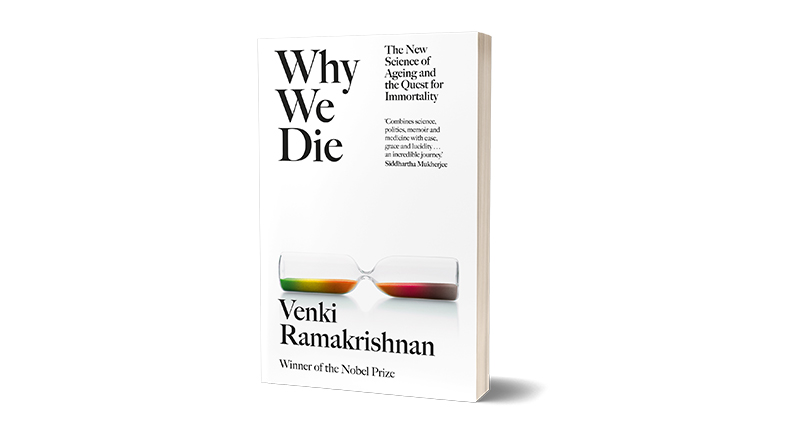








Life-and-death matters
A thought-provoking overview of the scientific perspective on ageing.
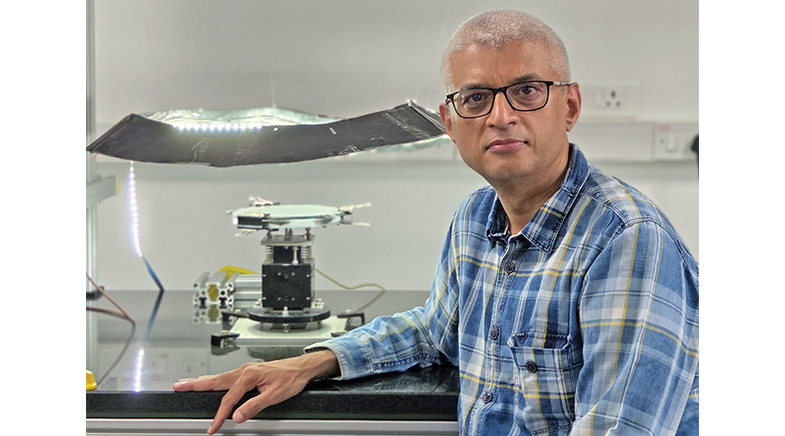
Harnessing heat
Researchers recreate the 'Stirling engine' in a tiny plastic bead.

Computers come alive
Fungal bodies may help make analogue computers one day.


Have a
story idea?
Tell us.
Do you have a recent research paper or an idea for a science/technology-themed article that you'd like to tell us about?
GET IN TOUCH