

Easy on the eyes
-
- from Shaastra :: vol 05 issue 02 :: Feb 2026

The surge in screen use is driving companies to tackle eye strain.
When David Sexauer joined Sun Vision Display in 2021 as its Business Development Manager, the nascent company's mission was clear: to build digital signage. It was developing reflective liquid crystal display (RLCD) panels for outdoor boards and food trucks, readable in sunlight.
Soon, though, they found themselves being bombarded with requests for indoor consumer electronics as well. "I started getting multiple calls a day, all from people searching for something that would help them provide relief as they worked on monitors for long periods," says Sexauer. So, U.S.-based Sun Vision Display made its foray into RLCD monitors. Next in their product line are tablets.
With greater use of smartphones, the eyes had to adjust to new ambient lighting, propelling an interest in displays that reduced ocular strain.
The company identified two types of customers: those facing discomfort, such as sleep issues and eye strain, and those seeking cleaner, healthier technology to prevent problems from developing. "Since COVID-19, many people want to work from home and be outside at the same time. With an RLCD, you can sit on your porch in full Sun and still see the panel. No other technology can do that reasonably," he says.
The pandemic changed the nature of white-collar jobs. Remote work was no longer for a niche few, and the definition of a workplace shifted from cubicles to any place with a laptop. More work was being done on smartphones than ever before, and the eyes had to adjust to new ambient lighting. It propelled an interest in displays that could reduce cognitive and ocular strain.
EMISSIVE LIGHT
Most laptop screens are liquid-crystal displays (LCD): they are powered by liquid crystals whose orientation can be manipulated when an electric current is passed through them. A white backlight illuminates the crystals and, depending on their orientation, they allow light to pass through or block it. The backlight is often harsh on the eyes, explains T.N. Ruckmongathan, a former Professor at the Bengaluru-based Raman Research Institute, who is known for his significant work in LCD technology.
The backlight shines directly into the eyes and, despite polarisers (optical filters), there is always some leakage of the light through the screen. White light is made up of green, red, and blue colours. Blue, which is present in large quantities, can disrupt sleep patterns by suppressing melatonin production, he says.
On the other hand, in OLEDs (organic light-emitting diodes) that power television and smartphone screens, light is emissive: the diodes switch on and off to control brightness. When the switching between the on and off states is not fast enough (that is, the pulse-width modulation frequency is lower than 400Hz), it can cause screens to flicker, leading to eye strain and headaches.
In RLCDs, instead of a backlight, a back panel reflects ambient light, which passes through the crystal and polariser layers. Ruckmongathan points out that looking directly at sources of light strains the eyes. "You can't look at the Sun, but you can look at the Moon, which is reflecting sunlight. In fact, everything you see is reflected light," he says. "That's why RLCDs are easier on the eyes because the light is non-emissive." Since there is no switching between states, the screens are also flicker-free.
The technology, however, is not new. Electronic paper displays have been around for a while, and E ink, used in Kindles and other e-readers, has been an economical choice. To compete with them, RLCDs had to figure out how to retain images even without power, a feature known as bistability in e-readers. LCDs use a memory-in-pixel technique with liquid crystals that retain their state in the absence of energy. Cholesteric LCDs (ChLCD) work this way and have been at the centre of companies such as Azumo from the U.S., GeneTouch from China and IRIS Optronics from Taiwan. These LCD types do not require a separate reflective layer or polarisers; instead, the crystals themselves reflect light.
A major push for companies to develop eye-friendly screens came from the education sector. In the late 2010s, smart classrooms gained prominence, and screens began replacing boards. This opened up the market beyond e-readers and minimalist tablets to displays that could be large-scale, offer a whole gamut of colours, and play videos at reasonable refresh rates — that is, how many times a screen updates its image per second (of around 60 Hz, at 1080p).
Another new development is geared towards reducing glare; smartphones are changing how the light they emit is polarised, from a linear fashion to circular.
Compared to backlit LCDs or OLEDs, these refresh rates might seem basic. However, for companies such as Sun Vision Display and Azumo, it is about striking a balance: they had to improve resolution and colour saturation to appeal to a wider audience, without compromising eye safety. To adapt to various environments, front lighting had to be added to ChLCDs and RLCDs. Instead of a light source at the back that would shine directly into the eyes, manufacturers began adding LEDs at the edges of the screen and a thin plastic film on top to disperse the light.
For monitor company BenQ, the use of monitors in dark rooms became such an important application of their products that, in 2024, it released a line of products targeted at developers and programmers for long, late-night coding sessions. Along with hardware features that would eliminate reflections, filter blue light, and enhance text contrast, the company based in Taiwan paired it with halo lighting that would disperse light around the back of the monitor to reduce contrast between the screen and the surroundings.
FOR HEALTHIER EYES
At the Consumer Electronics Show held in Las Vegas in January 2026, Chinese electronics company TCL launched the NXTPAPER 70 Pro, a smartphone that uses LCD-based technology to mimic a paper's matte appearance and texture. For the past few years, companies such as TCL and Bigme have been promoting minimalist phones with eye-friendly displays like e-paper and RLCDs. Yet, their customer base remains niche, given their high prices for lower functionality.
For smartphones, OLED seems to be the easiest choice, offering quality contrast, actual colours and fast refresh rates. "Worldwide, I think around 40% of phones are OLED technology," says Debdutta Ray, Principal Investigator at the AMOLED Research Centre at the Indian Institute of Technology Madras. Ray's team is working on new manufacturing techniques for OLEDs that are faster and produce less waste.
"I would not say that making the screen less harmful to the viewer is the main focus for the display industry," Ray admits. "A display-maker's first concern is how accurately the colours are replicated, so that the picture is as close as possible to the real one."
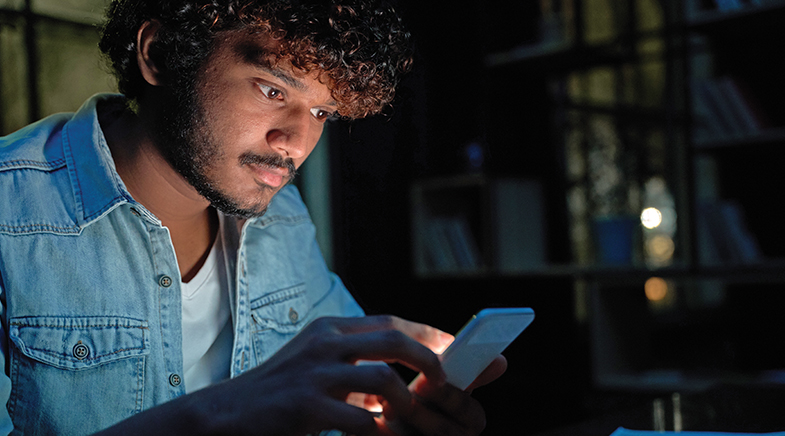
Nevertheless, mitigating visual strain has been an attractive marketing feature for companies, boasting certifications from eye comfort standards. For almost a decade, companies have been introducing features such as dark mode and adaptive lighting, powered by ambient light sensors that automatically reduce brightness. More recently, phones have been adopting circadian display technology, pioneered by brands such as Samsung, that adjusts screen colour temperatures according to the time of the day, shifting to warmer tones towards nighttime. Artificial intelligence algorithms are put in place to understand not just the ambient atmosphere but the media being displayed. Some content is brighter than others, and phones learn when to intuitively adjust it.
Another new development is geared towards reducing glare; smartphones are changing how the light they emit is polarised, from a linear fashion to circular. Linearly polarised light is restricted to vibrating along one plane. Natural light is unpolarised, or random. Adding a circular polarising filter to the screen reduces glare and unwanted reflections when the phone is rotated and viewed from any direction. In 2021, a study published in the National Library of Medicine indicated that circularly polarised smartphones minimise eye dryness and visual fatigue (bit.ly/polarized-dry-eye).
Screen displays are also shifting to new types of hardware, such as microLEDs, which use inorganic emitters rather than organic materials to achieve high brightness, good contrast, and high pixel density. "The challenge is placement and cost. OLEDs and LCDs are cost-effective. Although microLED is not commercially viable, we may see a great future for it in near-eye, micro displays for smart glasses that can project images directly onto the retina," says Ray.









A Kerala village shows the way
Harnessing technology, and drawing on enlightened ecological policies, Meenangadi is on the path to becoming India’s first carbon-neutral village.
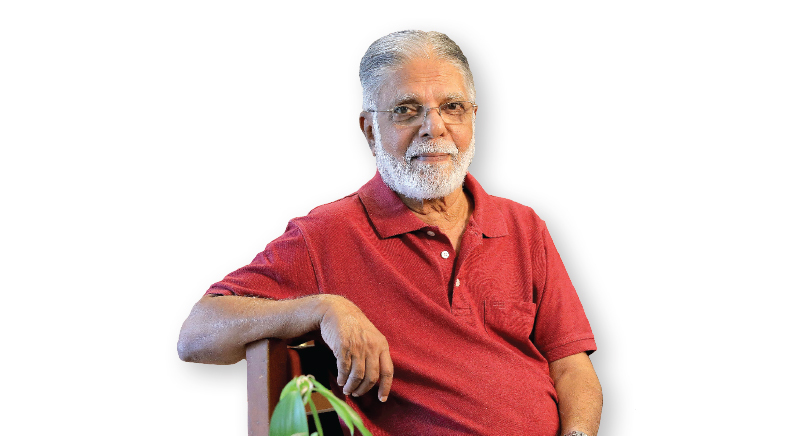
ITER will demonstrate feasibility of nuclear fusion: P.I. John
Plasma physicist P.I. John on India's contribution to the nuclear fusion experiment – and the passion that drives scientists.
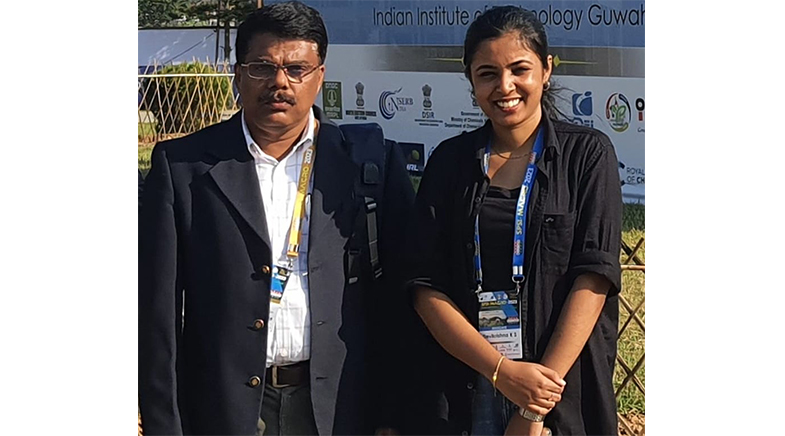
Material, heal thyself
Everyday products get a shine with an eco-friendly coat that disperses in water and repairs on its own when scarred.
Have a
story idea?
Tell us.
Do you have a recent research paper or an idea for a science/technology-themed article that you'd like to tell us about?
GET IN TOUCH