

Shoot for the stars
-
- from Shaastra :: vol 05 issue 08 :: Aug 2026
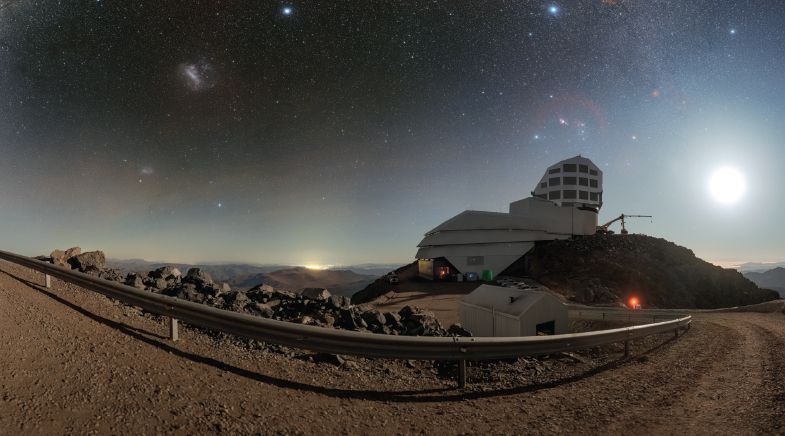
The universe opens up as the world's largest optical camera swirls over the southern skies.
A top the southernmost peak of the Cerro Pachón mountain ridge in Chile, the Vera C. Rubin Observatory goes about its business of studying the skies almost silently. Observatory chief Bob Blum's words veer on the poetic as he describes the telescope and its environs: the night is dark and still outside; inside, the telescope, camera, dome and data systems move through a carefully choreographed sequence. "It is relatively quiet in the human sense, but certainly not unattended; trained observing specialists monitor it every night," he says.
The observatory has begun the Legacy Survey of Space and Time (LSST), an ambitious project to capture wide, sharp and dynamic time-lapse images of the southern skies over the next decade. The first observing night of the LSST officially began on June 29, though it captured its first test images in 2025, and has been giving trial runs since then. The telescope is being closely studied by Chilean engineers and scientists, as well as remotely from operation rooms at SLAC in California and NSF NOIRLab in Tucson, Arizona.
The first glimpse of the dynamic optical sky with the world's largest camera, captured with remarkable depth and speed, is a major breakthrough.
The very first images that the Vera Rubin telescope produced in test runs were not of galaxies or nebulae — gigantic clouds of gas and dust where stars are born — but a head of Romanesco broccoli. "Its intricate, repeating texture made it an excellent test subject," Blum, the observatory's Director of Operations, says. "There is something wonderfully human about using the most advanced astronomical camera ever constructed to photograph a vegetable before allowing it to photograph the universe."
To astronomers, the LSST, which is the first glimpse of the dynamic optical sky with the world's largest camera, captured with remarkable depth and speed, is a major breakthrough. "It felt like the beginning of a new era in astronomy," says Jayanta Roy, Associate Professor at the National Centre for Radio Astrophysics, Tata Institute of Fundamental Research, Pune (NCRA-TIFR). According to him, it gives the impression that the changing night sky can now be observed in real time, and every new transient event has the potential to lead to exciting multi-messenger discoveries.
The idea of doing a synoptic survey — repeated observations of the same part of the sky — is more than 30 years old, points out Yogesh Wadadekar, Professor at NCRA-TIFR. Legend has it that once, Tony Tyson, Professor at the University of California, Davis, heard some astronomers say that they wished for a large enough camera to re-observe parts of the sky. The idea took shape, and Tyson pursued it relentlessly. "So, reaching this stage is fantastic," says Wadadekar.
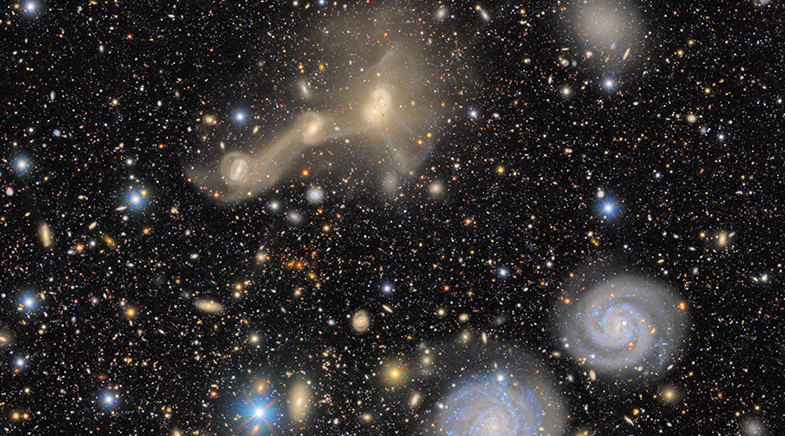
The observatory announced on June 30 that, during its preliminary run, Rubin had, in approximately a month and a half, discovered over 11,000 previously unknown asteroids, including 33 near-Earth objects and 380 trans-Neptunian objects (TNOs), minor celestial bodies. According to Blum, these discoveries help construct a much more complete inventory of the Solar System and help scientists understand how different populations that were a part of it formed and evolved. Asteroids preserve material from the early Solar System, while distant TNOs retain clues about the migration of the giant planets. Comets and interstellar objects can inform scientists about volatile material and, potentially, the formation of other planetary systems.
Rubin's near-Earth observations are also important from the perspective of Earth's defence. "By repeatedly observing moving objects, we can determine their orbits more accurately and identify objects that approach Earth," Blum says. Most are harmless, but finding them early is essential for understanding their trajectories. "Rubin is expected eventually to determine millions of Solar System orbits, making it the most powerful Solar System discovery system yet constructed," he says.
In a month and a half, Rubin had discovered over 11,000 previously unknown asteroids, including 33 near-Earth objects and 380 trans-Neptunian objects.
A limitation of the LSST is that it is not equipped with a spectrograph. It is only an imaging telescope, and the spectrum will need follow-up studies by other telescopes. "Nevertheless, LSST will make many discoveries whose true nature will be understood years later, when we get the spectrum," says Wadadekar.
As it sweeps over the southern skies, Rubin will image every section nearly 800 times, returning to the same point every now and then. Visits separated by minutes or hours are needed to detect movement of Solar System objects and rapid changes in brightness; visits separated by days, to follow supernovae and variable stars; and observations spread across years to measure slow movements, such as the proper motions of stars, and long-term evolution of variable stars and galactic nuclei, Blum says.
Imaging the southern skies is important in many ways. Wadadekar explains that the centre of the Milky Way, the Magellanic Clouds and some spectacular regions, such as the Lagoon Nebula, a region of star formation, are in the southern skies. The nearby galaxy, Centaurus A, can be viewed there.
Rubin will lay the path for many astronomers to walk in the future. "A useful analogy is that Rubin will make the movie and identify the actors whose behaviour is interesting. Webb and other observatories can then zoom in for detailed close-ups," Blum says. For example, Rubin may discover a distant supernova, an unusual variable object or a rapidly changing galaxy and alert the global community; the James Webb Space Telescope, the Gemini North and South telescopes and other facilities can then study that object in greater detail or at other wavelengths.
Rubin generates about 10 terabytes of data and 7 million alerts every night. The Zwicky facility, an observatory in southern California, generated about 10,000 alerts, whereas the LSST can yield a crore of alerts every night, Wadadekar points out. "It's mind-blowingly huge," he says, adding that it should generate around 500 petabytes (500,000 terabytes) of data in 10 years. "If you have hard discs of 10 terabytes each, 50,000 of them would be needed to store the data," he explains.
The raw data are transferred, duplicated and stored in U.S. data facilities at SLAC, with additional archival facilities in Europe. "The raw images are only the beginning," Blum says.
Every image is calibrated and processed to produce science-ready images and catalogues. While the processing done every night identifies changes and moving objects, each year, the complete collection of raw observations accumulated to that point is reprocessed to produce deeper combined images and increasingly precise catalogues.
The data are protected by levels of access. "The alert stream is world-public and has no proprietary period. Anyone can access alerts through Rubin's community brokers," says Blum. The full images, catalogues and annual data releases initially have a two-year proprietary period, during which they can be accessed by scientists and students at U.S. and Chilean institutions. Access during this period is also given to international contributors whose institutions have contributed to Rubin's in-kind programme. "To gain access to this data, you have to propose an in-kind contribution," says Wadadekar.
In 2020, the Rubin Observatory called for proposals for in-kind collaboration — either to develop software, or offer telescope time on other facilities or build a data centre for storage. "Indian astronomers offered software contribution," he says. Wadadekar is the Principal Investigator of one such directed software contribution, where people work on one of eight science collaboration programmes, and, with postdoc researchers, build the software they need. "We gain access to images 60 hours after they are taken," he says. The U.S. defence wipes out all traces of satellite tracks from the images, so that they cannot be tracked. The images can be shared between one PI and four junior associates.
"There will be so much discovery that we will be kept busy for decades," Wadadekar declares.
See also:








PINNing hopes on the future
Physics-informed neural networks are emerging as the future of medical science — enabling cancer detection and drug discovery.
Fighting superbugs that resist antibiotics
Start-ups have joined the war against superbugs. Taken together, their work straddles prevention, diagnosis, and treatment.
Big little tactics
Plants rely on photosynthetic tricks to survive lethal heat.


Have a
story idea?
Tell us.
Do you have a recent research paper or an idea for a science/technology-themed article that you'd like to tell us about?
GET IN TOUCH