

Symphony of science
-
- from Shaastra :: vol 04 issue 11 :: Dec 2025
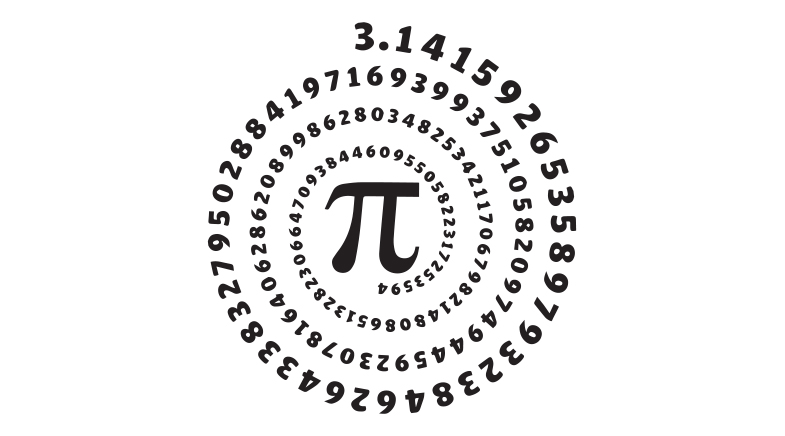
Researchers find a connection between math legend Ramanujan's pi series and black hole physics.
Physicists at the Centre for High Energy Physics of the Indian Institute of Science (IISc), Bengaluru, have traced a deep connection between a bunch of 111-year-old mathematical formulae attributed to mathematician Srinivasa Ramanujan and fundamental physics problems known today.
The relationship, as established by Aninda Sinha and his former PhD student Faizan Bhat in a recent study (bit.ly/ramanujan-physics), has both physicists and mathematicians abuzz.
Their quest had its roots in a 2024 paper (bit.ly/string-field-theory) in which Sinha and Arnab Priya Saha, then a postdoctoral researcher at IISc, investigated questions related to the origins of string theory. Serendipitously, they found a formula for calculating the value of pi, the mathematical constant that appears in many mathematics, geometry and physics calculations. This formula matches an infinite mathematical series known as the Madhava-Leibniz-Gregory series (or Madhava series). The Madhava series was shown to be a series expansion for pi, expressed as the ratio of a circle's circumference to its diameter – and whose value is crudely approximated to 3.14.
From a physics point of view, that work was very interesting as it resolved an apparent discrepancy between the string theory method and the field theory method of calculating physical quantities, according to Debashis Ghoshal, a member of the physics faculty of Jawaharlal Nehru University, Delhi. Ghoshal's colleagues, who (along with others) conduct a math seminar circuit named Special Functions and Number Theory, invited Sinha to an online math seminar about this work.

At that seminar, when Sinha spoke of the close relationship of their formula to the Madhava series, one of the mathematicians in attendance pointed out that the Madhava series was not the best one for obtaining a formula for pi, as it had alternating terms of different signs, which is always a problem for computations. There were much better formulae, some of which were attributed to Ramanujan.
In 1914, before Ramanujan set off to Cambridge on a historic voyage, he published a paper with 17 formulae to calculate the value of pi. Using these formulae, supercomputers compute the value of pi accurately up to trillions of decimal places.
The comment at the seminar drew Sinha's attention to the brilliance of Ramanujan's formulae. These formulae make it easy to calculate the value of pi to large accuracies, but do they have a physics connection? This was a question that intrigued Sinha and prompted work that resulted in the research study published along with Bhat in December 2025.
However, Ramanujan's paper was very terse, and "looking at it, I could not figure out what the physics connection is", says Sinha.
Review of literature led him to a paper (bit.ly/simply-ramanujan) that recast the formulae in modern notation. It reminded Sinha of a class of theories called conformal field theories, which describe critical phenomena, such as the point where water becomes vapour.
Given Sinha's experience in working with conformal field theories in high energy physics, he was able to reckon what type of conformal field theory needed to be pursued. Sinha and Bhat found that when they tried to calculate physical quantities using the logarithmic conformal field theories, Ramanujan's pi formulae came up naturally. Using the formula, they were able to calculate the physical properties much more easily.
"This tells us that there is an ongoing dialogue between physics and mathematics," says Sinha. He feels that the study has merely scratched the surface, and there is a need to understand it deeper.
"It is exciting that Ramanujan's formula has come up in a physical situation," says mathematician Gaurav Bhatnagar, one of the organisers of the Special Functions and Number Theory seminar. A number theorist, he spends considerable time in explaining Ramanujan's work (all of which can be accessed at ramanujanexplained.org).
According to Bhatnagar, these formulae are very close to what mathematician Bill Gosper used to test supercomputers that were used to estimate pi to high accuracies. "Calculating pi is like climbing the Everest," says Bhatnagar. And it's "cool" that Sinha and Bhat have shown how Ramanujan's formulae share a connection to physics, he adds.








In aid of teeth, words and drugs
With nanorobots and data banks, ventures are resolving a spectrum of problems — from dental to oral.

Cold comfort
As heat-spewing data centres rise across India, the focus now is on ways to keep them cool.




Have a
story idea?
Tell us.
Do you have a recent research paper or an idea for a science/technology-themed article that you'd like to tell us about?
GET IN TOUCH