

The travel bug
-
- from Shaastra :: vol 05 issue 08 :: Aug 2026
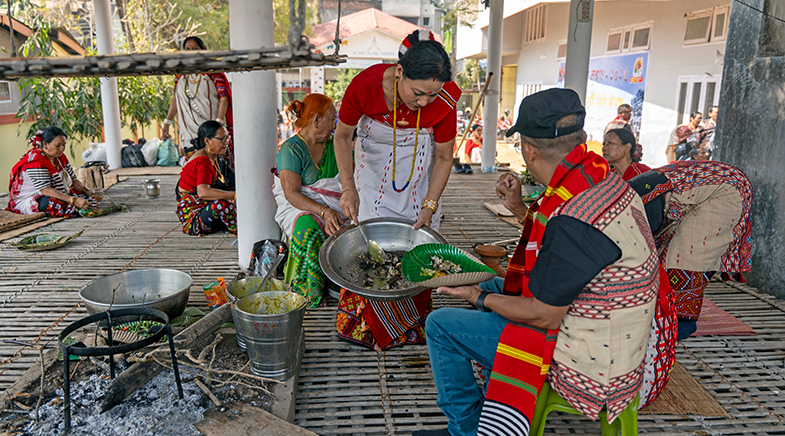
Tracking gut bugs among migrant tribal community members.
A person's gut microbiome is a snapshot of their past, their present, and perhaps even their future. The bacteria residing within the digestive tract encompass the stories of the individual's diet, lifestyle, and migration. How the biota changes, and what the main influencers of the change are, is an area of ongoing investigation.
A recent paper (bit.ly/gut-change) notes that among South Asians, geography and community affiliation have more influence on the variation of microbiome composition between communities than rural or urban lifestyles alone. However, it notes that a transition to urban living and processed foods reduces microbial diversity, and also causes a rise in bacteria known to be associated with urban lifestyle issues such as obesity.
The paper reports on a study of gut microbes of 10 remote-dwelling communities across India and Sri Lanka. The study, called South Asian MicroBiome ARray (SAMBAR), reached out to 575 adults from Spiti in the Himalayas, the Mizo and Pochury Nagas from North-East India, Gond, Kolam and Koya tribes from Central India, and the Kani tribe from South India, as well as adivasis from Sri Lanka. The researchers sampled members living in these isolated groups and consuming traditional diets, and also investigated individuals who had migrated to towns and cities and made corresponding tweaks in their diets. In Sri Lanka, they studied urban Sinhalese and Tamil communities.
DISTINCT AND VARIED
The study found that the South Asian microbiome profile was very distinct and had a stronger correlation to geography and community affiliation than other global cohorts. The researchers also noted immense variation in the microbial profiles between communities, which they attribute to the vast differences in local diets, environment, and cultural practices. "India has immense dietary complexity and diversity, so this finding was not surprising," says Niraj Rai, one of the corresponding authors, who heads the Ancient DNA lab at the Birbal Sahni Institute of Palaeosciences, Lucknow.
For instance, the Bifidobacterium genus associated with wheat and yoghurt consumption was largely absent from communities that do not consume these foods traditionally, but was seen among the Spiti population. However, it rose to prominence in some individuals who left the ancestral village for an urban life. The researchers note that this change in the microbiome profile may help people tolerate dairy products better even if they did not have the genetic ability to digest lactose. This change represents an adaptation driven by the gut instead of genetic evolution. Yet, the change was not uniform across communities.
The genus Bacillus was found in greater abundance among the Pochury members, whose diet comprises the fermented, Bacillus-heavy condiment axone.
A shift consistent with urbanisation was the increased presence of the bacterium Megamonas, which is associated with obesity and other urban lifestyle diseases like Type 2 diabetes. It is also associated with low microbial diversity, an indicator of poor gut health. "In fact, this bacterium is considered a marker of globalisation and urbanisation in food," says Rai. He points out that Indians' diets have changed significantly from traditional fare. "There is increased consumption of ultra-processed food. Worse, there is also much adulteration in urban food. This impacts gut bacteria and health."
"The biggest takeaway is that there is no single, universal microbiome response to urbanisation," says Maanasa Raghavan, Assistant Professor of Human Genetics at The University of Chicago and corresponding author. "The overall effects depended strongly on the dietary and cultural context of each community,” she adds. Raghavan notes that since the gut microbiomes of South Asian cohorts have distinctive features, findings from one population cannot be automatically generalised to others.
A unique feature of this study was that it involved the community. "We spent several days in their villages, understanding their lifestyles and diets and developing a rapport with them. We had an elaborate questionnaire. The researchers later returned to the communities to share and explain the results," says Rai.
The study does not establish whether a specific food or bacteria is directly connected with a particular outcome. Rai says the next phase of the project will investigate these connections, with additional data from Andaman and Nicobar.
Also read
The inside story









Red alert!
Are the 'leopard spots' on Mars signs of ancient life? Time will tell.

Architect's plan and builder's craft
The genetic influence is important, for sure, but cells, too, are critical to how we are made.



Have a
story idea?
Tell us.
Do you have a recent research paper or an idea for a science/technology-themed article that you'd like to tell us about?
GET IN TOUCH