

Wear the screen, watch the sleeve
-
- from Shaastra :: vol 05 issue 11 :: Nov 2026
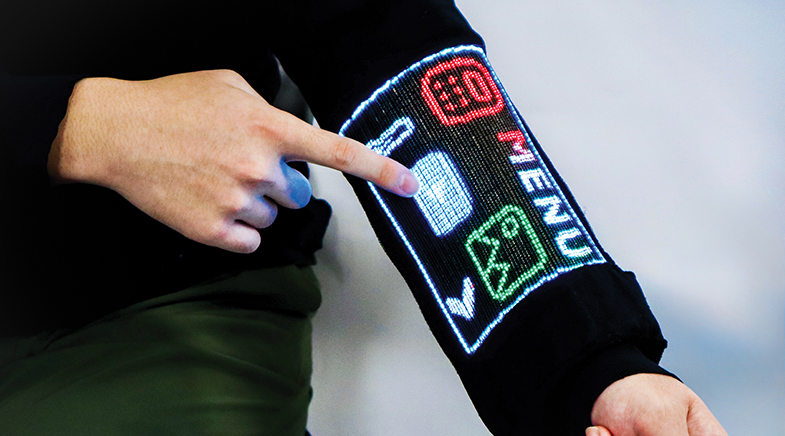
Digital pixel fibre makes wearable screen a reality.
A smartphone not fitting into a denim pocket shouldn't bother people for long as a new innovation offers a middle ground. Researchers have combined textiles and touchscreens to make an interactive sleeve, and moved closer towards realising wearable computing.
Researchers at the National University of Singapore, led by Assistant Professor Tural Khudiyev, have developed a graphical user interface (GUI) embedded in a garment sleeve that has smartphone features such as a touchscreen, audio-video playback, and wireless connectivity. It is machine-washable, flexible, and breathable like daily-wear clothing. A statement from the university claims it is "the world's first touchscreen built into a garment".
Khudiyev and colleagues achieved this by fabricating a touch-sensing digital pixel fibre. "By merging display, sensing, and computation within a single fibre, this work establishes a scalable platform for intrinsically interactive textiles," says the study published in Nature (bit.ly/touchsleeve). The researchers integrated 54 of these pixel fibres, each with 96 serially connected LEDs, into the sleeve of a knitted textile. The prototype covers an area of about 17cm×10cm on the forearm and allows multi-touch interaction. It can stream video with audio at 25 frames per second, and has an adaptive display that can auto-rotate and adjust brightness like a smartphone screen.
The digital pixel fibre developed by the team is about 1mm thick and up to 10m in length. The fibre survived 50 machine washes with a detergent, and 1,000 bending cycles without losing resistance or illuminance, the study notes. In addition to pixel fibres, the researchers have integrated peripheral fibres that carry a microphone, speaker, and sensors that track movement and ambient light. The pixel fibre fabric's breathability is similar to that of denim, cotton, and polyester.
It can also be used to measure body temperature. "Healthcare is one particularly promising application," Khudiyev says. "A garment could continuously collect physiological information through fibre-based sensors." In combination with artificial intelligence, it could make personalised health monitoring possible, he adds in the statement. "Just as smartphones enabled applications that were difficult to imagine when they first appeared, garment GUIs could ultimately enable entirely new applications that do not yet exist." For now, the sleeve connects to a smartphone. But Khudiyev envisions a future where it could work as a smartphone.



Seeds of hope
Soviet agronomist who endured persecution set up the world's oldest seed bank.

Zeroing in on zero waste
Indian cities are harnessing technological interventions in the cause of solid waste management.



Have a
story idea?
Tell us.
Do you have a recent research paper or an idea for a science/technology-themed article that you'd like to tell us about?
GET IN TOUCH