

Intel and vitals
-
- from Shaastra :: vol 05 issue 08 :: Aug 2026

Averting risks — on land and for health.
SOPHROSYNE TECHNOLOGIES
Founders: Manish Srivastava and Jatin Gupta
Year: 2022
Big idea: To develop an SoC for the medical devices industry
With years of experience in the semiconductor industry, Manish Srivastava had noted the shortcomings in high-powered silicon chips used in medical devices. He was convinced that chips could be built specifically for medical wearables and devices, providing accuracy and efficiency without being high-powered or expensive. These devices also use multiple chips for different functions; Srivastava wanted to design a single chip that would carry out all functions.
He teamed up with Jatin Gupta, with whom he had worked in a semiconductor chip company, to form Sophrosyne Technologies. The company has designed a medical-grade ultra-low-power System-on-Chip (SoC) for monitoring heartbeats, blood oxygen levels, temperature, respiration, and other vital parameters via medical devices or wearables.
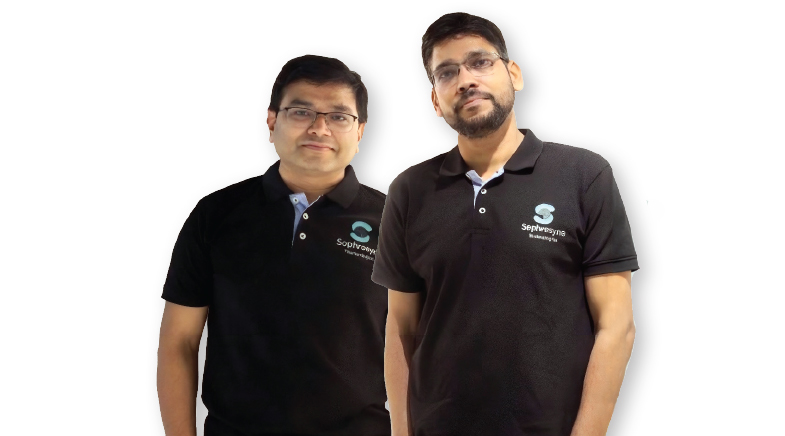
Srivastava, who earned a PhD in Analogue Designs from University College Cork, Ireland, after completing his Master's in India, says most smartwatches and wearable devices that monitor health parameters do not use medical-grade chips. To cut down costs, chips are often imported from China, but these are not medical-grade. Procuring the right kind of chips substantially increases costs. This is the problem Srivastava and Gupta, an engineer from the National Institute of Technology Allahabad with an MBA from the Indian Institute of Management Lucknow, decided to tackle through Sophrosyne.
They started working on a single chip that would be low-powered and noise-sensitive, crucial to the accuracy of medical devices. "…we have reduced the power and, at the same time, we use only one chip," Srivastava says. They visited hospitals across the country to assess whether there was a need for such a chip, he adds. The consultations helped them better understand the requirements and prices.
Srivastava says Sophrosyne's flagship product will be a purpose-built semiconductor platform that delivers high-precision, ultra-low-power performance for use in devices and wearables for tracking vital parameters. The company is also building proprietary artificial intelligence models for advanced signal processing and deep learning, transforming data into health insights. The final product is expected to be ready by November 2026. Sophrosyne hopes to conduct a proof of concept with a customer in the first quarter of 2027. The company will get a 65-nm chip manufactured by the Taiwan Semiconductor Manufacturing Company, according to Srivastava. He adds that Sophrosyne has signed agreements with three companies that are in the business of medical devices and consumer wearables.
EARTHSENSE LABS
Founder: Nirdesh Kumar Sharma
Year: 2025
Big idea: A software-as-a-service platform providing geospatial intelligence
For Nirdesh Kumar Sharma, starting his own venture was the culmination of the work he had done during his PhD at the Indian Institute of Technology Delhi, using satellite imagery, artificial intelligence (AI) and a paper he had published on landslides. Sharma, a civil engineering graduate from the National Institute of Technology Hamirpur, says he used foreign software for geospatial analyses during his research. The software was extremely expensive, and since he had a penchant for software development, he founded EarthSense Labs as a software service platform.
Geospatial data and images take up considerable storage space and require high-end computing resources. EarthSense Labs, Sharma says, will run extremely large datasets without needing the high-end compute power.
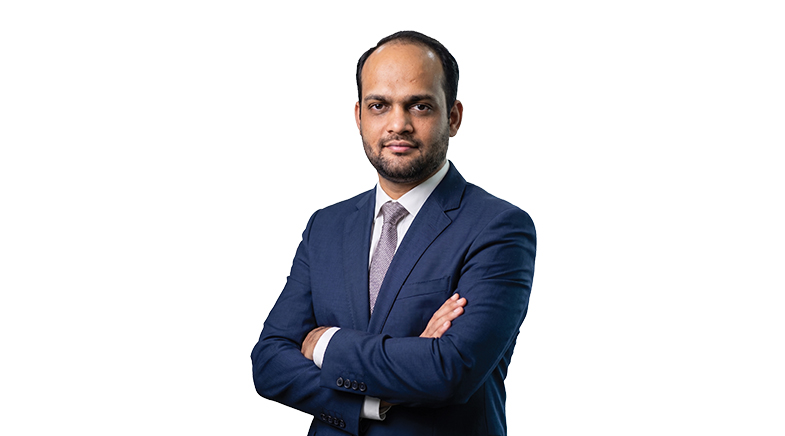
According to him, EarthSense's flagship platform, GeoTwin 4D, is a digital twin of the Earth, built using terabyte-scale LiDAR (Light Detection and Ranging) and geospatial data powered by AI models. GeoTwin 4D turns fragmented geospatial data into a predictive digital twin of a city or a particular area. He adds that by fusing satellite imagery, LiDAR, and AI, GeoTwin 4D will help city planners and decision-makers anticipate risks by enabling continuous monitoring of assets, detection of changes, and evaluation of scenarios. The platform can also help in flood and landslide modelling.
EarthSense Labs combines terrain intelligence, geological data, land cover, rainfall triggers and patterns, and uses AI models to assess landslide susceptibility in areas prone to these disasters and for critical infrastructure. Likewise, it uses hydrological models and real-time inputs to simulate flooding risks in river basins and cities.
Sharma says that six to seven years of research data that he collected during his PhD went into developing the platform from the ground up. EarthSense's flooding model was developed over three years, while the buildings in 3D took about four years. "The base layer has been developed over time, but we were able to put the software together in six to seven months," he adds.
The company's customers would include city governments studying urbanisation. Its map can be used to detect building bylaw violations — such as an illegal floor. The digital twin model can be used to anticipate areas where flooding might occur and prepare for risk mitigation. The company is working to assess reservoirs, their susceptibility to flooding, landslides, and siltation, and overall dam management. A digital twin of a reservoir can help monitor inflows and water levels. It can determine siltation in the reservoir and assess the shape of the dam infrastructure. The company hopes to launch its services in six months.
OPEN MEDLABS
Founders: Deval Karia, Manish Arora and Neha Bhatia
Year: 2023
Big idea: To design and build an affordable insulin pump
Deval Karia took up three projects during his Master's programme in Design at the erstwhile Centre for Product Design and Manufacturing, Indian Institute of Science (IISc). One was to help children with hearing impairment with speech therapy. Another project — called LifeBox, an organ-preservation device to extend the life of out-of-body organs — won him several awards, including the James Dyson Award. And while Karia hopes to launch LifeBox commercially one day, it was his third project that led him to set up Open MedLabs, following an open brief by Manish Arora, Associate Professor in the Department of Design and Manufacturing at IISc and Karia's guide.
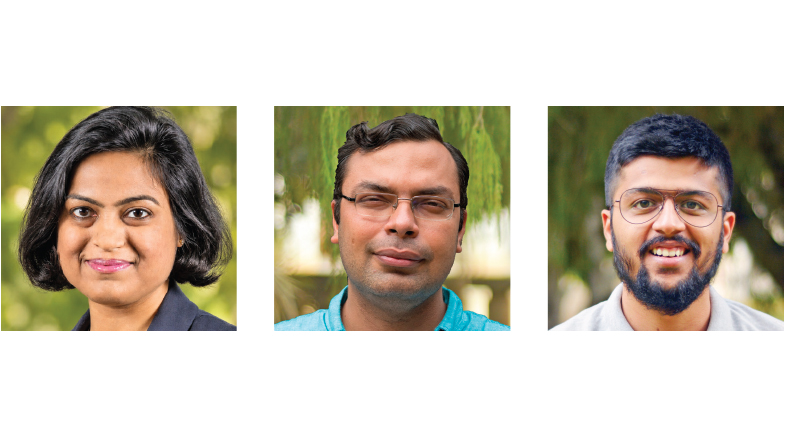
The project was to develop an affordable insulin pump to help people with Type 1 diabetes. The product developed by the start-up, co-founded by Arora and Neha Bhatia, who leads strategy, is called Insuflo. It will undergo clinical trials shortly at a leading diabetes management chain in India.
The idea to make an indigenous version of an insulin pump took shape at the Universal Technology Solutions for Accessible and Affordable Healthcare Laboratory at IISc. Available insulin pumps cost between ₹3.6 lakh and ₹6 lakh, excluding consumables. The adoption of such pumps in India is 0.5%, as against 40%-80% in the West. "Our aim is to get the adoption levels in India to a level where some of the mature economies are at present, upwards of 30%," says Karia, who graduated in Production Engineering from Jadavpur University.
While developing an insulin pump was its first project, it aims to design medical devices for people with other chronic conditions.
The team discussed the issue with patients and healthcare professionals and realised that affordability was a major reason for the low adoption rate. Besides, there was insufficient awareness of the benefits of insulin pumps. "We then pivoted to making not just an insulin pump, but a more affordable one that is still state-of-the-art," Karia says.
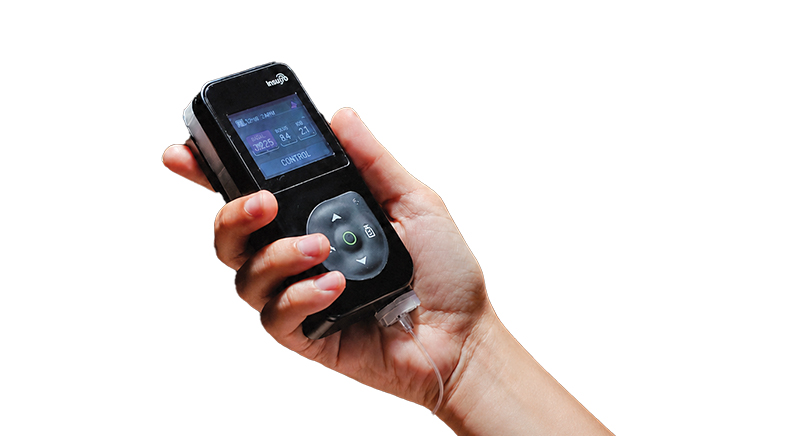
While developing an insulin pump was its first project, Open MedLabs aims to design medical devices for people with other chronic conditions, including for pain relief in palliative care.
According to Karia, the company is looking to raise funds for the clinical trials. With some support from the Indian Council of Medical Research, it plans to produce the pilot batches of the pumps. He expects the trials to take six to nine months, after which the company will start manufacturing the devices. "If everything goes as per schedule, we anticipate applying to CDSCO (the Central Drugs Standard Control Organisation) for manufacturing approval in 18 months," he adds. Their goal is to price it at least a third or a fourth of the cost of current commercially available insulin pumps, he says.









The floppy disk that revolutionised computing
IBM’s 8-inch ‘memory disk’ catalysed the ‘personal computer’ revolution and contributed to the birth of the software industry.
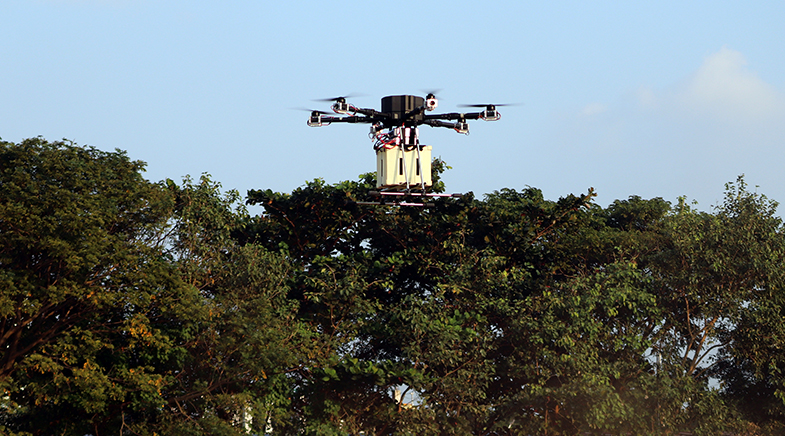
Out for drone delivery
A flying machine to transfer organs for transplant.
And wellness for all
Mobility, simplicity and automation are the three primary axes for making healthcare more accessible and affordable.



Have a
story idea?
Tell us.
Do you have a recent research paper or an idea for a science/technology-themed article that you'd like to tell us about?
GET IN TOUCH