

Memory in motion
-
- from Shaastra :: vol 05 issue 05 :: May 2026
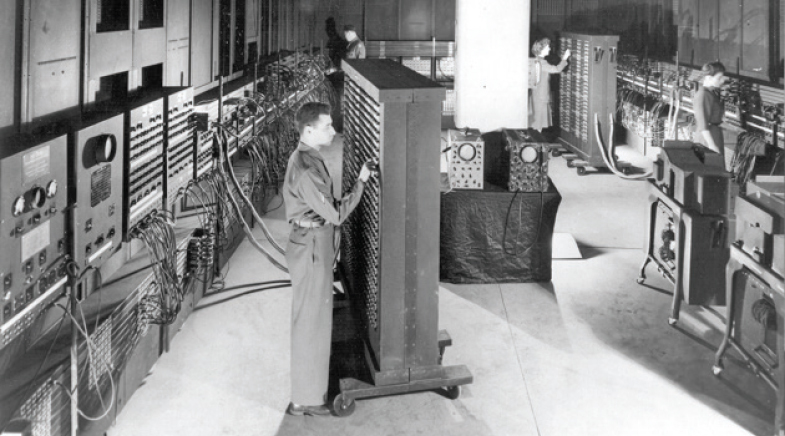
An obsolete storage form led to computers.
In the late stages of the Second World War, Allied radar systems had great difficulty detecting low-flying enemy aircraft. They would send out radio waves that bounced off the aircraft and estimate its distance by measuring the time it took for the echo to return. At low altitudes, however, radar signals would also bounce off the ground and nearby buildings and trees, creating clutter that masked the aircraft's blip on the screen. Researchers across the U.S. raced to solve this challenge. Among them was John Presper Eckert, who was then working on one of the world's first digital computers — ENIAC, or the Electronic Numerical Integrator and Computer.
CHEERS TO THAT!
When British scientist Alan Turing heard about mercury delay lines being used in EDSAC, he half-jokingly suggested that gin be used instead of mercury, arguing that both liquids had similar properties — the team could simply "pop over" to the local liquor store to save money (bit.ly/Gin-Memory). The EDSAC team, however, decided to stick to mercury, but they still had to wash the tubes with alcohol first to ensure that the crystals creating sound waves and mercury made good contact.

At that time, scientists had been experimenting with "delay lines" that could slow down the movement of electrical signals. Eckert realised that if a radar echo could be delayed or "stored" briefly, it could be compared with the next incoming echo and cancelled out if identical — ensuring that only blips from moving objects remained visible. To achieve this, the radar signal was converted into a sound wave and sent through a tube of liquid mercury, where it moved much more slowly than an electrical signal, providing the time delay needed.
CREDIT CONTROVERSY
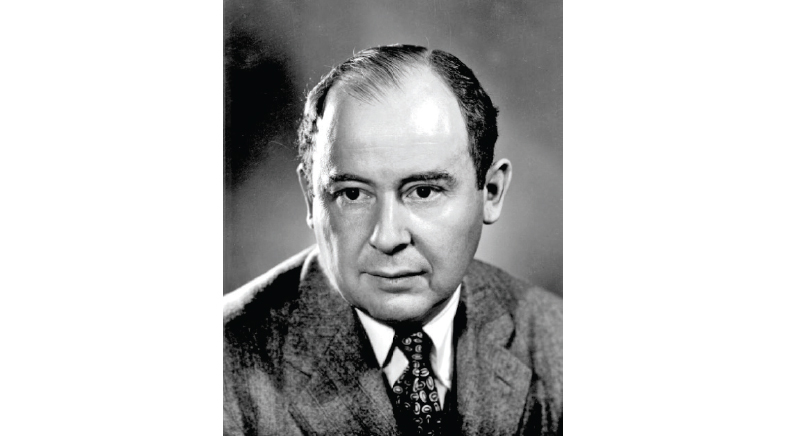
While consulting on EDVAC, which followed ENIAC and used mercury delay-line memory, American mathematician John von Neumann (pictured) published an influential report on how computers could store both data and instructions. However, he did not clearly credit the original ENIAC team, including Eckert and Mauchly, leading to a dispute over who conceived the modern computer (bit.ly/Credit-Dispute).
PHOTO:WIKICOMMONS
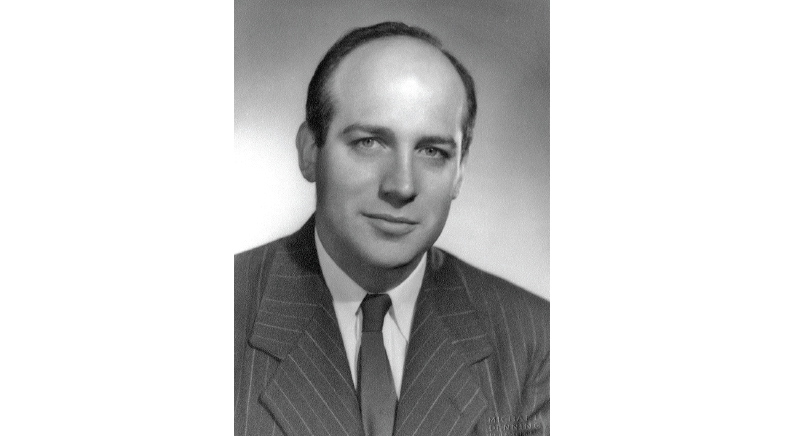
Towards the end of the war, Eckert and his mentor, John Mauchly, finished building ENIAC, which was capable of ultrafast calculations. But it lacked a practical solution for storing data. When they began work on their next machine, Eckert turned once again to the mercury tube (bit.ly/Storing-Data). He employed a quartz crystal to convert electrical impulses into sound waves and encode binary digits — a pulse for 1 and no pulse for 0 — that were then passed through the tube. At the other end, the pulses were reconverted into electrical signals, boosted, and sent back to the beginning of the tube. In this way, bits of data moved continuously like a looping conveyor belt until the machine needed them at a specific time to carry out a mathematical operation. As long as power was supplied, the bits could loop around indefinitely.
Each mercury tube could hold up to 1,000 bits looping around, offering a compact and efficient form of storage for its time. However, because the speed of sound in mercury was temperature-sensitive, the tubes had to be kept in large, temperature-controlled rooms. Mercury was also toxic and needed careful handling. Despite its shortcomings, Eckert and Mauchly, as well as others, used delay-line memory to build several early computers, such as the UNIVAC I and EDSAC, and it became the first device widely accepted as a "reliable" memory system (bit.ly/Memory-System). Later versions used nickel wires that would twist, creating torsional waves rather than sound waves to store data.
Delay-line memory was phased out as more efficient storage methods, such as magnetic cores and semiconductor RAM, emerged. Today's USB sticks, for example, can store trillions of times more data than an entire room full of mercury tubes. For a fleeting moment, however, delay-line memory was a crucial cog in the development of modern computing.










The world's back-up plan to counter global warming
Geoengineering is a deliberate attempt to change the Earth's features on a global scale.
They're building in space!
Researchers and engineers are looking at space as the new frontier to manufacture crystals, optical fibres and drugs.



Have a
story idea?
Tell us.
Do you have a recent research paper or an idea for a science/technology-themed article that you'd like to tell us about?
GET IN TOUCH