

Brave new world
-
- from Shaastra :: vol 04 issue 11 :: Dec 2025
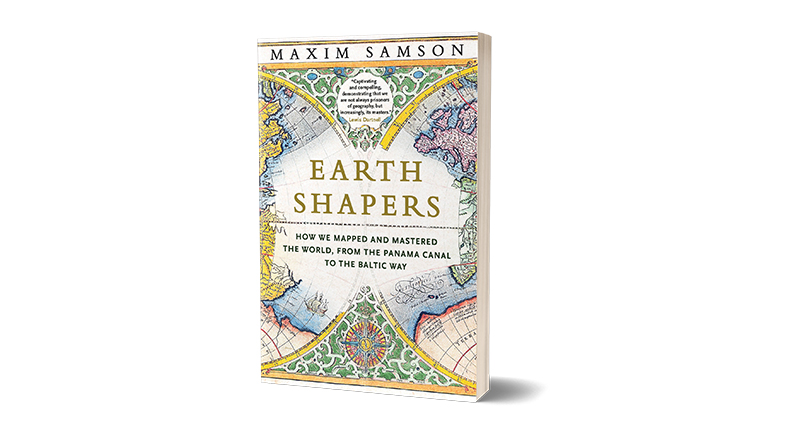
How the power of geographical connection was used to reshape the world.
In March 2021, Ever Given, a container ship, ran aground in the Suez Canal, through which 12% of the world's trade passes every day. Disruptions to trade have also been caused by droughts affecting water levels in the Panama Canal. These two canals radically altered the global economy. In other places, other man-made geographic landmarks share a theme of humans looking to change their own circumstances by reshaping their surroundings.
Geographer Maxim Samson has written a thought-provoking book about the power of geographical connections to reshape geopolitics. "Earth shaping", as he calls it, always has a big political component, and its impact can be far-reaching.
Samson focuses on eight geographical "shapings", and delves into the way each of these changed the world. Chapter 1 focuses on one of the more obscure, the Qhapaq Ñan, the 'Great Road', a network that ran for over 40,000 km across the Inca Empire of South America. It connects six nations, linking ancient cities across the world's longest mountain range (the Andes), the largest rainforest (the Amazon), a desert (Atacama), and the Pacific coastline. Modern road networks, including the Pan-American Highway, are built along its alignments.
It was an incredible engineering achievement and integral to managing an Empire across some of the world's most challenging terrains. But it also proved to be the Incas' undoing. It enabled Spanish troops to move swiftly during their colonial takeover.
The book may seem political, but the author illustrates how shaping the Earth drives humanity's collective destiny.
Chapter 2 looks at Mozambique's chaotic railway networks. Rail systems usually connect economic hubs and population centres. Mozambique's big cities, however, are not connected to each other. The Portuguese, the British, the Belgians, and the Germans set up competing companies that created a fragmented rail network focused on profit. This was designed to export the vast mineral wealth of southern Africa while allowing slave labour and near-slave labour to move to the mines. So, the railway network connects the mines of Mozambique, Zimbabwe, Congo, Angola, Namibia, and South Africa to the Atlantic coast.
The Panama Canal features in Chapter 3. This may be the most impressive infrastructural achievement ever, connecting the two biggest oceans through an intricate system of locks and artificial lakes through dense jungle. The economics of building the canal, the vast death toll, the bankruptcies associated with decades of construction, and the continuing politics around control of the Canal make for a fascinating story.
Chapter 4 moves into what some would consider the realm of science fiction fantasy. Saudi Arabia's NEOM or The Line is conceptualised as a smart city which fosters innovation. It's to be 170 km long, 400 metres wide, and to be built within two mirrored walls of skyscrapers, with one end in the Red Sea and most of it in the mountains. The infrastructure would be serviced robotically; connections would be hyperloop or fast rail. It would be powered entirely by renewables, supplied water from desalination, and house 9 million people. (Saudi Arabia's population is 35 million.) The project is going slow. Some of the technology doesn't exist. Costs have escalated.
Chapter 5 is about an overtly political movement that used roads to good effect. The Baltic Way or Baltic Chain was a political demonstration in August 1989. The Baltic Republics of Estonia, Latvia and Lithuania were occupied and forcibly incorporated into the Soviet Union by Stalin. The 675-km human chain across the three nations consisted of 2 million residents of these three nations (which have a combined population 8 million) holding hands to mark the anniversary of their occupation. The Baltic Chain has inspired many imitations, including a re-enactment in Belarus in 2020. The author uses this event to philosophise about the "earth shaping" of resistance.
Chapter 6 speaks of another ongoing mega-project: the Great Green Wall (GGW), a tree buffer stretching from the east to the west, south of the Sahara, to prevent desertification. The GGW is already a mosaic of re-greened territory across many nations. But the project faces challenges like poverty, terrorism, and international conflicts.
Chapter 7 is about the city of Chicago, Illinois. The bustling industrial metropolis is a merchandise and transport hub. The history of its geographical connections and its spiritual importance to Native Americans is interesting, to say the least. Chapter 8 comes to the Baekdu-daegan chain of mountains of Korea. This has many holy associations, and influences the distribution and configuration of the divided peninsula's settlements.
The book may seem overly political. Some readers may disagree with the author's politics since there's no question that big infrastructure has mega political influence. However, the scholarship is solid, and the author illustrates how shaping the Earth drives our collective destiny.









'Geoengineering masks climate change problem'
Climate scientist G. Bala on the pros and cons of geoengineering, and why we need to treat this emerging area with caution despite the possibilities.
Defective is effective
Perfection may be overrated: scientists find that flaws in two-dimensional materials greatly enhance the material’s properties.

Raising the bars
Drug companies' appetite for new testing methods may boost research and spawn a new industry.



Have a
story idea?
Tell us.
Do you have a recent research paper or an idea for a science/technology-themed article that you'd like to tell us about?
GET IN TOUCH