

Bot in the white coat
-
- from Shaastra :: vol 05 issue 03 :: Mar 2026
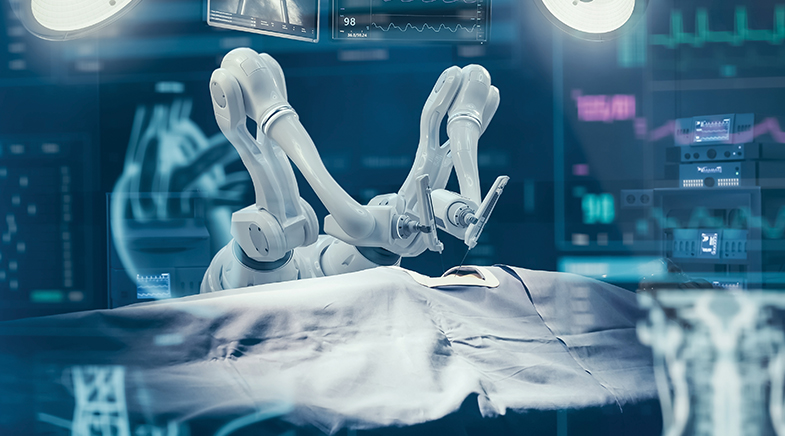
Robots are on the verge of revolutionising surgery, with improved imaging, AI and other technologies.
Roughly four years ago, T.R. Maloney, the late archaeologist who was then working at Griffith University in Australia, dug up the remains of a child in Borneo with clear evidence of surgical amputation of the leg. The body had been buried formally 31,000 years ago, a fact that shocked the archaeology team and later the rest of the scientific world. Till then, the earliest evidence of surgery — the amputation of an arm — was from around 7,000 years ago near Paris. In both cases, the patient had survived and was likely to have lived for at least a few years. These and later examples have led to the belief that human beings had extraordinary medical skills in prehistoric times.
Our Cover Story gives a sense of the robotics revolution in the works, and takes note of other advances that could change surgery in the future.
After human beings settled into agriculture around 10,000 years ago, surgery became more common, though it remained fraught with high risks. The Indian surgeon Sushruta describes a variety of surgical techniques and instruments in his Sushruta Samhita, a treatise written around 600 BCE. The Greek physician Aelius Galenus, widely known as Galen, performed several dissections of animals in the third century CE and influenced surgical practice for a long time. Surgery advanced through the Middle Ages and into the modern age after William Harvey discovered blood circulation. Towards the end of the 19th century, the discovery of anaesthesia and antiseptics revolutionised surgery. Since then, it has been a relentless march forward with the aid of technology. The last half-century saw advances such as organ transplants, coronary bypass surgery, laparoscopic surgery, limb transplants, nerve transfers, and so on.
Over the past 50 years, surgery has become an extremely sophisticated discipline, with the traditional concept of surgery — cutting and suturing by hand — being challenged repeatedly by modern technology. Lasers, which can be focused onto a small spot with high energy, provide a way to cut, vaporise, or seal a specific spot. Electrical currents are another way of cutting tissue with minimal blood loss. Computers are routinely used to plan surgeries, as surgeons can use images to view tissue from all angles. All these methods have been gradually improving in the past four or five decades, making surgery relatively safer and recovery faster. At the turn of this century, the U.S. Food and Drug Administration allowed Intuitive Surgical, a California-based company, to use a robot for surgery. A quarter of a century since this event, robots are on the verge of revolutionising surgery. Our Cover Story by Rekha Dixit describes this revolution, while also taking note of other advances that could change surgery in the future.
In some ways, using robots for surgery is not different from assistive technologies in other fields. Cars, for example, have driver assistance systems that can warn of approaching dangers, such as getting too close to another vehicle or straying from the lane due to distractions. These similarities, however, are only in the early years of robotic surgery. Robots assist surgeons with fine manoeuvres, but they also help them perform tasks no human could. When combined with imaging technologies, robots can achieve a precision that was impossible so far even for the best of surgeons. Technology is advancing enough to overlay live images during orthopaedic procedures and neurosurgery, letting surgeons know where their scalpels go with millimetre precision. Robots enable telesurgery to be performed from remote locations, a boon especially for rural areas with low population densities.
There are other technologies advancing surgeries. Digital twins help surgeons prepare for surgery precisely, by simulating operations that cannot be practised in advance. Nanorobots let surgeons reach unreachable areas and perform intervention at the level of a few cells or even a single cell. Such robots could perform a mop-up operation after a cancer surgery and destroy cells that have escaped into the bloodstream. As Rekha's story describes, such technologies are in their early stages of development. Over the decade, their power will become increasingly apparent as robotics and automation spread through societies, along with improved imaging, artificial intelligence and other technologies. Engineering has been one of the main drivers for human flourishing. It will continue to bring extraordinary power to healthcare.
See also:








Back to the board
Indian companies are reinventing the battery.




Have a
story idea?
Tell us.
Do you have a recent research paper or an idea for a science/technology-themed article that you'd like to tell us about?
GET IN TOUCH