

Reimagining plastic
-
- from Shaastra :: vol 05 issue 02 :: Feb 2026
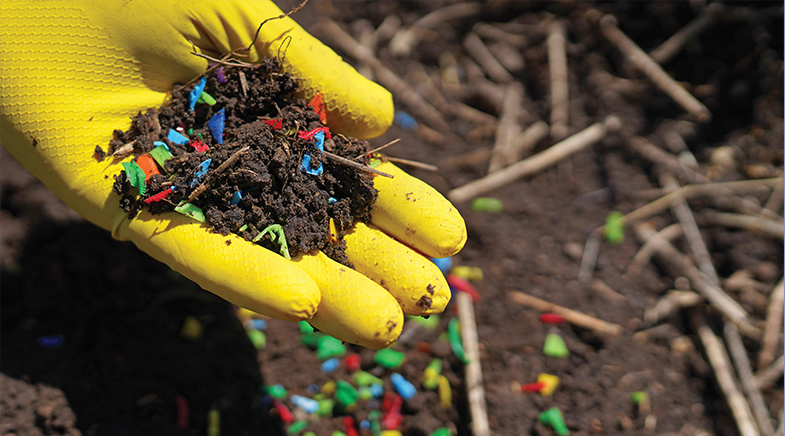
Researchers are fashioning innovative solutions to the perilous problem of plastic pollution.
Till about five decades ago, public discussion of existential threats to humanity focused largely on nuclear war, asteroid and comet impacts, runaway pandemics, supervolcanoes, and so on. It was the era before climate change. Global warming was not discussed in public or even in scientific circles till the 1980s. Careful measurements of atmospheric carbon dioxide started in the 1950s. The turning point was the 1979 publication of the Charney Report, a study on carbon dioxide and climate funded by the U.S. National Academy of Sciences. It was a public acknowledgement, backed by scientific data, that human beings were changing the climate and could cause runaway warming if fossil fuels continued to be used on a large scale. Despite the report's findings, there was little coordinated global action for a long time.
The efforts to address the plastic problem mark the start of a transition to a world where plastics are not seeping into every living being on Earth.
In 1974, a few years before the Charney Report, scientists discovered that chlorofluorocarbons (CFCs), used in refrigerators and air conditioners, rise into the stratosphere and release chlorine when they are exposed to ultraviolet light. This chlorine can then dissociate ozone molecules in the stratosphere. Moreover, it was found that one molecule of chlorine was enough to destroy 100,000 molecules of ozone. In 1985, the British Antarctic Survey reported a massive loss of ozone in the stratosphere over the continent. Within two years, the Montreal Protocol was signed, and steps were taken to phase out CFCs. The ozone layer has since recovered well, and is expected to recover fully in three decades. Now, the Montreal Protocol and subsequent efforts remain the benchmark for international cooperation to solve a global technical problem.
The two problems are a study in contrast in multiple ways. One was a slow-moving problem, not severe enough when discovered, but with the potential to become critical over time. The other, stratospheric ozone depletion, was an unexpected discovery that was serious enough at the time. Reversing climate change requires enormous research, discipline, and international cooperation. Since the problem was not yet serious, governments did not act fast enough in the twentieth century. The ozone-depletion problem required action on a much smaller scale, with scientists developing new refrigerants and industry replacing older ones with less harmful alternatives. Since these two global problems were discovered, humanity has added one more to its list of grave global threats: plastic pollution.
In seriousness, plastic pollution could one day rival ozone depletion as an existential threat to all life if left unchecked. Life may one day find a way to overcome the microplastics and nanoplastics that have seeped into living organisms, but humanity does not have time to wait. Attempts to phase out plastics have not succeeded. In fact, the World Plastics Council has been keen to increase plastic production, saying that recycling plastics in a circular economy is the lasting solution to pollution. However, recycling the plastics currently in use does not solve the problems of microplastics and nanoplastics. For that, plastic as a material has to be reinvented.
The Cover Story on Good plastic, bad plastic by T.V. Jayan describes early attempts to address the global plastic problem. These include plastics that can be programmed to deconstruct, glues that degrade during recycling, plastics made entirely of natural materials and thus — purportedly — not harmful in the open environment, methods to capture and destroy microplastics, and so on. Some of these involve novel materials. Some include clever redesign of existing materials. A few others entail creating materials that are similar to existing materials but behave differently.
Since these are early developments, the methods are currently at the laboratory level. A lot of work needs to be done for them to be scaled well. In some cases, the entire plastics manufacturing chain may need to be reimagined. In other cases, completely new materials must be developed at scale. In at least the intermediate period, recycling will have to improve, but with plastics that are more amenable to recycling. It is quite possible that, in a decade or two, none of the methods described in this story will reach the market precisely as they are now. But they would have started a transition to a better world with plastics not seeping into every living being on Earth.
See also:









Heat and crush
Start-ups work on cancer therapy, heated shelters, and sugarcane juice.
'Future of science in India is bright'
Principal Scientific Adviser Ajay K. Sood on the path to technological sovereignty.

Eyes wide shut
Advances in molecular studies and genetics are helping scientists understand the link between sleep disorders and illnesses.



Have a
story idea?
Tell us.
Do you have a recent research paper or an idea for a science/technology-themed article that you'd like to tell us about?
GET IN TOUCH