

High pressure, 'low lives'
-
- from Shaastra :: vol 05 issue 10 :: Oct 2026
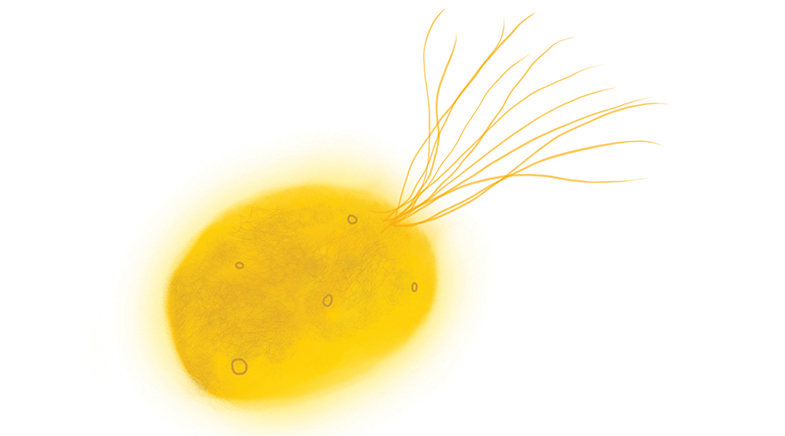
The way deep-sea creatures cope with 'high-pressure situations' offers a fascinating lesson in evolutionary biology.
Stand on a beach, and the air above you presses down with a force of one atmosphere. Dive into the sea, and that pressure doubles by the time you are just 10 metres down. It keeps adding up; every 10 metres brings another atmosphere. By 1,000 metres, the pressure is 100 atmospheres. The ocean averages about 3,700 metres in depth; so, much of its floor sits under around 370 atmospheres. In the deepest part of the ocean, the Challenger Deep in the Mariana Trench, it is 1,100 atmospheres. That is like trying to balance a car on your finger!
Yet, life is abundant at these depths. Bacteria thrive in the mud of the trenches, amphipods scour the floor of the Challenger Deep for food, and fish, squid and sea cucumbers make the abyssal plains their home. Some of these creatures spend their entire lives in this extreme environment, never venturing away. Others — certain fish and invertebrates — commute up and down the water column every day. And then there are mammals such as whales and seals, which must surface to breathe but dive deep, sometimes for hours, to find food.
PAST ISSUES - Free to Read
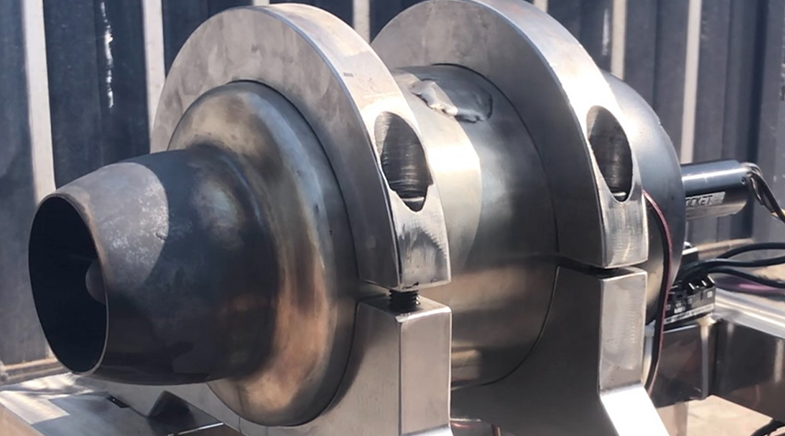








These start-ups are speedy and smooth
Start-ups are working on high-quality silk, indigenous multi-fuel jets, and rapid, point-of-care blood test results.

Intel and vitals
Averting risks — on land and for health.

Time for a reality check
The next platform war will be waged over immersive technologies. We peer into the AR/VR market and gauge its enormous potential.



Have a
story idea?
Tell us.
Do you have a recent research paper or an idea for a science/technology-themed article that you'd like to tell us about?
GET IN TOUCH

