

Divide, and rule
-
- from Shaastra :: vol 05 issue 10 :: Oct 2026
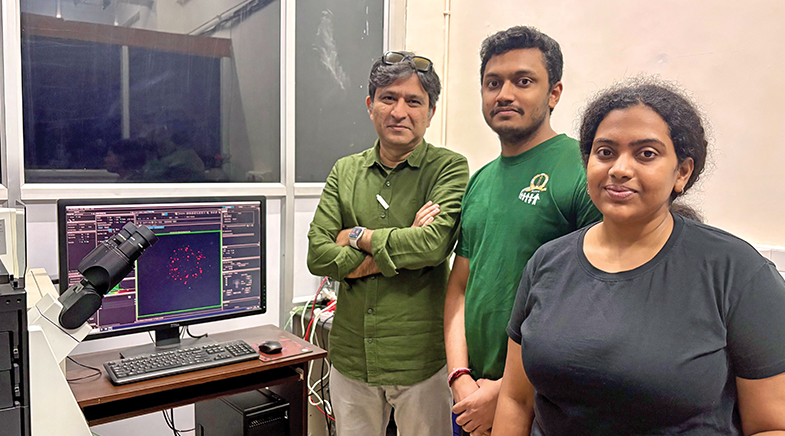
A tech to control cell division may shed light on health disorders.
A life form grows and multiplies as cells divide. Cell division is a dynamic process with multiple players, but the role each actor plays remains unknown. Now, a team of researchers led by Sachin Kotak at the Indian Institute of Science, Bengaluru, has developed a light-powered technique to control cell division and used it to unravel the role of a key cell-division protein. This new method enables a detailed study of cell division, shedding light on associated developmental disorders and cancer.
Before a cell divides, the DNA is duplicated so that it can be distributed equally among the new cells. This is enabled by a spindle, a temporary protein fibre scaffold. Centrosomes organise and control the spindle, separating chromosomes when the cell divides. The centrosome comprises about 200 proteins, and scientists have been trying to identify the proteins essential for its function in cell division.
Kotak’s group was particularly interested in the role of Aurora A kinase, one of the centromere proteins, and sought to control protein levels in the cell to understand its role in spindle formation. They engineered a protein in which Aurora A kinase was attached to a light-sensitive module and was put into cells. The proteins clustered and activated when light was shone on the cells, and dissolved and deactivated when it was not. “It gives you reversibility,” says IISc Associate Professor Kotak.
The technique, which acts like a light switch to activate/deactivate Aurora A kinase, can be used for screening drugs.
In a paper in EMBO Reports (bit.ly/LISA-technique), the researchers showed that this clustering activated Aurora A proteins, making them the centre from which spindle fibres start emanating. The researchers call the reversible method of artificially inducing spindle fibres Light-Induced Spindle Assembly, or LISA. The study also showed that a protein, TPX2, which stabilises Aurora A kinase, is essential for its light-induced activation and spindle formation. The team found that even in cells without centrosomes, activating Aurora A kinase leads to normal cell division, establishing the protein’s critical role in cell division.
Kotak says that because Aurora A kinase imbalance is linked to developmental disorders and even cancer, the LISA technique, which acts like a light switch to activate and deactivate Aurora A kinase activity, can be used for screening drugs for these diseases.
See also:
A whole new way of looking at medicine: Siddhartha Mukherjee









Ideas that will shape our future
At Shaastra, we believe in science and technology as a force for positive change. Our stories will, therefore, focus on solutions rather than problems.

The great AI jailbreak
With the rising threat of catastrophic misuse of AI models, researchers are working on safety mechanisms to prevent jailbreaking.



Have a
story idea?
Tell us.
Do you have a recent research paper or an idea for a science/technology-themed article that you'd like to tell us about?
GET IN TOUCH

